100 Products That Changed the World · #13: Alipay
On May 26, 2026, Alipay published a number: it had completed 300 million payments initiated by AI agents, meaning payments a user handed off to an AI that then paid on its own.
The same day it launched a product called the AI Wallet. In Alipay’s description, users can manage an agent’s task in real time before and during payment, and check the bill afterwards. Put plainly, it lets you set limits, grant permissions and keep records for an AI that spends your money.
Ant Group CEO Cyril Han said at the launch that this was Alipay moving the industry forward again, after Quick Pay and QR code payments.
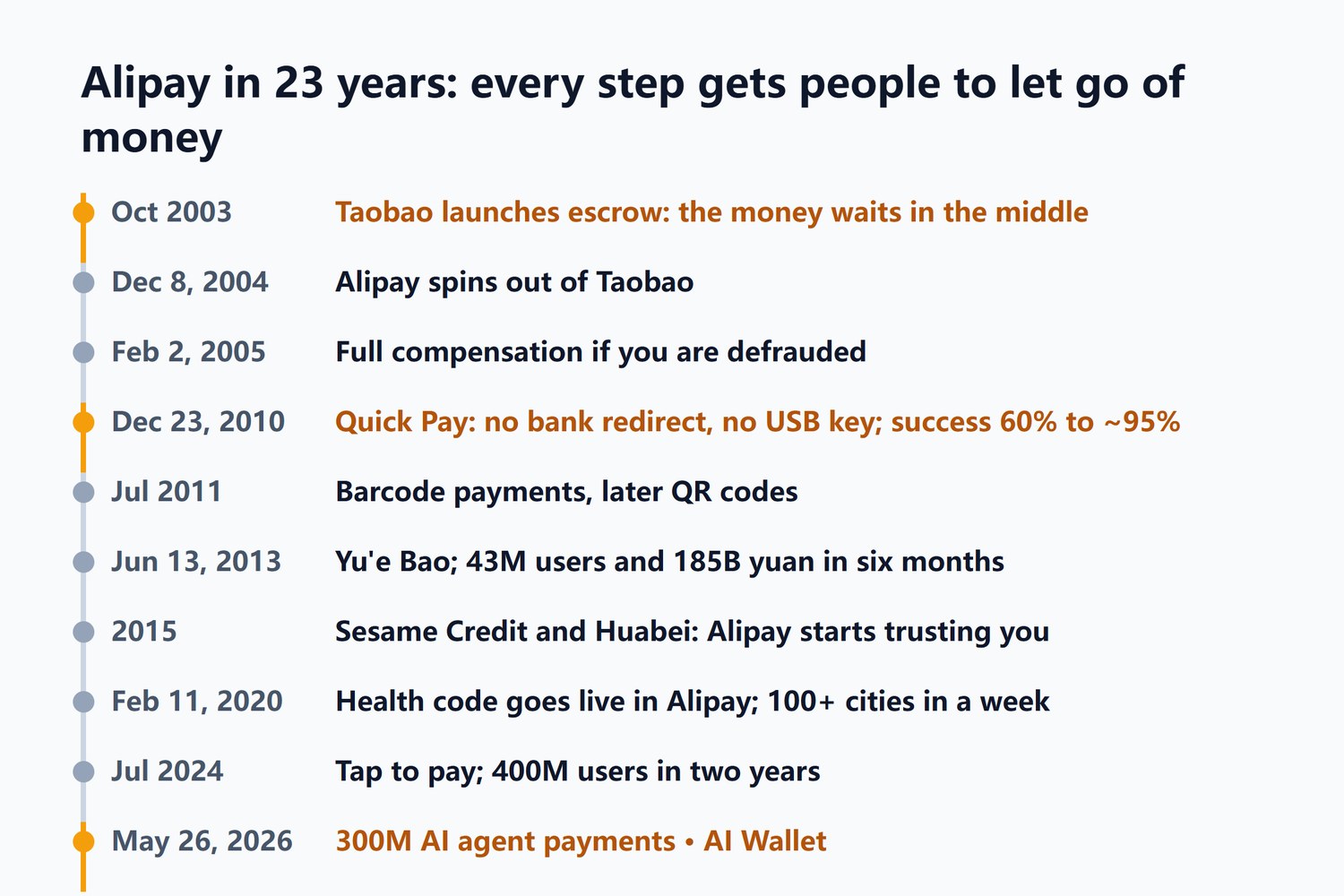
The things he listed, plus the escrow that came first, are the main line of Alipay’s 23 years. Each one solves the same problem: getting people to let go of their money. To a stranger selling something, to a website, to a phone, and finally to an AI.
2003: put the money in the middle
In October 2003, Taobao launched escrow payments. The buyer paid into a third-party account, the seller shipped, and only after the buyer confirmed receipt did the money go to the seller. An unhappy buyer could ask for a refund back to their account.
The biggest obstacle to buying online in China that year was not internet access. It was that nobody wanted to pay first. Pay first and the seller might never ship; ship first and the buyer might never pay. Escrow meant neither side had to trust the other. Both only had to trust the account in the middle.
Holding money with a third party was not a new idea; offline deals had used it for a long time, and PayPal came earlier for online payments. What Alipay did was make escrow the default flow for every Taobao transaction, not an optional service. On December 8, 2004, Alipay was spun out of Taobao as its own company and started handling payments for other websites.
On February 2, 2005, it went a step further with a promise it called “You dare to pay, we dare to compensate”: if a user was defrauded while paying with Alipay, Alipay would cover the full loss. It kept repeating that line for well over a decade.
2010: Quick Pay, skipping online banking
Escrow solved trust between buyer and seller. It did not solve payments that failed to go through.
Paying on a PC back then meant jumping from Taobao to a bank’s online banking page, plugging in a USB security key, installing a browser plug-in, and sometimes visiting a branch first to activate online banking. Many people got stuck there, and the sale was lost. The 21st Century Business Herald later reported that Alipay shipped more than 200 optimizations in 2009 and only moved its payment success rate from 60% to 62%.
On December 23, 2010, Alipay and Bank of China launched credit-card Quick Pay, and ICBC and China Construction Bank followed. Users bound a card to Alipay once, then paid with just their Alipay password: no online banking redirect, no USB key. The success rate rose to around 95%.
That step moved the risk from the bank to Alipay. The password was Alipay’s, so if a card was stolen and used, Alipay had to pay first. Banks were reluctant at the start. Alipay’s answer was the same promise: it would cover fraud losses first.
On May 26, 2011, the People’s Bank of China published the first 27 payment business licenses for non-bank institutions, and Alipay was on the list. Third-party payments finally had a formal legal status.
2013: Yu’e Bao, making money stay
Every earlier step was about money flowing through Alipay. Yu’e Bao, launched on June 13, 2013, was about money staying in it.
Yu’e Bao was a money market fund Alipay built with Tianhong Asset Management. Move your Alipay balance into it and it earned interest; move it back out at any time to pay for something. Before this, buying a fund meant opening an account at a bank or a brokerage.
By December 31, 2013, Yu’e Bao had 43.03 million users and 185.3 billion yuan under management. It peaked at 1.69 trillion yuan in March 2018. Tianhong lowered the per-person holding cap several times from 2017, and the fund shrank steadily afterwards, to about 750 billion yuan by 2024.
Yu’e Bao got tens of millions of people to buy a fund for the first time, and most of them did not feel they were buying a fund.
Scan, then tap: from online to offline
In July 2011, at an online-goods trade fair in Guangzhou, Alipay launched barcode payments: the user showed a barcode on their phone and the cashier scanned it with a barcode gun. Barcodes later gave way to QR codes.
QR payments mattered even more to merchants. A small shop did not need to pay for a card terminal; it could print a QR code, tape it to the wall and start taking payments. A large share of China’s small merchants went straight from cash to phone payments without ever passing through card swiping. The reason line Alipay gets on this ranking says it “skipped the credit-card generation entirely”, and this is what it refers to.
In July 2024, Alipay added “Tap”: touch your phone to a merchant’s device and you have paid. By July 2026, it said Tap had 400 million users.
2015: the other way round, Alipay starts trusting you
On January 28, 2015, Sesame Credit began a public beta with some Alipay users, expressing a person’s creditworthiness as a single score. In April the same year, Huabei launched, letting people buy now and pay later, with Sesame Credit users getting limits of up to 30,000 yuan.
For more than a decade, Alipay had worked on getting users to trust it. Now the direction flipped: Alipay used your record with it to decide how much to trust you, and how much to lend you.
On November 3, 2020, the Shanghai Stock Exchange announced it was suspending Ant Group’s listing on its STAR Market, two days before the planned listing date of November 5. On July 7, 2023, Chinese financial regulators fined Ant Group and its subsidiaries 7.123 billion yuan, including confiscated illegal gains.
2020: a code that took no money
On February 11, 2020, Hangzhou’s health code went live inside Alipay, in green, yellow and red. Within a week, Alipay’s health code was running in more than 100 cities.
It was the first time Alipay carried something nationwide that had nothing to do with paying. It spread that fast because of what the previous decade and a half had built: nearly everyone had it on their phone, and nearly everyone had verified their real identity in it.
A billion users, Alipay+, and the AI assistant
Ant Group’s 2020 prospectus said that as of June 2020, Alipay had more than 1 billion annual active users, 711 million monthly active users and more than 80 million monthly active merchants.
Outside China, Alipay opened its network up as Alipay+. By public figures from September 2026, Alipay+ connects more than 50 international payment partners to over 150 million merchants across 220 markets.
At the Inclusion Bund Conference on September 10, 2026, Cyril Han said Alipay’s AI assistant would introduce incentives for developers to build agents that plug into it.
Why it ranks #13
| Dimension | Score | Why |
|---|---|---|
| Originality ORG | 92 | Tied lowest. Third-party escrow was not its invention, and PayPal came first in online payments; what it originated was making escrow the default, plus specific moves like Quick Pay and barcode payments |
| Scale SCL | 93 | Over a billion annual users, but mostly in China. Five points behind Facebook and its three billion |
| Impact IMP | 94 | A large share of China’s small merchants went straight from cash to phone payments, and it solved trust in online shopping first |
| Experience EXP | 92 | Tied lowest. Quick Pay and QR payments were huge leaps in experience, but the app grew heavier over the years |
| Business BIZ | 93 | Payments are not the most profitable part: in the first half of 2020, digital payments and merchant services were 35.86% of Ant’s revenue, while credit, wealth and insurance together made up 63.39% |
| Durability DUR | 95 | Its highest. Twenty-three years in, the core job has not changed: getting people to let go of their money |
Overall 93.10, ranked #13.
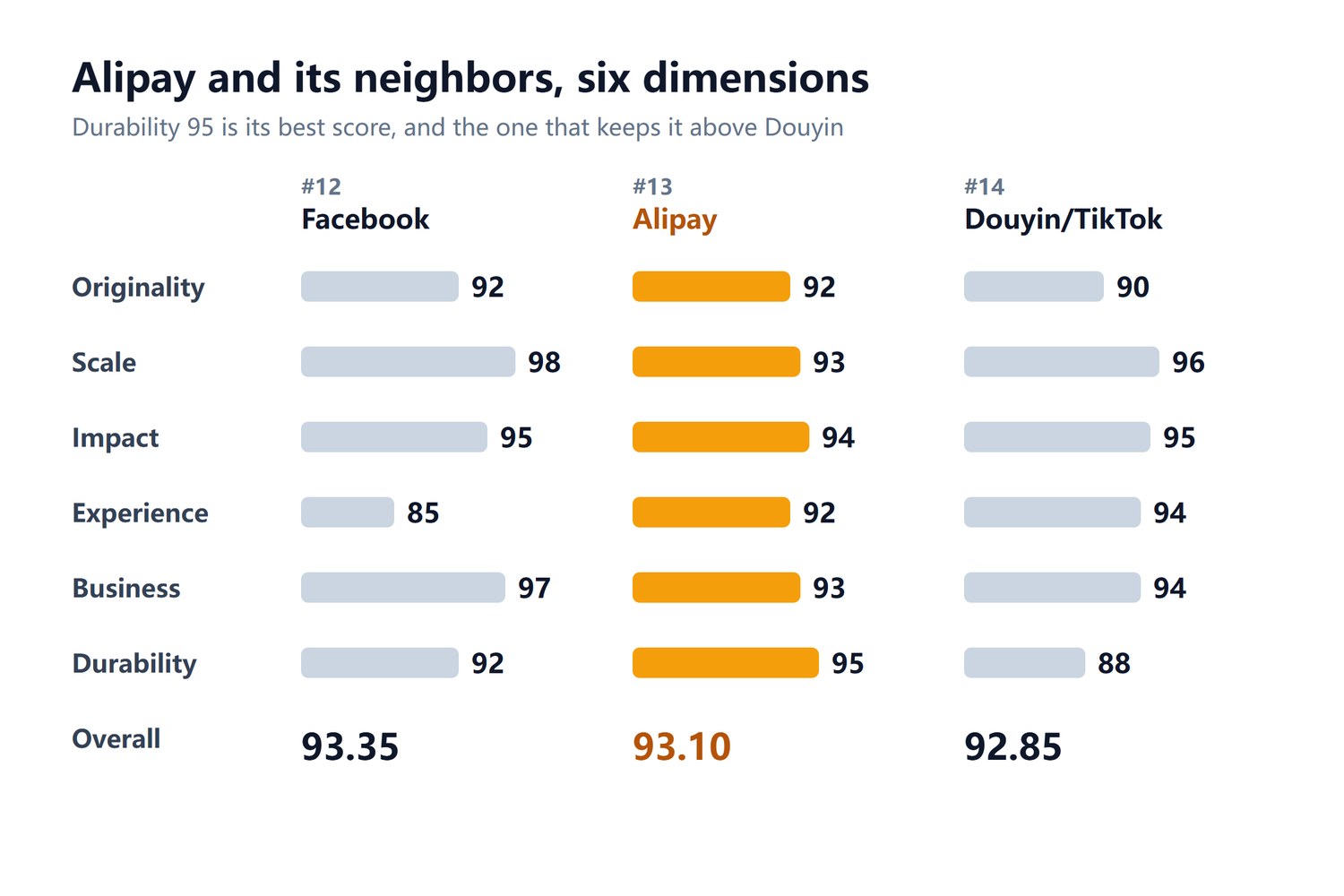
Against Facebook at #12: both launched in 2004 and both score 92 for originality. Facebook is 5 points ahead on scale and 4 on business; Alipay is 7 ahead on experience and 3 on durability. The gap ends at 0.25. Facebook wins on reach and revenue, Alipay on ease of use and staying power.
Against Douyin/TikTok at #14: Douyin is 3 points ahead on scale, 2 on experience, 1 each on business and impact, and 2 behind on originality. Add those up and Douyin would lead Alipay by 0.80; durability, 88 against 95, takes back 1.05 on its own. Douyin is ten years old. The need Alipay serves has not changed in twenty-three.
Its most direct rival at home, WeChat Pay, does not have its own entry; it counts as part of WeChat at #5 (overall 94.75).
What makes Alipay valuable is not any single feature. It is that for more than twenty years, every major product it built answered the same question. In 2003 the question was whether two strangers would dare to pay first. In 2026 it is whether you will let an AI pay for you.
All scores and rankings in this article were produced by Claude (AI).
Sources: the 300 million AI agent payments, the AI Wallet description and Cyril Han’s remarks on Quick Pay and QR payments come from launch coverage on May 26, 2026 (Yangtse Evening Post online and others); the developer incentives for Alipay’s AI assistant come from Sina Finance’s report on the Inclusion Bund Conference on September 10, 2026; Tap’s July 2024 launch and 400 million users come from Sina Tech on July 8, 2026; the escrow flow comes from Taobao Open Platform documentation and related reports; the December 8, 2004 spin-out comes from the Chinese Wikipedia entry on Alipay; the February 2, 2005 compensation promise comes from public reports on Alipay; Quick Pay’s December 23, 2010 launch with Bank of China, the 60% to 62% success rate in 2009, the roughly 95% rate after Quick Pay and fraud compensation come from the 21st Century Business Herald, August 12, 2020; the first 27 payment licenses come from China News Service, May 26, 2011; Yu’e Bao’s launch date and end-2013 figures come from China Economic Weekly (People’s Daily), July 28, 2014, and the 1.69 trillion yuan peak, holding caps and roughly 750 billion yuan come from Jiemian, August 2024; barcode payments launching in July 2011 at the Guangzhou fair come from Woshipm and Sohu; Sesame Credit’s January 28, 2015 beta and Huabei’s April 2015 launch with limits up to 30,000 yuan come from the 21st Century Business Herald and People’s Daily, 2015; the listing suspension comes from the Shanghai Stock Exchange announcement of November 3, 2020 (via China News Service); the 7.123 billion yuan fine comes from the China Securities Regulatory Commission on July 7, 2023 (via China Financial Information Network); the health code launch date and 100+ cities in a week come from Xinhua, February 19, 2020; user, merchant and revenue-mix figures come from Ant Group’s prospectus of August 2020, as reported by The Paper; Alipay+ figures come from the TerraPay and Alipay+ press release of September 9, 2026. The ranking scores product dimensions only.
Discussion