100 Products That Changed the World · #12: Facebook
On August 26, 2026, Meta agreed to pay up to $18 billion to settle a lawsuit brought by US state attorneys general. The states alleged that Meta knew Facebook and Instagram would hook teenagers and designed them that way anyway. Meta denied wrongdoing.
The settlement lists several changes. Accounts under 18 get a default limit of two hours a day, are locked from midnight to 6 a.m. by default, and no longer see like counts on posts. And one more: users under 18 get the option of a feed that is not ranked by an algorithm.
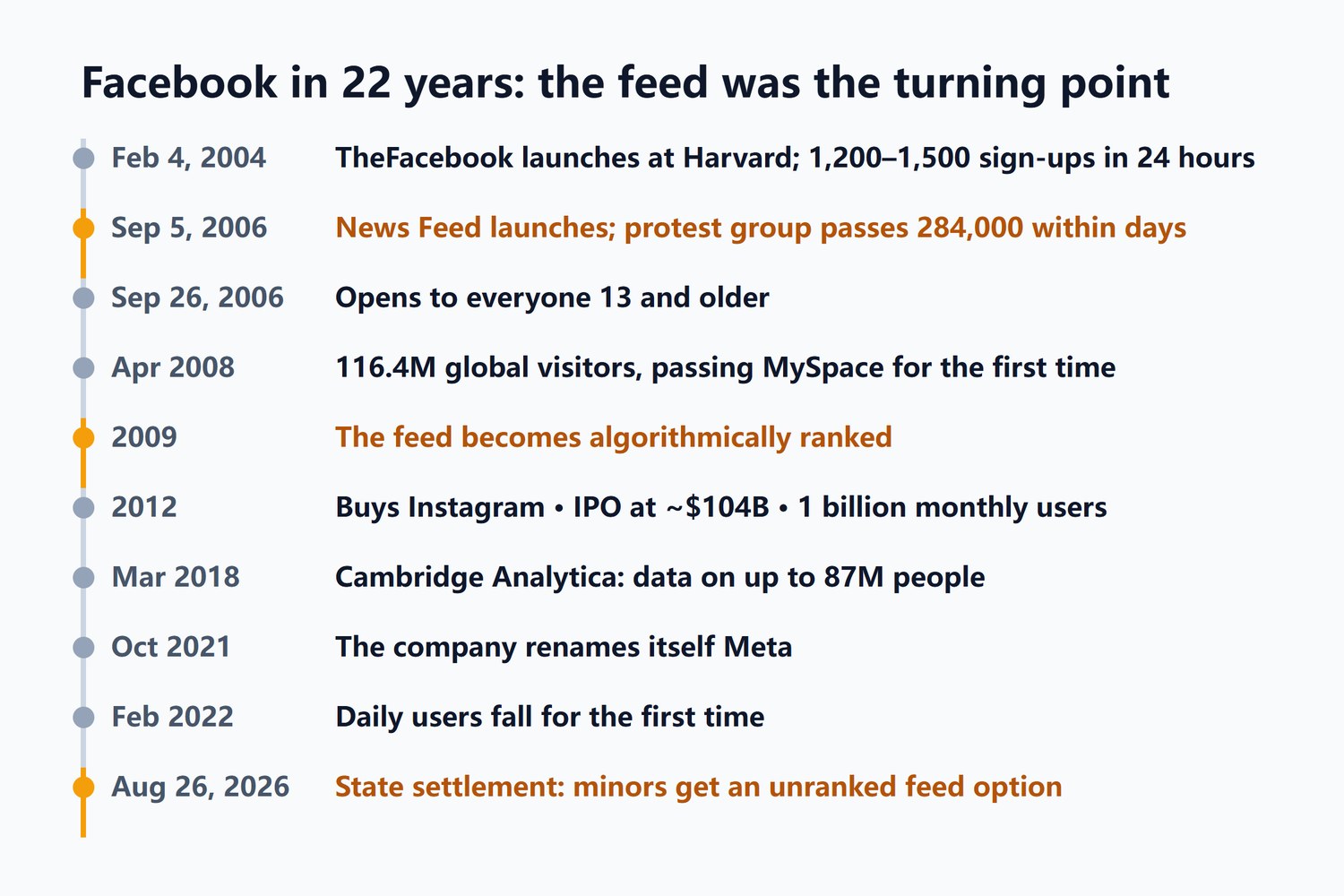
Facebook launched News Feed on September 5, 2006. Twenty years later, it has been told for the first time to give some of its users a switch that turns the algorithm off.
Nearly everything Facebook got right afterwards, and most of what it is in trouble for today, traces back to that one feature.
It was not the first social network
First, why originality is 92 and not higher.
Websites that connected you to your friends existed before Facebook. Friendster launched in 2002 and MySpace in 2003, and as late as 2006 MySpace was far bigger.
On February 4, 2004, Zuckerberg launched TheFacebook from his Harvard dorm. He later recalled that 1,200 to 1,500 people signed up in the first 24 hours.
The biggest difference from the sites before it: you could only join with a school email address. Everyone you saw used their real name and was someone you could run into in the dining hall or a lecture. The other sites ran on usernames and self-presentation; this one ran on real relationships between classmates.
It also expanded one school at a time: Stanford, Columbia and Yale in March 2004, a high-school version in September 2005, and only on September 26, 2006, did it open to anyone 13 or older with an email address.
That decision about real identity is what later made Facebook the most accurate map of human relationships ever sold to advertisers.
September 5, 2006: News Feed
Before News Feed, if you wanted to know what your friends were up to, you clicked into their profiles one by one.
On September 5, 2006, Facebook put a constantly updating list on the home page: who changed their profile picture, who changed their relationship status, who joined which group. Information that used to sit on hundreds of separate profiles was now pushed in front of everyone.
Users were furious. Ben Parr, a Northwestern student, started a group that same day called “Students Against Facebook News Feed (Official Petition to Facebook)”. It hit 13,000 members within hours, 100,000 by 2 a.m., and more than 284,000 a few days later. At the time Facebook had a little over 8 million student users in total.
The protest grew that fast because of the very feature it opposed: when one person joined, every one of their friends saw “so-and-so joined this group” in their feed.
Zuckerberg first posted a blog entry titled “Calm down. Breathe. We hear you.” It withdrew nothing and only restated the existing privacy settings. A few days later he published an open letter that began “We really messed this one up”, and Facebook then added settings that let users control which of their actions showed up in other people’s feeds.
News Feed itself never went away. The people protesting it spent more time on the site while they did.
From newest-first to ranked
News Feed started out in time order, newest at the top.
In May 2007, at its first f8 developer conference, Facebook launched its developer platform, letting outside developers build apps inside Facebook. From 2009 the feed moved from time order to algorithmic ranking: Facebook decided which post you saw first.
After that, the feed was no longer “what your friends are doing”. It was “what Facebook thinks you are most likely to stop and look at”. The same ranking also decided where ads went and who saw them.
Growth got steep from here:
- April 2008: comScore counted 116.4 million worldwide unique visitors for Facebook, passing MySpace’s 115.7 million for the first time
- April 12, 2012: bought Instagram for about $1 billion
- May 17, 2012: priced its IPO at $38 a share, a valuation of about $104 billion
- Early October 2012: Zuckerberg announced one billion monthly active users
- February 19, 2014: announced the $19 billion acquisition of WhatsApp
The two acquisitions bought two rivals that might have gone around it.
The cost
Handing “what you should see” to an algorithm produced two kinds of problems.
The first was data. In the Cambridge Analytica scandal that broke in March 2018, a personality-quiz app used Facebook’s developer interfaces to collect data on up to 87 million people, most of whom had never installed the app; they were simply friends of people who had. The data was used to target political advertising. In July 2019 the US Federal Trade Commission fined Facebook $5 billion over it.
The second was the ranking itself. A ranking algorithm wants you to stop, click and comment, and the content best at making that happen is often content that makes people angry. In early 2018, Zuckerberg announced that the feed would prioritize “meaningful social interactions” with friends and family. The non-algorithmic feed option in this year’s settlement is the first time an outside party has reached directly into the ranking.
Another signal came from its own users. In February 2022, Facebook’s daily active users fell for the first time in its 18-year history. The company had renamed itself Meta in October 2021. Since 2024, Meta no longer reports user numbers for the Facebook app on its own; the last figures, for the end of 2023, were 3.07 billion monthly and 2.11 billion daily users.
The company as a whole is still growing. In the second quarter of 2026, 3.6 billion people a day used at least one Meta app, and quarterly revenue was $60.8 billion, up 28% year over year.
Why it ranks 12th
| Dimension | Score | Notes |
|---|---|---|
| Originality ORG | 92 | It did not invent the social network; real identity plus the feed were its own calls |
| Scale SCL | 98 | Over 3 billion monthly users for a single app (last reported, end of 2023) |
| Impact IMP | 95 | ”The feed” became the default shape of almost every content product |
| Experience EXP | 85 | Its lowest score. Algorithm, ads and privacy settings stacked on one another |
| Business BIZ | 97 | A real-name social graph is the best ad-targeting tool there is |
| Durability DUR | 92 | Lowest in the top 13. The product is alive, but young users are leaving the app |
Overall OVR 93.35, ranked 12th.
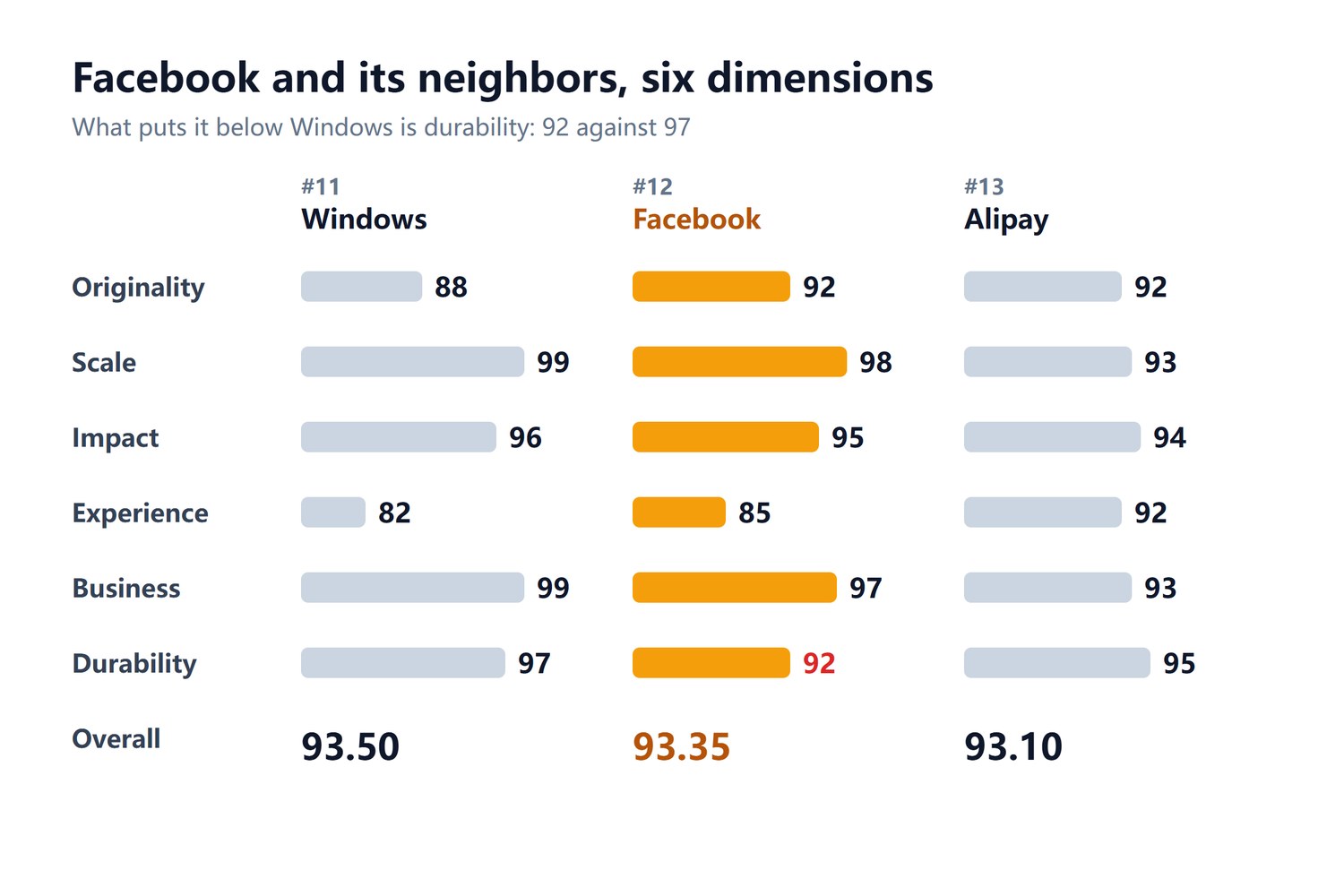
Against Windows one place above, Facebook is 4 points higher on originality and 1 to 2 points lower on scale and business, and the overall gap is only 0.15. What actually puts it below Windows is durability: 92 against 97. Windows has been on office desks for forty years. Facebook is twenty-two, and its company has already changed its name and stopped reporting the app’s user numbers.
Against Alipay one place below, both score 92 on originality and both launched in 2004. Facebook is 5 points higher on scale and 4 on business; Alipay is 7 higher on experience and 3 on durability; Facebook ends up 0.25 ahead. Alipay solved “can I safely hand my money to a stranger”, a need that has not changed in twenty years. Facebook solved “what are my friends doing”, a need its own algorithm later replaced with “which post will you stop on”.
There is one more comparison higher up the list. YouTube at #9 is from the same 2004–2005 generation and has exactly the same originality, scale and impact as Facebook (92, 98, 95), yet scores 0.30 higher overall. The difference is experience (88 against 85) and durability (95 against 92); the only place Facebook comes out ahead is business (97 against 93).
Facebook is the best moneymaker of its generation of products, and the first one its users got tired of. Both come from the same decision: on September 5, 2006, it decided to choose what everyone sees first.
All scores and rankings in this article were produced by Claude (AI).
Sources: the August 26, 2026 settlement (up to $18 billion), the two-hour default limit for minors, the midnight-to-6 a.m. default lock, hidden like counts, the optional non-algorithmic feed and Meta’s denial of wrongdoing are from same-day reports by Engadget, NBC News and CNBC; TheFacebook’s launch date, first-day sign-ups, the March 2004 expansion, the September 2005 high-school version, the September 26, 2006 opening, the May 2007 developer platform, the April 12, 2012 Instagram purchase, the May 17, 2012 IPO price of $38 and valuation of about $104 billion, one billion monthly users in October 2012, the February 19, 2014 WhatsApp acquisition, the October 2021 rename to Meta and the February 2022 first decline in daily users are from the English Wikipedia article History of Facebook; the News Feed launch date, the membership of Ben Parr’s protest group and the 8 million student users at the time are from TIME’s September 2006 report “Inside the Backlash Against Facebook”; Zuckerberg’s open letter and the privacy settings added afterwards, the 2009 move to ranking and the 2018 “meaningful social interactions” change are from the English Wikipedia article Feed (Facebook); the April 2008 visitor figures against MySpace are comScore data as reported by Campaign and CBC at the time; Cambridge Analytica and the July 2019 $5 billion fine are from the English Wikipedia article Facebook–Cambridge Analytica data scandal; the last reported 3.07 billion monthly and 2.11 billion daily Facebook users (as of December 31, 2023) are from Meta’s fourth-quarter 2023 results; 3.6 billion daily active people and $60.8 billion quarterly revenue are from Meta’s second-quarter 2026 results, released July 29, 2026. The ranking scores product dimensions only.
Discussion