Pony Ma: in the worst month of the 3Q War, he approved WeChat
On the evening of 3 November 2010, hundreds of millions of QQ users saw an open letter pop up on their computers. It began:
By the time you see this letter, we have just made a very difficult decision.
The decision: QQ would stop running on any computer that had 360’s software installed.
Users were told to choose one. It was the most extreme step in what became known as the “3Q War”. The next day, China’s Ministry of Industry and Information Technology and the Ministry of Public Security stepped in.
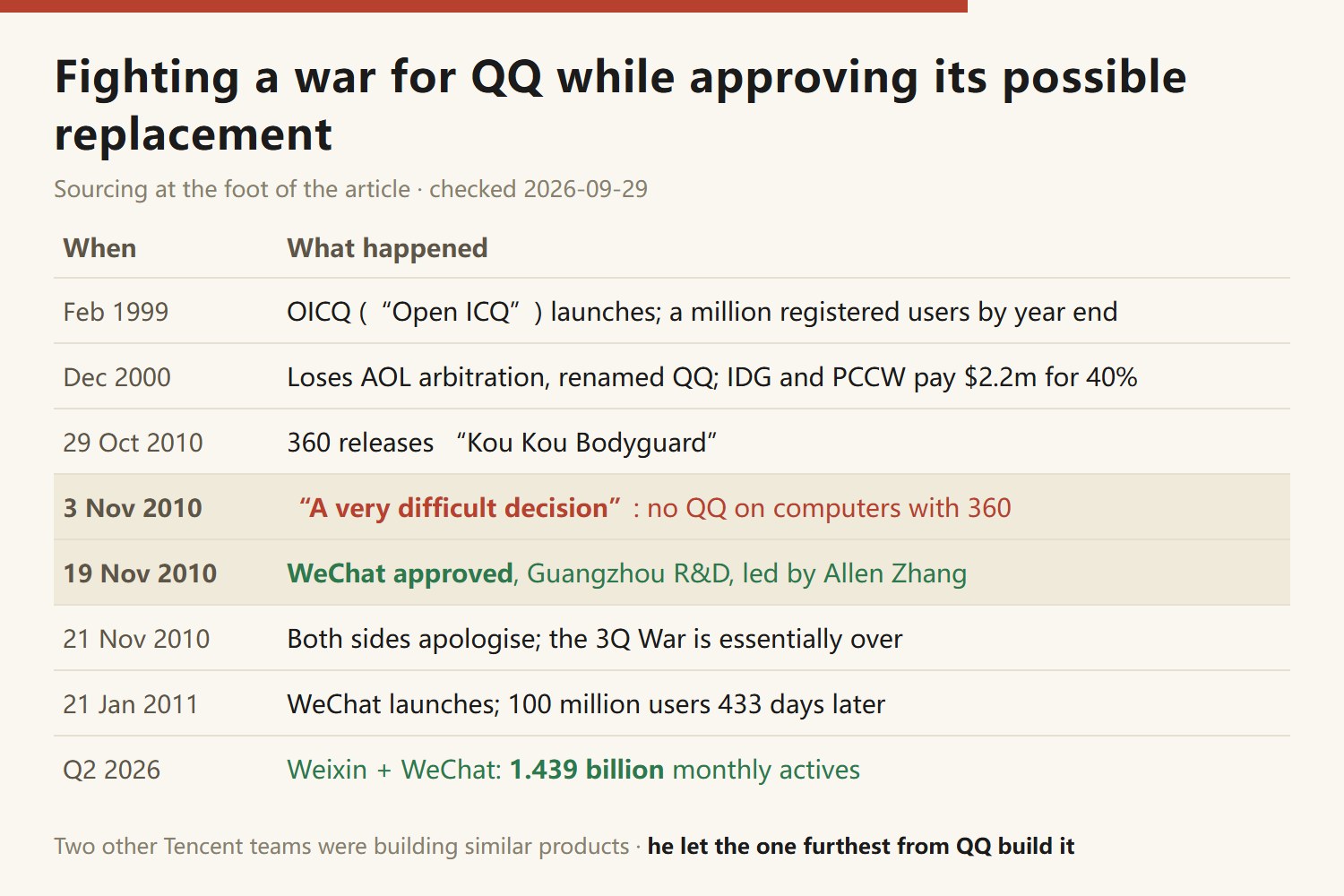
A little over two weeks later, on 19 November (some accounts say the 20th), a new project was formally approved inside Tencent. It sat in the Guangzhou R&D centre, it was led by a man called Allen Zhang, and it was a messaging app for phones.
It became WeChat. From the day it was approved, it was seen as something that could replace QQ.
While Tencent was fighting a war for QQ on the front line, it approved, in the back office, a project that could kill QQ. The person who made the call was Pony Ma.
Shantou, Shenzhen, pagers
Ma Huateng, known as Pony Ma, was born on 29 October 1971 in Chaoyang, Shantou, in Guangdong, and graduated in computer science from Shenzhen University in 1993.
His first job was at China Motion Telecom, writing software for pagers. It was the first time large numbers of Chinese people could be reached anywhere: a pager on the belt, a number on the screen, a walk to the nearest payphone to call back.
In 1998 he and four partners founded Tencent in Shenzhen.
OICQ: it started as a copy
Tencent’s first product was not original.
In February 1999 Tencent launched OICQ, short for “Open ICQ”. ICQ was an instant messenger built by an Israeli team and later sold to AOL, and it was popular abroad. Ma had seen a presentation on ICQ and decided to build a Chinese version.
By the end of 1999, OICQ had more than a million registered users.
But for a free product, more users meant bigger server bills. In 2000 IDG and PCCW put in $2.2 million for 40% of Tencent. The same year AOL took the OICQ name to arbitration, and Tencent lost. In December 2000, OICQ was renamed QQ.
The first QQ number, 10001, belongs to Pony Ma.
The rename turned out well: “QQ” is far easier to remember than “OICQ”. In 2004 Tencent listed in Hong Kong, raising $200 million.
The 3Q War
By 2010 QQ was standard on Chinese computers, and Tencent was in games, portals, email, e-commerce and security software. You could find it on almost every track.
On security software, it ran into 360. In September, 360 released a “privacy protector” claiming QQ scanned users’ computers and uploaded personal information. On 29 October it released “Kou Kou Bodyguard”, which blocked QQ’s ads and some of its features.
On 3 November Tencent sent the “difficult decision” letter. On 21 November both sides published apologies, and it was essentially over.
The lawsuits lasted longer. In February 2014 China’s Supreme People’s Court ruled in the final instance that 360 must pay Tencent 5 million yuan, and dismissed 360’s antitrust claim against Tencent.
Tencent won in court and lost in reputation. Hundreds of millions of users forced to choose at a pop-up is an image that outlasted any judgment. Tencent’s president Martin Lau later admitted:
Looking back, the way we handled it was not well considered. We lacked communication with users.
Afterwards Tencent began pushing an “open platform”, opening some of its traffic and interfaces to outside developers.
An email
Around the time the 3Q War broke out, in October 2010, a mobile chat app called Kik got a million users abroad in 15 days.
Allen Zhang ran Tencent’s Guangzhou R&D centre and was in charge of QQ Mail. In the most widely told version, he looked at Kik one evening, thought about it for an hour or two, and concluded that mobile would produce a new kind of instant messenger that could seriously threaten QQ. He emailed Pony Ma suggesting Tencent build one itself.
Ma replied quickly, agreeing.
The project was approved on 19 November, staffed mainly from the QQ Mail team.
Two things here deserve a second look.
First, WeChat was not the only one Tencent was building. At the same time, two teams in Tencent’s wireless business were working on similar products. The mobile QQ team was building for phones too, tied to lucrative partnerships with the carriers. Three teams in one company were building the same kind of thing. Two were bound up with QQ’s interests; only one, in Guangzhou, was far from headquarters and far from QQ’s interests.
Second, the decision was made in the tensest weeks of the 3Q War. In those weeks Tencent made hundreds of millions of users choose for QQ’s sake, and at the same time approved a project seen from the start as a possible replacement for QQ.
WeChat launched on 21 January 2011. On 29 March 2012 Pony Ma announced on Tencent Weibo that WeChat had passed 100 million users, 433 days after launch.
Today Weixin and WeChat have 1.439 billion combined monthly active users. QQ, in March 2023, had 597 million.
What he got right
Looking back, Pony Ma wrote no code here and drew no prototypes. Shake, Moments and Official Accounts were not his designs.
He did three things:
- Approved it: at the peak of QQ, just after fighting a war for QQ, he agreed to build something that could replace QQ
- Let it go: he let the Guangzhou team, the furthest from headquarters, build it, rather than handing it to the mobile QQ team. A team bound to QQ’s interests would find it hard to go all-in on something that replaces QQ
- Took the heat: according to Jiemian’s “Ten Years of WeChat”, he gave Allen Zhang’s team “enormous freedom” and dealt with outside criticism of WeChat himself
None of these three things appears anywhere in WeChat’s interface.
Why he ranks here
| Dimension | Score | Note |
|---|---|---|
| Vision VIS | 90 | He saw the threat of mobile messaging, but the first email was Allen Zhang’s |
| Insight INS | 94 | He knew a new thing has to be built where the old interests can’t reach it |
| Taste TST | 88 | His lowest. Tencent’s early products started as followers and copies; OICQ was a Chinese ICQ |
| Business BIZ | 96 | From a free chat app, a full business in games, ads, payments and cloud |
| Scale SCL | 97 | His highest. 1.439 billion combined monthly actives for Weixin and WeChat |
| Originality ORG | 89 | QQ followed ICQ, and one trigger for WeChat was Kik; Tencent’s originality lies more in business models than product forms |
Overall 92.50, ranked 17th.
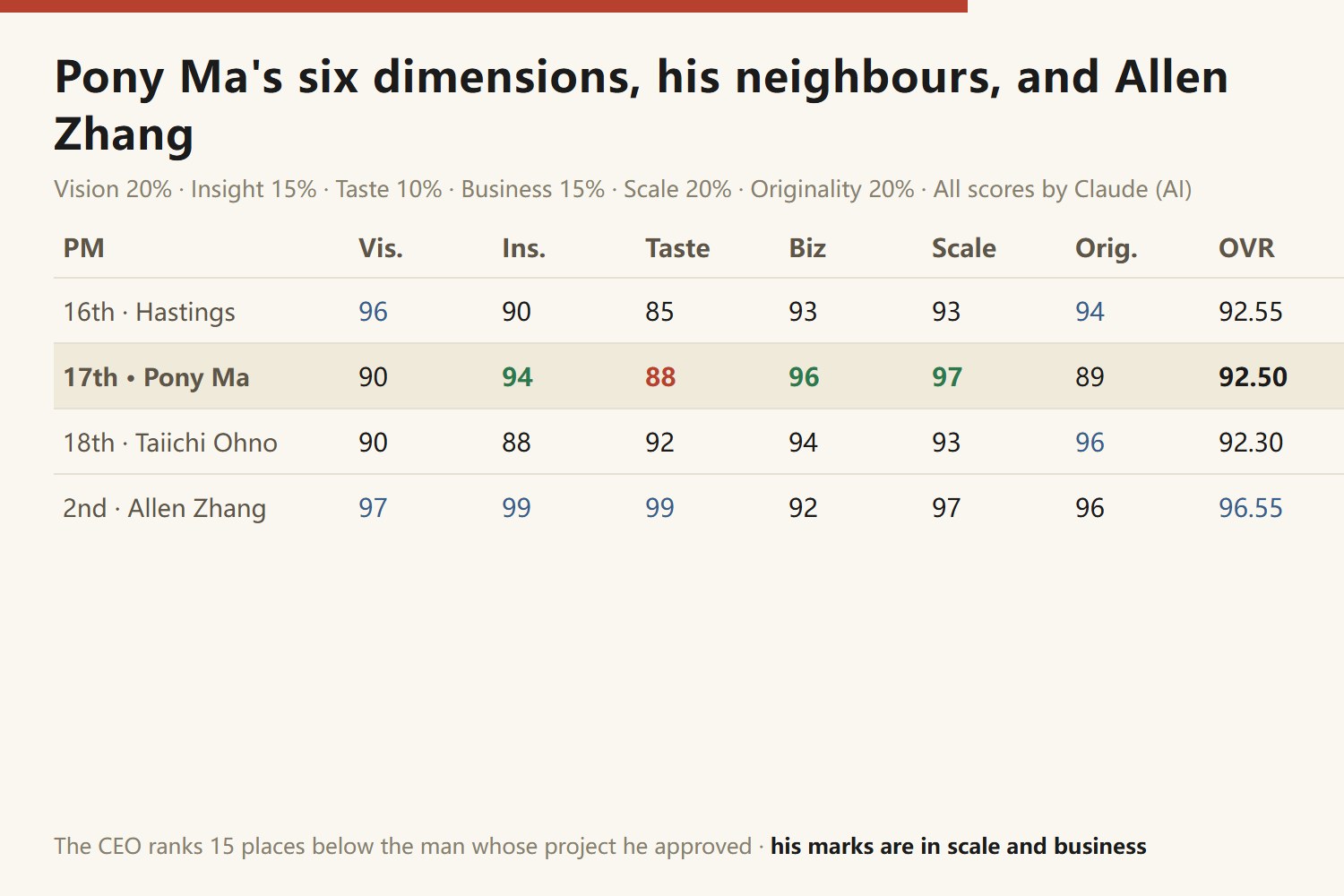
First, the placing. The list shows scores rounded to whole numbers, and Lei Jun at 15th, Reed Hastings at 16th and Pony Ma all show 93. Only at two decimal places do they separate: Lei Jun 92.70, Hastings 92.55, Pony Ma 92.50.
He and Hastings are 0.05 apart, with very different shapes. Hastings has vision 96 and originality 94: someone who sees further than everyone and kills his own cash cow. Pony Ma has vision 90 and originality 89, but business 96 and scale 97: someone who gets hundreds of millions of people using a thing and then turns it into a business.
Then a comparison few people notice: No. 2 on the list is Allen Zhang.
Allen Zhang scores 96.55, with taste 99 and insight 99, a full 4 points above Pony Ma. A company’s CEO ranks 15 places below someone who worked for him.
That is not a verdict on who matters more. The list scores the act of building products. Allen Zhang is the one who actually built WeChat, so he takes the high marks for taste and insight; Pony Ma’s marks are in scale and business.
But without that approval in November 2010, Allen Zhang’s email would have stayed an email.
Pony Ma’s most important product decision was to let someone else build a thing that could beat his main product, and not to hand it to the team with the most reason to hold it back. That doesn’t show up on any screen, which is why his taste is 88. It shows up in the number 1.439 billion, which is why his scale is 97.
All scores and rankings were produced by Claude (AI).
Sourcing: Pony Ma’s date and place of birth, Shenzhen University graduation year, pager software work at China Motion Telecom, co-founding Tencent in 1998, OICQ’s February 1999 launch and a million registered users by year end, IDG and PCCW’s $2.2 million for 40% in 2000, the AOL arbitration and December 2000 rename to QQ, and the 2004 Hong Kong listing raising $200 million come from the English Wikipedia entries for Ma Huateng and Tencent QQ; QQ number 10001 and QQ’s 597 million monthly actives in March 2023 come from the Tencent QQ entry; the 3Q War timeline (360’s September 2010 privacy protector, the 29 October Kou Kou Bodyguard, the 3 November letter, the 4 November government intervention, the 21 November apologies), Martin Lau’s statement and the February 2014 Supreme Court judgment come from the Chinese Wikipedia entry on the 3Q War; Kik’s million users in 15 days, Allen Zhang’s email and Pony Ma’s reply, the 19 November 2010 approval and staffing from the QQ Mail team come from an iHeima article republished by NetEase Tech on 28 February 2014 (other reports give 20 November); the two other wireless-business teams, the “enormous freedom” given to Zhang’s team and 100 million users after 433 days come from Jiemian’s “Ten Years of WeChat”; WeChat’s 21 January 2011 launch comes from the Chinese Wikipedia entry for WeChat; 1.439 billion combined monthly actives comes from Tencent’s Q2 2026 results announcement and coverage of it. The list scores product decisions, not people.
Discussion