100 Product Managers Who Changed the World · #32: Ken Kutaragi
Inside Sony’s corporate headquarters in Tokyo during the late 1980s, an unspoken caste system ruled the hallways.
Engineers who built Trinitron televisions, Walkman cassette players, and broadcast cameras were the aristocracy. Mention the words “video game console” in an executive meeting, and the room would freeze in disdain:
“Sony is the world’s premier high-technology audio-visual brand. Why on Earth would we stoop to making children’s toys to compete with a Kyoto playing-card peddler like Nintendo?!”
Twenty years later, when televisions and portable audio players had shrunk into low-margin commodities, the single division keeping the entire Sony empire afloat — generating billions of dollars in operating profit — was that despised “toy”: PlayStation.
And the man who forced it into existence against the nearly unanimous hostility of Sony’s board was a rebellious hardware engineer labeled a traitor, a lunatic, and a daydreamer by his own colleagues: Ken Kutaragi.
The “Sony Traitor” Who Secretly Moonlit for Nintendo
Born in Tokyo in 1950 to parents who ran a small printing shop, Kutaragi spent his childhood taking apart clocks, radios, and printing presses after school.
Joining Sony’s digital research labs in 1975, he helped build early LCD displays, digital cameras, and the System G — a quarter-million-dollar real-time 3D graphics workstation used by television networks.
Then, in the mid-1980s, Kutaragi watched his young daughter sit mesmerized in front of the living-room TV playing Nintendo’s Famicom (NES). Where other parents saw a distraction, Kutaragi saw the future of personal computing: a dedicated graphics computer inside every home.
What bothered him was the Famicom’s tinny, primitive 8-bit beeps.
Learning that Nintendo was developing its next-generation 16-bit console — the Super Nintendo (SNES / Super Famicom) — Kutaragi did something unthinkable in corporate Japan: without telling his bosses at Sony, he secretly accepted a contract from Nintendo to design the console’s sound processor in his spare time.
The result was the SPC700, an 8-channel digital audio chip that replaced arcade bleeps with lush, CD-quality orchestral music.
When Sony’s executives discovered that one of their brightest engineers had secretly built a crown-jewel chip for Nintendo, they were furious and moved to fire him on the spot.
He was saved by a single man: Sony CEO Norio Ohga, a former opera baritone who listened to the SPC700’s audio output, recognized its brilliance, and turned the scandal into a joint venture — tasking Kutaragi with building a Sony CD-ROM attachment for the Super Nintendo, codenamed the “Play Station.”
The Humiliation in Chicago, 1991: “Do We Just Stand Down?!”
By mid-1991, Kutaragi’s team had built a working hybrid console that played both Super Nintendo cartridges and Sony CD-ROMs.
Behind the scenes, however, Nintendo’s ruthless president Hiroshi Yamauchi read the fine print of the original 1988 contract and realized a fatal trap: Sony held sole licensing rights over every game published on the CD-ROM format.
Yamauchi decided to execute a public ambush.
At the June 1991 Consumer Electronics Show (CES) in Chicago:
- On Day 1: Sony proudly took the stage and unveiled the Nintendo-Sony “Play Station” to the world press;
- Less than 24 hours later, on Day 2: Nintendo held its own press conference next door, never mentioned Sony once, and announced to a stunned room of journalists that Nintendo had dumped Sony to partner with Sony’s arch-rival, Philips!
Japanese business newspapers ran front-page headlines calling it “Sony’s Humiliation.”
Back in Tokyo, Sony’s old-guard executives demanded that the gaming project be buried forever. In a tense boardroom showdown with CEO Norio Ohga, 41-year-old Kutaragi stepped forward and asked the question that changed entertainment history:
“Nintendo just slapped Sony across the face in front of the entire world. Are we simply going to tuck our tails and retreat?! If we walk away now, Sony forfeits the digital future forever!”
Ohga — an operatic alpha who despised losing — slammed his fist onto the table: “Do it! Spin Kutaragi’s team out into Sony Music, give him 5 billion yen, and build our own machine to crush them!”
Real-Time 3D Polygons + $1 CDs: Dismantling the Cartridge Monopoly
Exiled to a separate building in Aoyama with a ragtag team of musicians and misfits, Kutaragi engineered a two-pronged product revolution that caught Nintendo completely flat-footed:
| Strategic Dimension | Nintendo’s Legacy Playbook (SNES / N64) | Kutaragi’s PlayStation (PS1) Architecture | Why It Shattered the Industry |
|---|---|---|---|
| Graphics Architecture | Traditional 2D sprites (and texture-starved N64 later) | Dedicated real-time 3D polygon engine (360,000 polygons/sec) | Brought arcade hits like Tekken, Ridge Racer, and Final Fantasy VII home |
| Storage Medium | Expensive silicon ROM cartridges (8MB–64MB) | Standard CD-ROM discs (660MB — 10x to 80x larger!) | Enabled full-motion CG cinema cutscenes and CD-quality symphonic soundtracks |
| Manufacturing Cost & Lead Time | $12–$15 per cartridge, 8-week factory lead time | $0.80–$1.00 per CD, 7-day restock turnaround | Eliminated inventory bankruptcy risk for third-party studios; Square & Enix defected |
| Brand & Cultural Identity | Family-friendly toy for kids under 12 | Edgy, aspirational hardware for 18–35 adults (△ ○ × □ icons) | Elevated video games from the children’s bedroom into global pop culture |
Launched in Japan on December 3, 1994, the original PlayStation became the first home console in history to ship over 100 million units (102.4M).
Then, in 2000, Kutaragi pulled off an even bolder masterstroke with the PlayStation 2 (PS2): at a time when standalone DVD movie players cost $400 to $500, he built a full DVD player directly into the PS2 and priced the entire console at $299.
Millions of households bought a PS2 as their family’s first DVD player, turning Sony’s console into the Trojan horse that standardized DVD video worldwide. The PS2 went on to sell over 160 million units — still the best-selling home video game console in human history.
Six-Dimension Score Breakdown
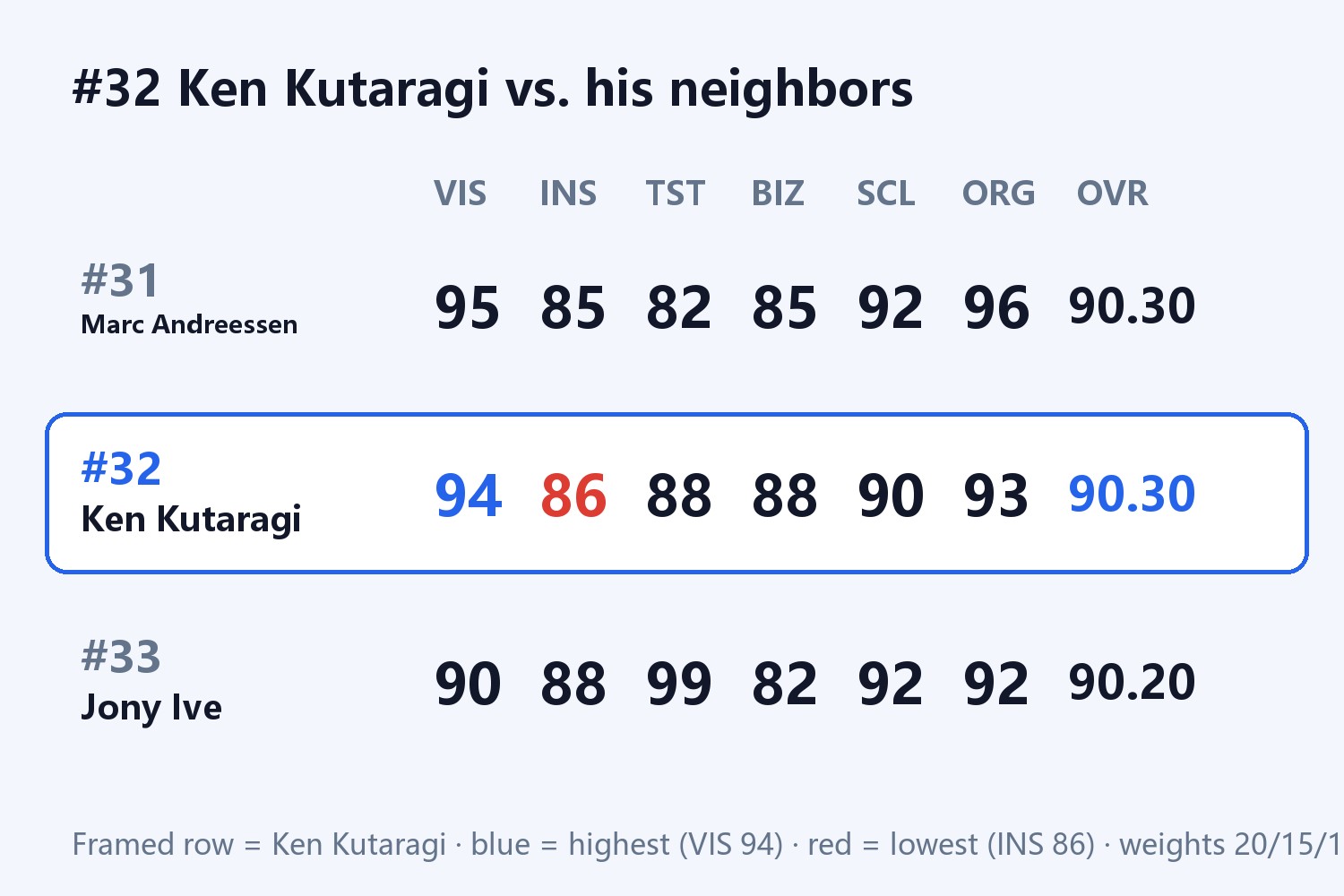
In the 100 Product Managers Who Changed the World framework, Ken Kutaragi earns a weighted overall score of 90.30 (displayed as 90), tying with Marc Andreessen (#31) and ranking #32 overall:
1. Vision: 94 (Highest Dimension)
In 1989, when everyone else saw consoles as cheap plastic toys, Kutaragi saw that real-time 3D graphics workstations would enter the living room through gaming first. His bets on 3D polygons (PS1) and DVD convergence (PS2) were each five years ahead of the industry curve.
2. Originality: 93
From the SNES SPC700 audio chip and the PS1’s 3D geometry engine to the iconic △ (Viewpoint), ○ (Yes), × (No), □ (Sheet/Menu) controller language (designed with Teiyu Goto) and the PS3’s heterogeneous Cell broadband processor, Kutaragi repeatedly invented new hardware paradigms from scratch.
3. Scale: 90
Across the first three generations he personally architected (PS1 at 102M, PS2 at 160M, PS3 at 87M, plus 80M PSP handhelds), his hardware shipped more than 430 million units, laying the foundation for a PlayStation ecosystem that has now surpassed 550 million consoles worldwide.
4. Taste: 88 & Business: 88
He gave PlayStation a cool, mature, futuristic aesthetic — from the hauntingly resonant PS1 boot chime to the monolithic black vertical tower of the PS2. Commercially, his decision to replace $15 proprietary cartridges with $1 CD-ROMs rewrote the unit economics of game publishing and turned SCE into Sony’s profit engine.
5. Insight: 86 (Lowest Dimension)
Like many uncompromising hardware visionaries, Kutaragi’s greatest strength eventually became his blind spot. High on the triumph of PS1 and PS2, he over-engineered the PlayStation 3 (2006) with the notoriously difficult-to-program Cell processor and an expensive Blu-ray drive, launching at a punishing $599. When consumers balked at the price, Kutaragi infamously remarked that people would “work more hours to buy one” — a lapse in consumer empathy that allowed Nintendo’s Satoru Iwata (#35) to blindside Sony with the $250 Wii.
Epilogue
On that June morning in Chicago in 1991, when Nintendo left Sony humiliated on stage in front of the global press, every rational executive in Tokyo wanted to bury the PlayStation name forever.
Ken Kutaragi refused to back down — and in doing so, proved that the greatest products inside giant corporations are rarely born from boardroom consensus; they are forged by the stubbornness of a single rebel who refuses to let the future die.
Discussion