100 Product Managers Who Changed the World · #28: Liang Wenfeng
If you were to search global tech over the past two years for the leader who least resembles a traditional tech celebrity, Liang Wenfeng would be the purest example.
He rarely delivers soaring keynotes on convention stages, virtually never grants profile interviews to mainstream lifestyle media, and you would struggle to find a single high-resolution press photo of him in a bespoke business suit.
Yet this quiet quant hedge fund founder, operating almost entirely behind the scenes, published a handful of technical papers and open weights between 2024 and 2025 that gave Silicon Valley titans months of sleepless nights:
While OpenAI’s Sam Altman courted sovereign wealth funds for $7 trillion to finance chip foundries, Liang and a team of a few dozen young engineers trained frontier reasoning models that rivaled or exceeded closed benchmarks in mathematics and code for under $6 million.
While incumbent cloud providers charged dozens of dollars per million tokens, he drove inference pricing down to pennies — shattering the monopoly profit margins of artificial intelligence and forcing an industry-wide price collapse.
For the first time, he forced the global tech establishment to reckon with an undeniable truth: at the cutting edge of frontier AI, Chinese engineers were not just fast followers, but masters of first-principles systems engineering capable of rewriting the cost equation of intelligence.
The Compute Hacker: From Quant Hunter to DeepSeek
Many in the West initially dismissed DeepSeek’s breakthroughs as an anomaly or lucky gamble. But examining Liang’s background reveals a calculated, fifteen-year technological march.
After graduating in Electronic Information Engineering from Zhejiang University, Liang avoided the crowded business models of consumer internet portals. Instead, he plunged into quantitative trading — a crucible where algorithmic efficiency, compute throughput, and latency dictate survival.
His firm, High-Flyer, climbed into the top tier of China’s multi-billion-dollar quantitative hedge funds through ruthless mathematical execution.
While other financial institutions leased generic cloud servers, High-Flyer took an audacious step: they built their own 10,000-GPU supercomputing clusters, “Firefly I” and “Firefly II.”
Long before generative AI became a buzzword, Liang recognized the profound implications of scaling laws. When ChatGPT triggered the global frenzy in early 2023 and thousands of entrepreneurs rushed to build chat wrappers, Liang made a contrarian move: he created an independent research laboratory — DeepSeek.
His goal was disarmingly simple, austere, and almost unfashionably idealistic: to discover the most direct path to Artificial General Intelligence (AGI), and to release the findings as open source.
Asymmetric Strike: Piercing the Silicon Valley Bubble
Before DeepSeek arrived, frontier AI development in the West had settled into a form of brute-force excess: if benchmarks plateaued, buy more chips; if intelligence lagged, multiply parameters. It became an arms race accessible only to trillion-dollar tech balance sheets.
Liang Wenfeng and his engineers took an entirely different philosophical path: extract efficiency from mathematics; reclaim margin from architecture.
First, Multi-head Latent Attention (MLA). The primary bottleneck in transformer inference is KV Cache bloat. As context windows expand, video memory fills with intermediate attention states, tanking concurrency and driving costs through the roof. DeepSeek devised a low-rank joint compression projection that compressed KV Cache footprints by upwards of 90%, enabling single GPUs to handle multiples of their former concurrent loads.
Second, Fine-Grained Mixture of Experts (DeepSeekMoE). While competitors relied on eight coarse expert networks, DeepSeek-V2 and V3 routed computations through 64 or more specialized sub-experts without auxiliary loss overhead. By activating only a fraction of weights per token, it delivered the intelligence of a massive model at the operational cost of a compact one.
Third, FP8 Mixed-Precision Infrastructure. Despite industry skepticism that 8-bit floating-point training risked explosive gradient instability, DeepSeek wrote custom CUDA communication kernels from scratch, achieving rock-solid FP8 mixed-precision training and halving memory and bandwidth overhead.
In May 2024, DeepSeek-V2 debuted at roughly $0.14 per million input tokens.
Within days, Alibaba, Tencent, Baidu, and ByteDance cut their API rates in half and then half again. Frontier AI in China stopped being an expensive enterprise luxury and became cheap infrastructure accessible to every independent developer.
The R1 Shockwave: Pure Reinforcement Learning Upends the Moat
If DeepSeek-V3 proved that Chinese teams possessed world-class engineering chops, the release of DeepSeek-R1 in early 2025 marked a leap from engineering optimization to scientific discovery.
Previously, complex chain-of-thought reasoning was thought to require millions of dollars in supervised fine-tuning (SFT) hand-curated by armies of human specialists. OpenAI treated the distillation behind its o1 model as an existential trade secret.
Liang Wenfeng and his team took the opposite approach:
They proved that large-scale reinforcement learning (RL) alone, without human-labeled reasoning data, could induce spontaneous self-correction, backtracking, and multi-step reasoning.
Even more consequential for global science: DeepSeek published its full technical report, openly disclosing the cold-start tricks, multi-stage pipelines, and distillation architectures, alongside free, unencumbered open model weights.
In the week following R1’s release, open-source communities erupted. Thousands of derivative models flooded Hugging Face, while public markets shuddered over the realization that inference costs had been compressed by an order of magnitude.
Microsoft CEO Satya Nadella publicly acknowledged DeepSeek’s technical brilliance, while Meta CEO Mark Zuckerberg positioned DeepSeek as a peer rival to Llama.
With pure technical substance, Liang Wenfeng proved that the closed-source AI moat was far more fragile than Silicon Valley believed.
Six-Dimensional Score Breakdown
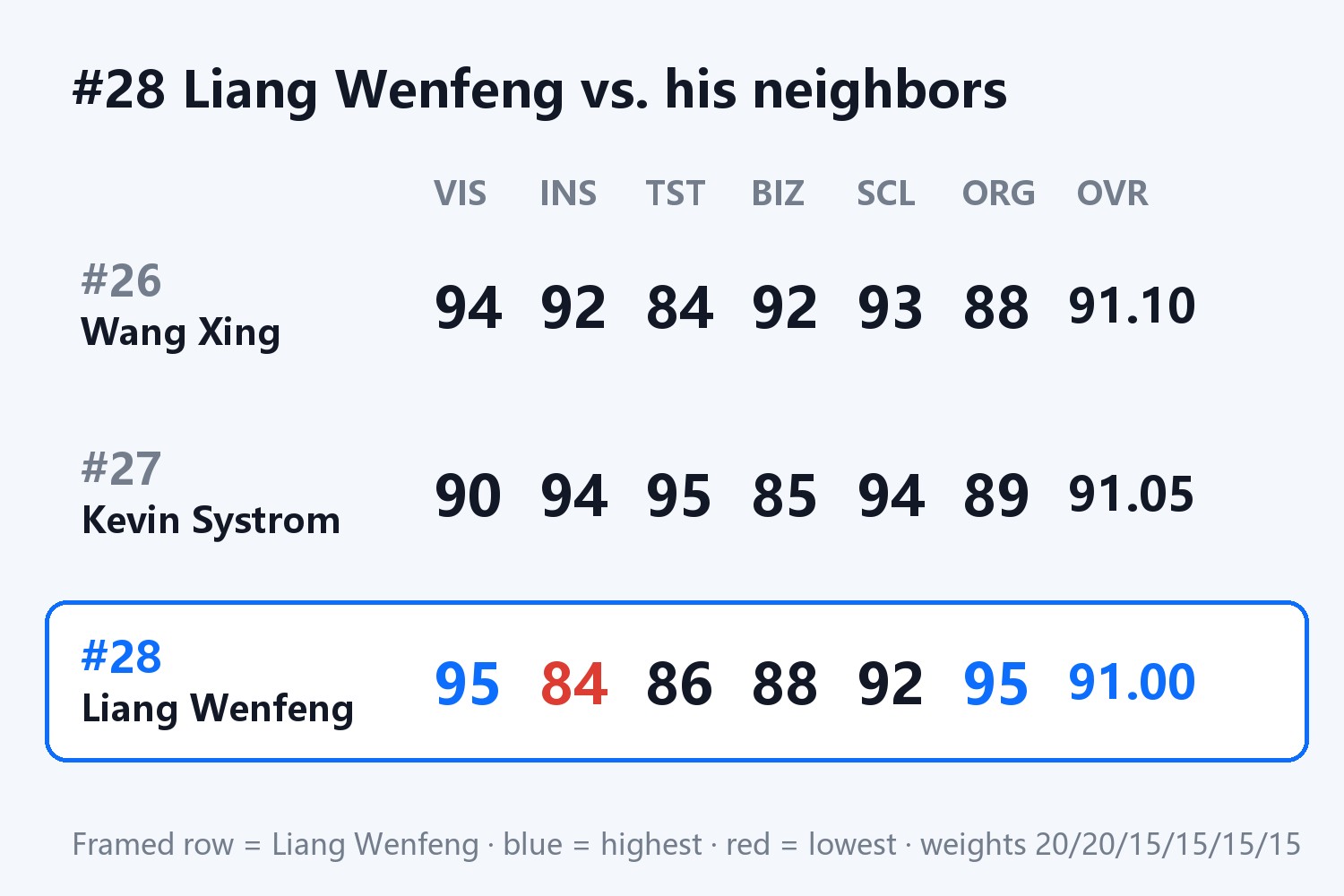
In the 100 Product Managers Who Changed the World ranking, Liang Wenfeng scores an overall 91.00, placing him at #28 in the “Legend” tier:
1. Vision: 95
While competitors treated quantitative finance as a short-term cash engine, he anticipated the primacy of private GPU infrastructure. While peers chased consumer chat wrappers, he invested in foundation models. While the industry worshiped brute-force compute, he bet on fine-grained MoE and pure reinforcement learning. His strategic trajectory shows extraordinary foresight.
2. Organization / Execution: 95
Unmatched engineering density and authentic hacker culture. With no corporate bureaucracy, no matrixed management layers, and a core research team of only several dozen contributors, DeepSeek moves faster than divisions of thousands. It represents a masterclass in elite engineering velocity.
3. Scale: 92
As open-source artifacts, DeepSeek’s weights and distillations run on tens of millions of developer machines, cloud environments, and academic workstations worldwide. It has established itself as the most formidable open-source AI force alongside Meta’s Llama.
4. Business: 88
His ruthless cost reduction democratized the economics of AI globally, giving open ecosystems the tools to counter proprietary monopolies. The deduction (12 points) reflects commercial strategy: DeepSeek prioritizes open-source distribution and bare-metal API pricing over aggressive monetization. Its mission is to disrupt existing monopolies rather than extract short-term surplus, relying on High-Flyer’s financial base to underwrite capital expenditures.
5. Taste: 86
A relative low point on his radar. DeepSeek’s web and mobile interfaces adhere to stark utilitarianism: a blue whale icon, a plain input field, and standard chat bubbles. It lacks emotional warmth, refined micro-interactions, or elevated visual design. It functions as an unadorned precision tool rather than a cultural artifact.
6. Insight: 84 (Lowest Dimension)
Liang’s genius lies in mathematical rigor, computational efficiency, and physical systems engineering, not the nuanced intuition of human consumer psychology. Unlike Steve Jobs or Allen Zhang, whose creations tapped deeply into emotional loneliness, social vanity, and human fragility, Liang’s products address logic, code, and truth directly. In understanding consumer vulnerability and mass cultural sentiment, his work displays an honest engineering blind spot.
Conclusion
In an era of performative tech hype, many measure founders by venture funding totals, bombastic press events, and paper valuations.
Liang Wenfeng offers a quieter, sturdier model:
A craftsman who devotes his waking hours to loss functions, compute clusters, and mathematical convergence. He shattered the myth that frontier AI requires boundless American capital, providing a sovereign, rigorous blueprint for what deep technical leadership can achieve.
The product managers who change the world include both the artists who design the human interface and the architects who decode the machinery underneath. Liang Wenfeng has earned the deepest respect of the global engineering community.
Discussion