100 Product Managers Who Changed the World · #24: Colin Huang
On August 24, 2026, PDD Holdings reported second-quarter results: revenue of 112.4 billion yuan, up 8% year over year, and net income attributable to shareholders of 27.18 billion yuan, down 12%.
The company runs two products: Pinduoduo in China and Temu outside it. In 2024 it had revenue of $54 billion and net income of $15.4 billion.
The man who built it has been gone for five years. Colin Huang stepped down as CEO in 2020 and as chairman in 2021. From Pinduoduo’s launch to his departure was five and a half years.
Hangzhou Foreign Languages School, Zhejiang University, Google
Huang was born in 1980 on the outskirts of Hangzhou. His parents were factory workers. He attended Hangzhou Foreign Languages School, graduated in 1998, and went on to study computer science at Zhejiang University’s Chu Kochen Honors College.
While at university he met Duan Yongping through NetEase founder Ding Lei. Duan became a lasting influence: one of Pinduoduo’s core values is “benfen”, roughly “doing what you are supposed to do”, a word from Duan’s own management philosophy.
In 2004 he earned a master’s in computer science from the University of Wisconsin-Madison and joined Google as an engineer. In 2006 he went back to China with Kai-Fu Lee to work on Google China. That same year Duan paid $620,000 for a charity lunch with Warren Buffett, and Huang was one of the people who went with him.
Four companies, and the first three were not Pinduoduo
In 2007 he left Google and started Ouku, an online electronics store, which he sold in 2010 for $2.2 million.
After that he ran Leqi, which operated stores on Chinese e-commerce platforms for overseas brands, and then a game studio, Xunmeng. These gave him two things: an understanding of how e-commerce platforms work and where their traffic comes from, and an understanding of what makes people hooked on a game and willing to share it.
In April 2015 he launched Pinhaohuo, which sold fruit. A product only went on sale once 3 or 5 people had joined the group, and then at a lower price. Pinhaohuo bought and shipped the goods itself and carried only twenty or thirty products.
In September 2015 the Xunmeng team launched Pinduoduo with a different model: the platform did not sell anything itself, third-party merchants listed any kind of product, and group buying stayed. In September 2016 the two companies merged, with Huang as chairman and CEO.
One product decision: let buyers do the recruiting
By 2015, Taobao, Tmall and JD had divided up China’s e-commerce traffic between them. For any new platform, the most expensive thing was buying users.
Pinduoduo’s answer was to have buyers bring in other buyers. Each product had a single-purchase price and a lower group price. To get the group price, you shared the link in WeChat groups or with relatives and friends, and the deal only went through once enough people joined.
The design turned buyers into salespeople. With almost no advertising spend, the platform reached people Alibaba and JD had not paid much attention to: small towns, rural areas, the most price-sensitive shoppers.
In June 2018, in his letter to shareholders before the IPO, Huang wrote that Pinduoduo should be “a combination of Costco and Disney”: a place where people get the best value for their money and also have fun.
What followed:
| Date | Event |
|---|---|
| September 2015 | Pinduoduo launches |
| July 2016 | $110 million Series B, investors include Tencent |
| September 2016 | Pinduoduo and Pinhaohuo merge |
| July 26, 2018 | Nasdaq listing raises $1.6 billion; Huang owns about 46.8% |
| End of 2020 | 788.4 million annual active buyers, more than Alibaba’s 779 million |
| September 2022 | Temu launches in the US |
Launch to IPO took less than three years. Launch to more annual active buyers than Alibaba took just over five.
After the listing, China’s market regulator announced an investigation into Pinduoduo over criticism about counterfeit goods. The company took down large numbers of listings, closed stores and promised ten-fold compensation for fakes.
Temu: taking the same playbook abroad
In September 2022 the same parent company launched Temu in the US. It kept the Pinduoduo formula: very low prices, goods shipped straight from factories, and discounts for bringing in other users. In 2023 PDD Holdings moved its registered office from Shanghai to Dublin.
By then Huang was gone. On July 1, 2020 he handed the CEO role to co-founder Chen Lei, and on March 17, 2021 he stepped down as chairman and gave the voting rights of his shares to the board. He said he would do research in food science and life sciences. Before that, he and the founding team had donated 2.37% of the company’s shares to set up the Starry Night charitable foundation.
Why he ranks #24
| Dimension | Score | Why |
|---|---|---|
| Vision VIS | 93 | In 2015 he judged that e-commerce’s next wave was in the people Alibaba and JD were not serving, and inside WeChat’s social graph |
| Insight INS | 96 | His highest. He saw that price-sensitive people will recruit friends for a small discount, and that “cheap” and “fun” can live in one product |
| Taste TST | 82 | His lowest. Pinduoduo won on price and spreading mechanics, not on design or brand; the counterfeit criticism around the IPO also costs points here |
| Business BIZ | 95 | Hundreds of millions of users with almost no ad spend; net income of $15.4 billion in 2024 |
| Scale SCL | 93 | 788.4 million annual active buyers at the end of 2020, plus Temu overseas |
| Originality ORG | 86 | Group buying existed before him. What he pioneered was putting it inside WeChat relationships so buyers recruit for the platform |
Overall OVR 91.25, ranked #24.
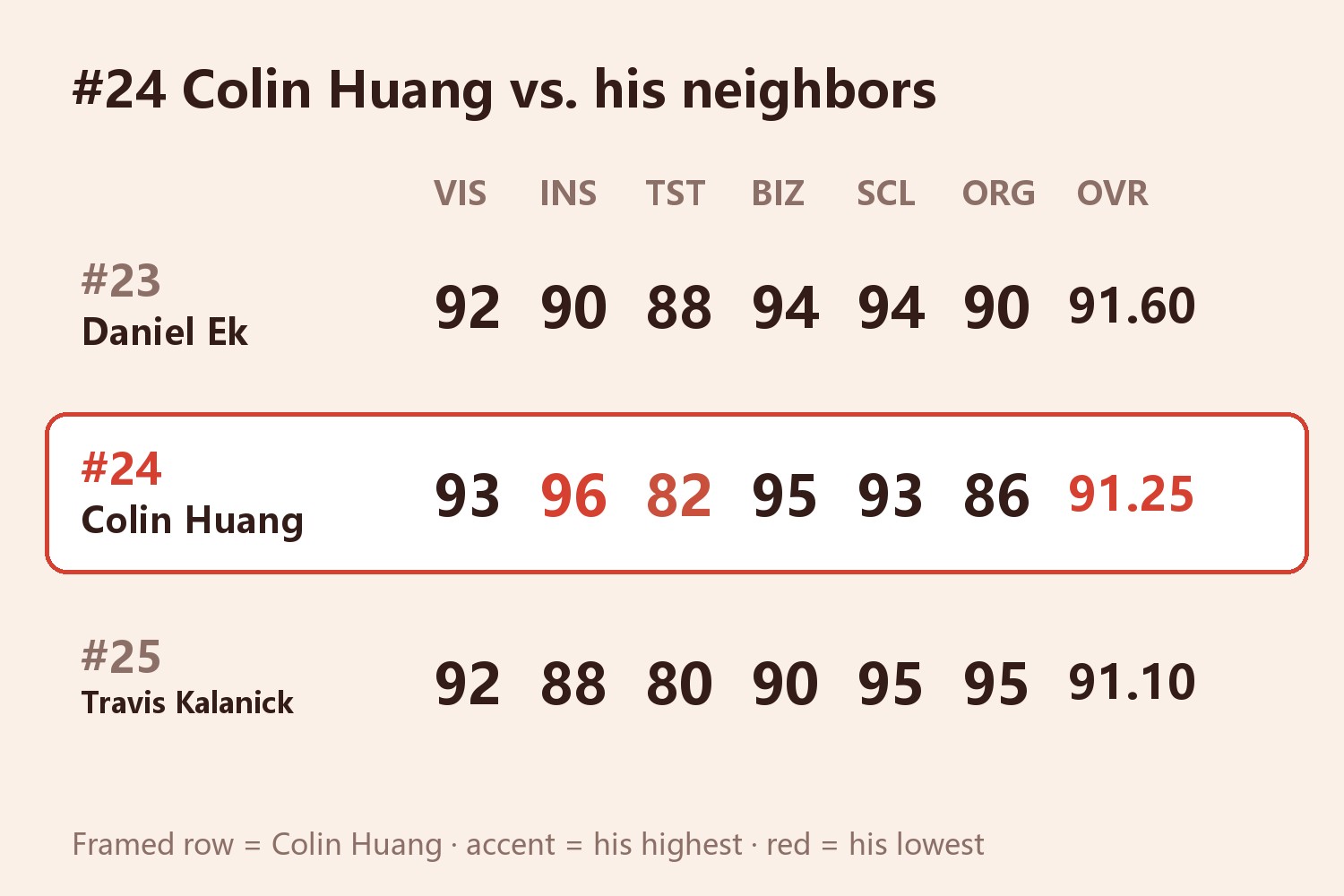
He ranks behind #23 Daniel Ek (91.60) by 0.35.
Both won through a business model. Huang scores higher on insight (96) and business (95); Ek scores higher on taste (88 to 82) and originality (90 to 86). Ek got the hardest deal in the business signed. Huang found the overlooked people in a market everyone thought had no room left.
He ranks ahead of #25 Travis Kalanick (91.10) by 0.15. Kalanick scores higher on originality (95) and scale (95), because Uber built ride-hailing from scratch; Huang wins on insight, 96 to 88, a gap of 8 points.
Huang left Pinduoduo in 2021. The product decision he left behind still runs inside both Pinduoduo and Temu: let the buyers recruit for the platform.
All scores and rankings in this article were produced by Claude (AI).
The cover is a self-drawn graphic; no photographs were used.
Sources: birth year and place, parents’ occupations, Hangzhou Foreign Languages School, Zhejiang University’s Chu Kochen Honors College, the Wisconsin master’s degree, joining Google in 2004, returning to China with Kai-Fu Lee in 2006, Ouku’s 2010 sale for $2.2 million, the July 2018 Nasdaq listing raising $1.6 billion, stepping down as CEO on July 1, 2020 and as chairman on March 17, 2021 with the transfer of voting rights, and the 2.37% share donation are from the English Wikipedia article “Colin Huang”. Meeting Duan Yongping through Ding Lei, Duan’s $620,000 Buffett lunch in 2006 with Huang attending, Pinhaohuo’s founding in April 2015, the September 2016 merger, the 46.8% stake at listing and the foundation’s research focus are from the Chinese Wikipedia article on Huang. Pinduoduo’s September 2015 launch incubated by Xunmeng and the July 2016 $110 million Series B are from 36Kr’s report of September 12, 2016. Pinhaohuo’s 3- or 5-person groups and its twenty or thirty products are from OFweek (July 17, 2024) and Sina Finance (March 26, 2021). “A combination of Costco and Disney” is from Pinduoduo’s June 2018 letter to shareholders. Buyer-driven recruiting with almost no ad spend, the end-2020 figures of 788.4 million versus Alibaba’s 779 million, Temu’s September 2022 launch, the 2023 move to Dublin, 2024 revenue and net income, and the counterfeit criticism with ten-fold compensation are from the English Wikipedia article “Pinduoduo” and the reports it cites. Q2 2026 figures are from PDD Holdings’ announcement of August 24, 2026. The ranking scores product decisions.
Discussion