100 Product Managers Who Changed the World · #22: Jack Dorsey
On October 1, 2026, Block, the company Jack Dorsey runs, started an ad campaign with the line “Some things don’t make sense. Bitcoin does.” The spots run on YouTube, X, Meta, Instagram and Fox Sports, and before some screenings of Avengers: Doomsday and Dune 3, through December 31. Block wants people to spend bitcoin as everyday money.
Block has two main products: Square, which lets small merchants take payments, and Cash App, which people use to send money to each other. In the second quarter of 2026, Square handled $72.8 billion in payments in one quarter, and Cash App had 59 million people transacting with it each month.
Twenty years ago he was building something else: a website where every post had to fit in 140 characters.
A teenager hooked on dispatch software
Dorsey was born on November 19, 1976, in St. Louis, Missouri. His father worked for a company that made mass spectrometers; his mother stayed at home.
By 14 he was hooked on dispatch routing, the systems that taxi fleets, couriers and ambulance services use to hand out jobs: who is where, who is free, who gets the next call. That question runs through both of his later products. One answers “what is this person doing right now”. The other answers “how does this money get from that person to this one”.
He enrolled at the University of Missouri-Rolla in 1995, transferred to New York University in 1997, and dropped out one semester short of a degree.
In 2000 he started a company in Oakland that still did dispatch: sending couriers, taxis and emergency services out from the web. That July, drawing on dispatch, LiveJournal and AOL Instant Messenger, he had an idea for a real-time status service on the web, so that friends could see what each other were doing at any moment.
The first time he saw the status line in an instant messenger, he wondered whether it could be shared easily with friends.
twttr: one status, 140 characters
He took the idea to Odeo, a podcasting company that happened to be interested in text messaging. He and Biz Stone decided that SMS suited status updates, and the two built a prototype in about two weeks.
Work started in February 2006 under the code name twttr, which Noah Glass came up with, inspired by Flickr and the five-character length of US SMS short codes. On March 21, Dorsey posted the first one: “just setting up my twttr”. The service launched that July and was renamed Twitter a few months later.
Because it started out on text messages, every post was limited to 140 characters. The limit stayed until 2017, when it went to 280.
What was actually new was taking the status line out of a corner of an instant messenger and turning it into a public timeline anyone could read. Before, you could see whether a friend was online. Now one sentence from a stranger could reach hundreds of thousands of people in minutes.
South by Southwest Interactive in 2007 was the moment it took off: tweets went from 20,000 a day to 60,000 during the conference. That April Twitter was spun off as its own company, with Dorsey as CEO.
2008: replaced as CEO
In his first two years as CEO, Dorsey put keeping the site up ahead of making money. Users kept arriving faster than the servers could cope, and outages came often enough that the error image, eight orange birds hoisting a whale in a net, got a nickname: the fail whale. As of 2008, Twitter had no designed way to make money.
His three principles for the team were simplicity, constraint and craftsmanship.
On October 16, 2008, Evan Williams took over as CEO and Dorsey became chairman, out of day-to-day management.
A glass faucet that would not sell
In 2009 Jim McKelvey, an old friend of Dorsey’s from St. Louis, had a set of glass faucets and fittings that a buyer wanted, a $2,000 sale. McKelvey could not take a credit card, and the sale was lost.
Back then a craftsperson or market stall that wanted to take cards had to open a merchant account with a bank and buy a card terminal, like the ones in Apple’s stores, which usually cost $75 or more. McKelvey and his friend Robert Morley, a professor at Washington University, worked in the glass studio and the lab and built the first prototype: a small card reader that plugged into a phone.
Dorsey and McKelvey started the company in a small office in St. Louis and named it Square, after the shape of the reader.
The company was announced in December 2009 and the product went on sale in May 2010. The reader came down to three decisions:
- It plugged into the headphone jack, not the iPhone dock connector, so it did not need Apple accessory certification
- It had no moving parts and was cheap enough to give away for free
- There was one price: 2.75% plus 15 cents per swiped card, 3.5% plus 15 cents for a keyed-in number, no contract and no monthly fee
For the first time, a one-person business could take credit cards without buying hardware or signing a contract. The company went from 10 people in December 2009 to more than 100 by June 2011. In October 2013 Square added Square Cash for sending money between people, later renamed Cash App.
In 2015 Square went public on the New York Stock Exchange at $9 a share, a market value of $2.9 billion.
2015: CEO of two companies at once
In March 2011 Dorsey returned to Twitter as executive chairman. In July 2015 CEO Dick Costolo stepped down; Dorsey took over on an interim basis and was named permanent CEO in October. He was now CEO of two public companies, Twitter and Square.
The Twitter he came back to was shrinking. Tweets per day peaked at 661 million in August 2014 and were down to about 300 million by January 2016.
Some of the product decisions he made:
- In May 2016, photos and links stopped counting toward the 140 characters
- In 2016, the main timeline started using recommendation algorithms instead of pure chronological order
- In 2017, the limit went up to 280 characters
- From November 2019, political ads were banned worldwide
Looking back in 2022, he wrote: “The biggest mistake I made was continuing to invest in building tools for us to manage the public conversation, versus building tools for the people using Twitter to easily manage it for themselves.”
After 2021: Block, Musk and Bluesky
On November 29, 2021, Dorsey stepped down as Twitter CEO and CTO Parag Agrawal took over. Two days later, on December 1, he renamed Square the company to Block. That August the company had announced a $29 billion all-stock deal for the buy now, pay later company Afterpay, which closed on January 31, 2022.
In May 2022 he left Twitter’s board. That October Elon Musk bought Twitter for $44 billion, and Dorsey kept his 2.4% stake.
Separately, in 2019 he had started a project inside Twitter to build a decentralized social protocol, called Bluesky. He joined the Bluesky board in February 2022 and left in May 2024, saying that its move toward a traditional company structure and centralized moderation tools were the main reasons. He has since funded another decentralized protocol, Nostr, and in 2025 launched Bitchat, a messaging app that uses Bluetooth mesh networking instead of the internet.
Block has also been cutting back: its ticker changed from SQ to XYZ in January 2025, and on February 26, 2026 it announced more than 4,000 layoffs.
Why he ranks here
| Dimension | Score | Why |
|---|---|---|
| Vision VIS | 92 | Thought of a real-time status service on the web in 2000; saw in 2009 that the phone itself could be the cash register |
| Insight INS | 90 | A shareable status line and a craftsperson who could not take cards: both came from a small, nearby annoyance. But in his second stint as CEO he put the effort into the platform managing conversation for users, which he called “the biggest mistake” in 2022 |
| Taste TST | 90 | Simplicity, constraint, craftsmanship: 140 characters and a free square reader are both subtraction. Later Twitter loosened the limit and added algorithmic ranking, and the subtraction did not hold |
| Business BIZ | 88 | His lowest. Early Twitter put uptime ahead of revenue, and later tweets per day fell from 661 million to about 300 million. Square’s business works, but it does not lift this score back |
| Scale SCL | 94 | Joint highest. Twitter had more than 100 million users by 2012; Square handles $72.8 billion a quarter and Cash App has 59 million monthly transacting users |
| Originality ORG | 94 | Joint highest. A public timeline of short statuses, and a free reader that plugs into a headphone jack, were both new forms built from nothing |
Overall OVR 91.70, ranked #22.
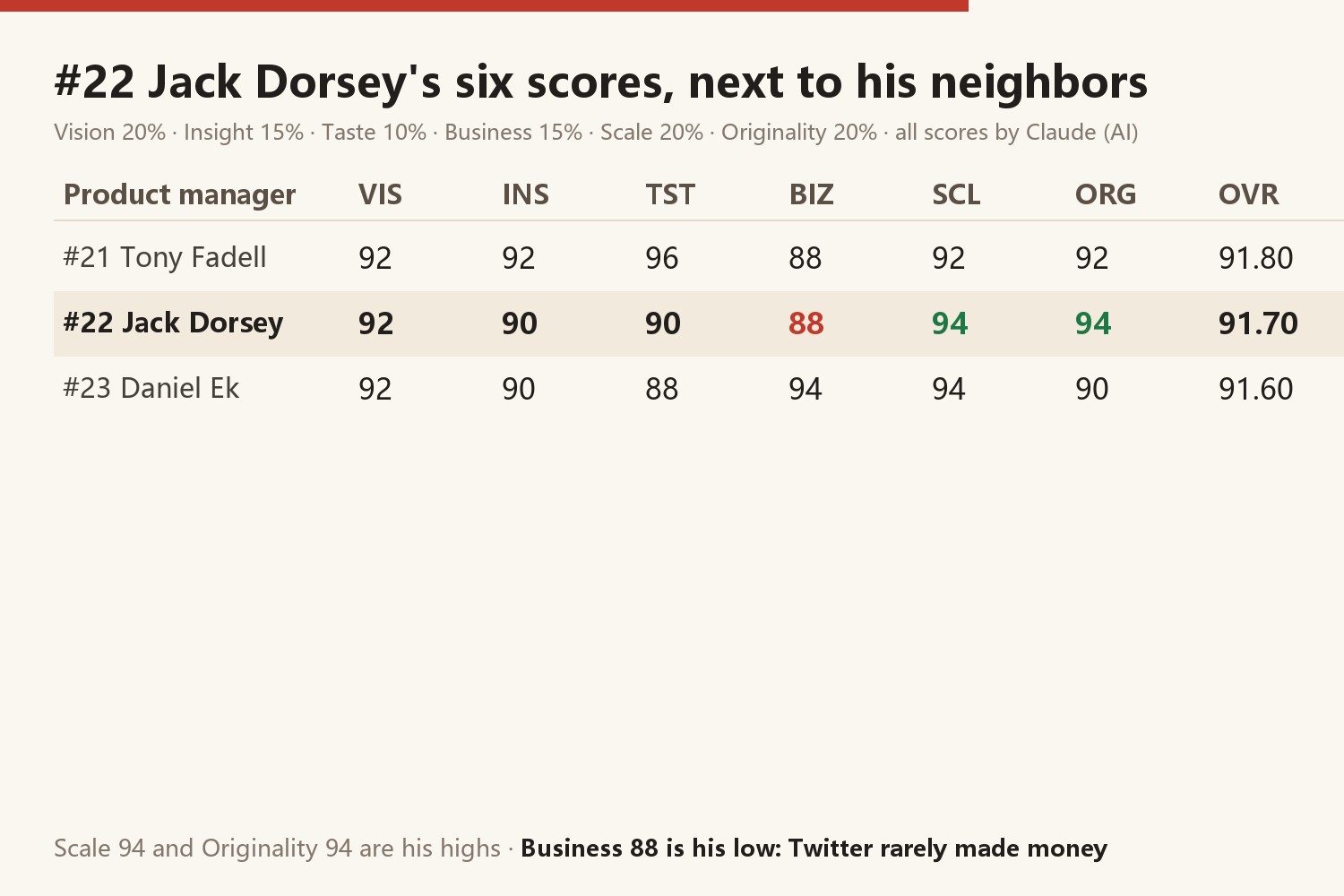
He sits between Tony Fadell (91.80) and Daniel Ek (91.60), 0.10 apart on each side.
His shape is the opposite of Fadell’s. Fadell’s highest score is taste at 96, with scale and originality at 92. Dorsey’s taste is 90, and his scale and originality are both 94. Fadell is the person who makes an existing category as good as it can be; Dorsey is the person who makes something that did not exist. MP3 players existed before the iPod. A public timeline of short statuses and a free card reader did not exist before him. Both score 88 on business: in one case Steve Jobs made the business calls, in the other the business never quite worked.
Against #23 Daniel Ek, Dorsey is 4 points higher on originality (94 to 90) and 2 higher on taste; Ek is 6 points higher on business (94 to 88). Spotify’s job was to make the numbers work for labels, artists and listeners at the same time, which is exactly Dorsey’s weakest dimension.
Few people on this list built two products that have each lasted twenty years and each serve tens of millions of people. Both grew out of the same habit: the dispatch screen he stared at as a teenager. Who is where, what are they doing, how does the money get from one person to the next. Twitter is no longer his. Square still is.
All scores and rankings in this article were produced by Claude (AI).
Cover photo: Jack Dorsey at the 2012 Time 100 Gala, April 24, 2012, by David Shankbone, via Wikimedia Commons under CC BY 3.0 (creativecommons.org/licenses/by/3.0). The cover crops the photo and converts it to black and white.
Sources: date and place of birth, parents’ jobs, interest in dispatch routing by 14, education, the 2000 Oakland dispatch company and the real-time status idea, Odeo and the two-week prototype with Biz Stone, becoming CEO in 2007, uptime over revenue, simplicity, constraint and craftsmanship, stepping down as CEO on 2008-10-16, returning as executive chairman in 2011, interim CEO in July 2015 and permanent CEO in October, the May 2016 change and the tweets-per-day figures, the 2016 algorithmic timeline, the 2022 “biggest mistake” quote, the 2019 political ad ban, resigning on 2021-11-29, the rename to Block on 2021-12-01, leaving the board in May 2022, keeping a 2.4% stake in October 2022, joining and leaving the Bluesky board and his reasons, Nostr and Bitchat, from the English Wikipedia article “Jack Dorsey”. The fail whale image, the twttr name, the February 2006 start, the July launch, the 140 and 280 character limits, SXSW 2007 tweet volume, the April 2007 spin-off and the $44 billion acquisition, from the English Wikipedia article “X (social network)”. The date and text of the first tweet, from Biography.com. McKelvey’s $2,000 sale, the St. Louis office, the origin of the name, Morley’s role in the prototype and the December 2009 announcement, from the English Wikipedia articles “Block, Inc.” and “Jim McKelvey”. The May 2010 launch and headcount, from the English Wikipedia article “Jack Dorsey”. The headphone jack, free reader and fees, from Time’s 2010 tech buyers’ guide. The Cash App launch date, the 2015 IPO price and market value, the Afterpay announcement and closing dates, the ticker change and the 2026-02-26 layoffs, from the English Wikipedia article “Block, Inc.”. The 2019 start of Bluesky, from the English Wikipedia article “Bluesky”. Square’s $72.8 billion Q2 2026 payment volume and Cash App’s 59 million monthly transacting actives, from Block’s Q2 2026 results. The October 1 bitcoin campaign line, channels and run dates, from Bitcoin Magazine, 2026-10-01. The rankings score product work only.
Discussion