100 Product Managers Who Changed the World · #20: Brian Chesky
Late September 2026, New York, the Skift Global Forum. Airbnb CEO Brian Chesky told the room he had become “a little less religious” about hotels.
Airbnb already lists more than 4,000 hotels, mostly boutique and independent ones, in New York, San Francisco and several Spanish cities, with Paris and London next. “At some point,” he said, Hiltons and Marriotts could be on Airbnb too.
It used to be different. Guests who wanted a hotel couldn’t find one on Airbnb, so they went to Booking and Expedia. At the same forum he put it this way: “We’ve gotten over a little bit of our religion of no commodities, but I will say the vast majority of our supply will always be unique.”
This company started as “not a hotel.” It started with a few air mattresses in a San Francisco living room.
Social workers’ son, industrial designer
Chesky was born on 29 August 1981 in Niskayuna, New York, the small town that is home to GE’s research center. His parents, Robert and Deborah, were both social workers.
After high school in 1999 he went to the Rhode Island School of Design (RISD) to study industrial design, and graduated with a BFA in 2004.
He then moved to Los Angeles and worked as an industrial designer at a firm called 3DID, designing toys, guitars and medical equipment.
That résumé comes up again and again later, because large Silicon Valley companies are rarely run by designers.
A design conference and some air mattresses
In October 2007 Chesky moved to San Francisco to share an apartment with his RISD classmate Joe Gebbia. They couldn’t make the rent.
That month the Industrial Designers Society of America (IDSA) was holding its conference in the city, and the hotels were full. The two of them put air mattresses in the living room, rented them to designers coming for the conference at $80 a person, and threw in breakfast.
They called it “Airbed & Breakfast.”
Nathan Blecharczyk, an engineer and Gebbia’s former roommate, was brought in to build the website. On 11 August 2008, airbedandbreakfast.com went live.
Almost nobody used it. The three of them pitched investors and were turned down, or simply got no reply.
Cereal at $40 a box
Summer 2008 was a presidential election year. The Democratic National Convention was in Denver, and the city was short of rooms.
They bought generic breakfast cereal and designed two boxes, “Obama O’s” and “Cap’n McCain’s,” each with a cartoon of the candidate. They sold them at $40 a box around the convention.
They took in about $30,000, which kept the website alive.
A few months later it helped get them into Y Combinator. Chesky has often retold how YC founder Paul Graham reacted: he wasn’t sold on the website, but people who could sell cereal for $40 a box were “cockroaches.” They wouldn’t die.
In January 2009 the three joined YC and got $20,000 for 6% of the company.
In March the name was shortened to Airbnb, dropping the part that made people think you could only sleep on an air mattress. By then the site had 10,000 users and 2,500 listings.
Door to door with a camera
During YC they saw that listings in New York converted badly. The reason was simple: hosts’ own photos were dark and blurry.
The three flew to New York and went door to door with a camera, shooting “professional” photos for hosts, signing up new ones and helping existing ones improve their listings.
When Graham wrote “Do Things That Don’t Scale” in July 2013, this was his lead example:
Airbnb now seems like an unstoppable juggernaut, but early on it was so fragile that about 30 days of going out and engaging in person with users made the difference between success and failure.
He also remembered that whenever they showed up for YC’s Tuesday dinners, they were pulling rolling bags, just back from somewhere.
The same year Greg McAdoo of Sequoia Capital invested $585,000. In the fall of 2010 Chesky formally became CEO.
”We have really screwed things up”
In June 2011 a San Francisco host known as EJ wrote on her blog that a guest who had booked through Airbnb had ransacked her apartment. A locked closet had been broken into. Her passport, cash, credit card, her grandmother’s jewelry and her birth certificate were gone, and there was bleach and fireplace ash all over the place.
TechCrunch picked up the story in late July. According to EJ, Airbnb had first told her it would not reimburse the damage and did not insure against losses. The coverage kept getting worse.
On 1 August, Chesky published an open letter. A few lines from it have been quoted ever since:
We have really screwed things up.
With regards to EJ, we let her down, and for that we are very sorry.
We weren’t prepared for the crisis and we dropped the ball.
The same letter announced a product: a $50,000 host guarantee. Property loss or damage from guest theft or vandalism would be covered by Airbnb, starting on 15 August and applying retroactively to hosts who had reported damage before 1 August.
Before this, a product that ran on trust between strangers left that trust entirely to its users. After it, the company began designing trust as part of the product: the guarantee, customer support, and later identity verification.
Snow White in 15 frames
Over the 2011 holidays Chesky read a biography of Walt Disney and learned that Disney had storyboarded Snow White before making it.
He hired a former Pixar animator, Nick Sung, to storyboard the whole Airbnb experience: 15 frames for the guest, 15 for the host, from first hearing about Airbnb, to checking in, to writing a review after leaving.
Inside the company the project was called “Snow White.” Every idea anyone had ever discussed went onto a sticky note under the frame it belonged to.
Once it was drawn, the team saw that most of the important moments happened offline: finding the keys, meeting the host, finding your way around a strange city. In those moments people were holding a phone, not sitting at a computer. Airbnb then made mobile its top priority.
Later, on Reid Hoffman’s podcast Masters of Scale, he described another exercise, the “11-star experience.” Write down what a 5-star check-in looks like, then 6 stars, 7 stars, all the way to 11. His 11-star version: you land at the airport, Elon Musk picks you up and takes you to space.
Eleven stars can’t be done. But somewhere on the way up from five there are a few stars that can be done and that nobody else is doing.
Cutting a quarter, then going public
In spring 2020 the pandemic brought global travel almost to a stop.
On 5 May Chesky announced that about 1,900 people, 25% of Airbnb’s 7,500 employees, would be laid off. He wrote that revenue that year was forecast to be less than half of 2019’s.
The letter spread widely in Silicon Valley because it was specific. US employees got 14 weeks of base pay plus one week for every year at Airbnb. The company paid 12 months of COBRA health insurance. It dropped the one-year equity cliff for everyone hired in the past year. A large part of the recruiting team became an Alumni Placement Team whose job was to find work for the people leaving. They could keep their Apple laptops.
In the same letter he paused Transportation and Airbnb Studios and scaled back Hotels and Lux, pulling the company back to one thing: homes.
On 10 December Airbnb listed on Nasdaq. The IPO was priced at $68 and raised $3.5 billion. The stock opened at $146 and closed at $144.71, up 113%.
Thirteen years after the air mattresses.
After the IPO, Airbnb had its first full-year profit in 2022: $1.893 billion in net income.
Getting rid of the “classic” product manager
On 22 June 2023, at Figma’s Config conference, Chesky said something that went off like a bomb among product managers:
The designers are equal to the product managers. Actually, we got rid of the classic product management function. Apple didn’t have it either. We combined product management with product marketing and we said that you can’t develop products unless you know how to talk about the products.
The next day he added: “I should have been more clear. We morphed the function into an Apple-style product marketing function.” On Lenny Rachitsky’s podcast he explained it again: what went away was the traditional PM role, and the new role is product management plus product marketing, defining the product inside and talking about it outside.
So a man who says his company got rid of the classic product manager ranks 20th among the 100 product managers who changed the world.
This list scores a person’s product decisions, not their job title. Chesky is Airbnb’s biggest product manager. The air mattresses, the photos, the host guarantee, the Snow White storyboard and the 2020 cuts were all product decisions.
Founder mode
In September 2024 Chesky spoke for two hours at a YC event about how he runs the company.
Paul Graham went home and wrote an essay called “Founder Mode.” It begins:
At a YC event last week Brian Chesky gave a talk that everyone who was there will remember. Most founders I talked to afterward said it was the best they’d ever heard. Ron Conway, for the first time in his life, forgot to take notes.
Graham’s summary of the talk: as Airbnb grew, well-meaning people told Chesky to “hire good people and give them room to do their jobs.” He followed that advice, and the results were disastrous. He had to work out a better way on his own, partly by studying how Steve Jobs ran Apple.
“Founder mode” has been Silicon Valley shorthand ever since. Roughly, it means the founder doesn’t hand product detail off to layers of managers but goes into the product personally, holds skip-level meetings and talks directly to the people doing the work.
It is the other side of the 2023 product-manager remark. In both cases the product decisions move back to the CEO and a small group around him.
The 2025 relaunch
In May 2025 Airbnb did a major relaunch. It added Airbnb Services, where you can book a private chef, a massage, a personal trainer, hair and makeup or a photographer, and rebuilt Airbnb Experiences.
It is Chesky’s second attempt to make Airbnb more than a place to book a room. The first was Experiences, launched in 2016, which never became a core business.
In 2025 Airbnb’s revenue was $12.2 billion and its net income $2.516 billion.
In September 2026, at the Skift forum, he said the relaunched Experiences business had finally clicked in one city, Paris, where bookings were up sixfold year over year. He also committed to launching Airbnb’s own AI agent next year.
He is 45 and still CEO.
Why he’s on the list
| Dimension | Score | Why |
|---|---|---|
| Vision VIS | 92 | In 2007 he bet that strangers would sleep in strangers’ homes, when almost every investor disagreed |
| Insight INS | 95 | Joint highest. He saw that listing photos, trust and the offline moments were what limited conversion |
| Taste TST | 95 | Joint highest. A designer by training; Snow White storyboards and 11-star experiences start from what the user goes through |
| Business BIZ | 90 | Fifteen years from founding to the first full-year profit; the 2020 retreat to the core business came first |
| Scale SCL | 89 | Lowest. Airbnb is big, but travel is low-frequency; a person books only a few times a year |
| Originality ORG | 93 | Turned “staying in a stranger’s home” from a niche couch-surfing habit into a global category, and made “host” a job |
Overall 92.05, ranked 20th.
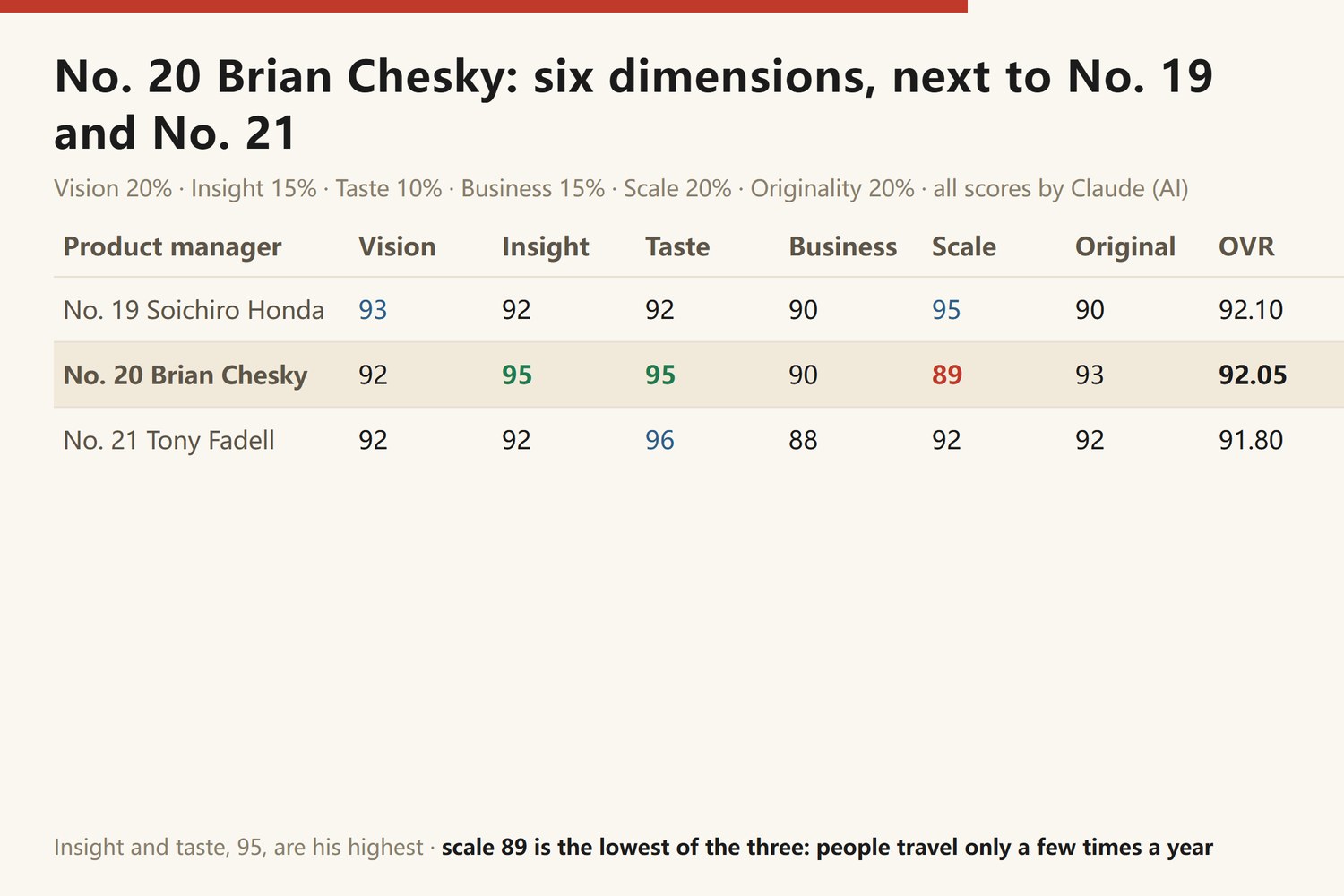
He sits between Soichiro Honda (92.10) and Tony Fadell (91.80), 0.05 behind the man above him.
Insight and taste, both 95, are his two highest scores. They are high because nearly all his key decisions came from watching how people use the product in real life: the door-to-door photos, the guarantee after EJ, the Snow White storyboard. None of those was a technical breakthrough. They are a designer’s working methods.
Scale, at 89, is his lowest score and the lowest of the three. Honda’s Super Cub is something many people ride every day, 100 million of them. Tony Fadell’s iPod and iPhone live in people’s pockets. Airbnb is used a few times a year, and that sets its ceiling.
Business, at 90, matches Honda. Airbnb lost money for years before its IPO. Only after the 2020 cuts, a quarter of the staff and every non-core project, did it post its first full-year profit, in 2022.
Against Honda he is 3 points higher on originality (93 to 90). Motorcycles already existed and Honda changed who they were sold to; short-term rental sites existed before Airbnb too, but Airbnb is the one that made staying in a stranger’s home a global category. He is 6 points lower on scale (89 to 95). Net, 0.05.
Against Fadell he is 3 points higher on insight (95 to 92), 1 point lower on taste (95 to 96) and 3 points lower on scale (89 to 92). Fadell’s taste lands on an object you can hold. Chesky’s lands on a whole service: booking, meeting, getting the keys, writing the review.
Every one of those air mattresses in 2007 was unique. Nineteen years later he told a forum that the vast majority of Airbnb’s supply always will be, and that Hilton is welcome too.
All scores and rankings in this article were produced by Claude (AI).
Cover photo: Brian Chesky speaking at the U.S. Department of State’s Gilman Scholarship Program luncheon, 12 September 2016, photographed by the U.S. Department of State, confirmed on Wikimedia Commons as public domain.
Sources: birth date and place, parents’ occupations, RISD degree and 3DID, becoming CEO in fall 2010 and Sequoia’s $585,000 are from the English Wikipedia article “Brian Chesky”; the October 2007 IDSA conference and $80 per guest, the 11 August 2008 launch, the $30,000 cereal money, YC’s $20,000 for 6% in January 2009, the March 2009 rename with 10,000 users and 2,500 listings, the May 2025 Services and Experiences launch and the 2022 and 2025 financials are from the English Wikipedia article “Airbnb”; $40 a box is from CNBC, 18 April 2023; Paul Graham’s lines on going door to door, the 30 days and the rolling bags are from his July 2013 essay “Do Things That Don’t Scale”; EJ’s account and Airbnb’s first response are from TechCrunch, 27 July 2011, and the 1 August letter, the $50,000 guarantee and its dates from TechCrunch, 1 August 2011; Snow White is from Fast Company and Sequoia Capital; the 11-star experience is from Masters of Scale; the 2020 layoff numbers are from CNBC, 5 May 2020, and severance, health insurance, equity, alumni placement and the business cuts from Chesky’s letter of the same day on the Airbnb newsroom; IPO price, proceeds, open and close are from CNBC and Yahoo Finance, 10 December 2020; the Config quote and next-day clarification are from multiple reports including Mind the Product and from Lenny Rachitsky’s podcast; the founder mode passages are from Paul Graham’s September 2024 essay “Founder Mode”; the 2026 Skift forum remarks on hotels, Experiences and the AI agent are from Skift, 23, 27 and 28 September 2026. The list scores product dimensions only.
Discussion