Taiichi Ohno: his product wasn't a car, it was the way to build one
In 1982 General Motors closed its assembly plant in Fremont, California.
Its workers were notorious. The English Wikipedia entry on NUMMI describes them as “considered the worst workforce in the automobile industry in the United States”: drinking and smoking marijuana on the job, frequently absent, some putting Coke bottles inside door panels.
Two years later the plant reopened as NUMMI, a joint venture between GM and Toyota. More than 85% of the people rehired were the same ones laid off in 1982.
What changed was the method. They began working under the Toyota Production System.
In December 1984 NUMMI’s first car rolled off the line, a yellow Chevrolet Nova. Soon the plant was running at the speed of Japanese factories, with Japanese-level quality.
Same people, different method. The chief designer of that method was Taiichi Ohno.
Dalian, Nagoya, a textile mill
Taiichi Ohno was born on 29 February 1912 in Dalian, China.
In 1932 he graduated from Nagoya Technical High School and joined Toyoda Spinning and Weaving. The Toyoda family’s main business was still looms and textiles.
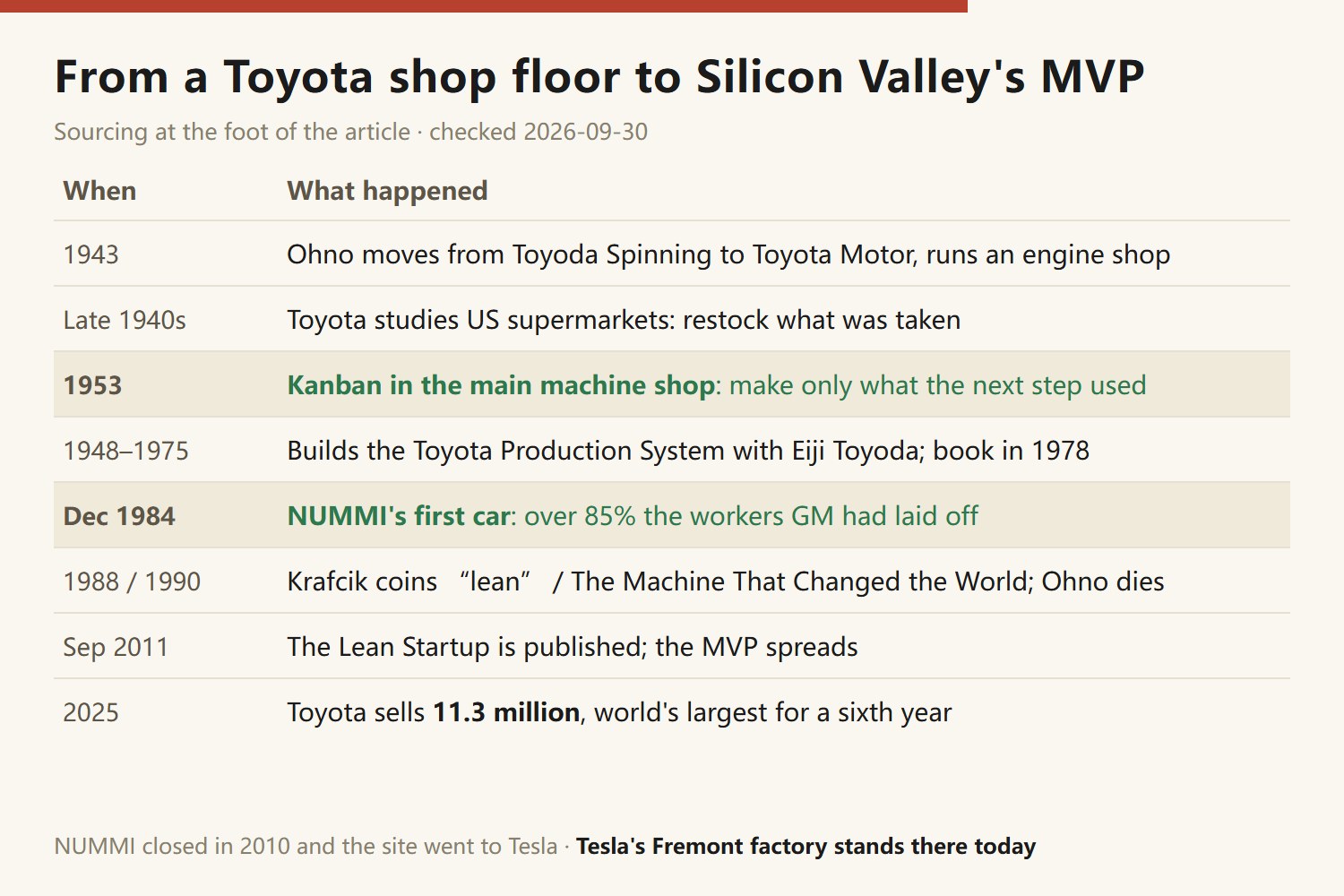
In 1943 he moved to Toyota Motor, working as a shop-floor supervisor in engine manufacturing.
Toyota was small then. Ford and GM had decades of assembly-line experience and far greater scale.
Toyota could not win by copying American mass production. Ohno went looking for another way.
Kanban, learned from supermarkets
Toyota’s founder Kiichiro Toyoda had already put forward an idea: make only what is needed, only when it is needed, and only in the amount needed. It became known as Just in Time.
Having the idea was one thing; doing it in a factory was another.
In the late 1940s Toyota began studying American supermarkets: shelves were restocked with exactly what customers had taken, no more and no earlier. Ohno saw in this what he wanted for the factory: not pushing production down from a plan, but having each step make only what the next step had used.
The tool was a card called a kanban. When a later process used up its parts, it took the kanban to the previous process to collect more; the previous process started the next batch only when it saw the kanban.
In 1953 Toyota put this to work in its main plant’s machine shop.
Between 1948 and 1975, Ohno and Eiji Toyoda refined these practices into what became the Toyota Production System: kanban, just-in-time, eliminating waste, and a rule that stops many people the first time they hear it: any worker on the line who sees a problem can stop the whole line.
A method that doesn’t rely on working harder
At the core of the Toyota Production System is the idea of waste. Inventory is waste. Overproduction is waste. Waiting, unnecessary transport and rework are waste.
American mass production aimed to run the machines flat out and maximise output; a bit of extra inventory didn’t matter.
The Toyota Production System took the opposite view: inventory isn’t an asset, it’s where problems hide. With parts piled up, defects go unnoticed; cut the inventory and whatever step is stuck shows up immediately.
The system was refined inside Toyota for more than twenty years. In 1978 Ohno wrote it up in a book, Toyota Production System; the English edition followed in 1988.
”Lean” was someone else’s word
In the US, the Toyota Production System came to be called “lean production”. The word wasn’t Toyota’s.
In 1988 a researcher named John Krafcik wrote an article titled “Triumph of the Lean Production System”, the first to use “lean” to describe Toyota’s methods. In 1990 MIT’s International Motor Vehicle Program published The Machine That Changed the World, which took “lean production” worldwide.
Taiichi Ohno died on 28 May 1990 in Toyota City, the same year the book came out.
From the shop floor to software: lean startup and the MVP
“Lean” later travelled beyond the car industry.
In 2008 Eric Ries proposed the “lean startup”, and in September 2011 published a book of the same name. The “lean” in the title comes from the Toyota Production System.
The book’s best-known term is the MVP, the minimum viable product: the version that lets a team learn the most about customers with the least effort, followed by a loop of build, measure, learn.
Put it next to Ohno’s shop floor and it’s the same thinking:
- Toyota: don’t produce a pile to a plan; make what the next step uses
- Lean startup: don’t build a big, complete product to a plan; build what users turn out to need
- Toyota: inventory hides problems
- Lean startup: six months of building without shipping hides problems too
When product managers say “let’s start with an MVP” or “move in small steps”, trace it back far enough and you reach the kanban cards on Taiichi Ohno’s shop floor.
What became of the plant
NUMMI ran until 2010. At 9:40am on 1 April 2010 its last car rolled off the line, a red Toyota Corolla.
On 20 May that year Tesla announced it would buy most of the former NUMMI site for $42 million. Tesla’s Fremont factory stands there today.
And Toyota? In 2025 Toyota, including Daihatsu and Hino, sold 11.3 million vehicles worldwide, the world’s largest carmaker for the sixth year running.
Why he ranks here
| Dimension | Score | Note |
|---|---|---|
| Vision VIS | 90 | He saw an alternative to mass production, though just-in-time began with Kiichiro Toyoda |
| Insight INS | 88 | His lowest. His subject was factories and processes, not the people buying the cars |
| Taste TST | 92 | Kanban, a single cord to stop the whole line: minimal designs |
| Business BIZ | 94 | Underpins Toyota’s run as the world’s best-selling carmaker, six years straight |
| Scale SCL | 93 | Spread from cars to manufacturing, hospitals and software development |
| Originality ORG | 96 | His highest. “Downstream decides what and how much gets made” turned mass production on its head |
Overall 92.30, ranked 18th.
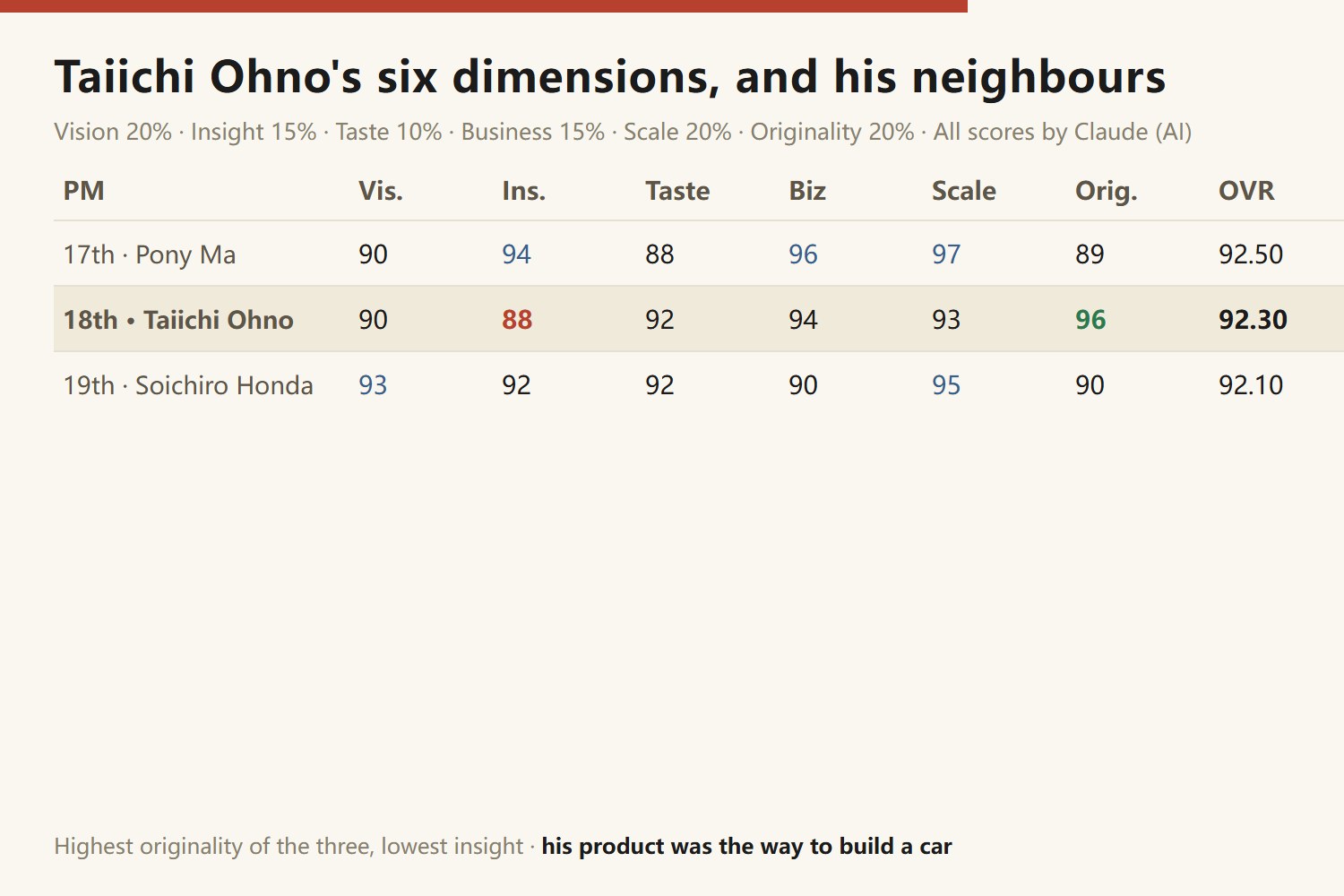
First, the placing. He sits between Pony Ma (92.50) and Soichiro Honda (92.10); the three are within 0.4 of each other.
His shape is the opposite of Pony Ma’s just above him: Pony Ma has originality 89 and scale 97, Ohno originality 96 and scale 93. One took existing things to more than a billion users; the other invented a method nobody had used before.
Insight 88 is his lowest. On this list “insight” measures understanding of user needs, and Ohno’s work was about shop floors, processes and inventory, not the people who bought the cars.
He is on a product-manager list because his product was never a car.
His product was the way to build one. Its users were workers and factories, and its most convincing test came in Fremont in 1984: the same workers considered the worst, given a different method, reached Japanese-level quality.
Product managers who say “MVP” today don’t necessarily know Taiichi Ohno’s name. They are using his method under a different name.
All scores and rankings were produced by Claude (AI).
Sourcing: Ohno’s date and place of birth, joining Toyoda Spinning in 1932, moving to Toyota Motor in 1943, the 1982 Order of the Rising Sun and his death on 28 May 1990 in Toyota City come from the English Wikipedia entry for Taiichi Ohno; the Toyota Production System built by Ohno and Eiji Toyoda between 1948 and 1975, just-in-time originating with Kiichiro Toyoda, and Ohno’s inspiration from American supermarkets come from the Toyota Production System entry; late-1940s supermarket study and the 1953 machine-shop kanban come from the Kanban entry; Krafcik’s 1988 article and The Machine That Changed the World (1990) come from the Lean manufacturing entry; the 1982 Fremont closure and its workforce, NUMMI’s first car in December 1984, over 85% rehired workers, Japanese-level quality, the 1 April 2010 closure and Tesla’s $42 million purchase come from the NUMMI entry; lean startup (2008, book September 2011) and the MVP definition come from the Lean startup entry; Toyota’s 11.3 million sales in 2025 and sixth year on top come from nippon.com and Bloomberg. The 1978 Japanese edition of Toyota Production System is public publishing information. The list scores product decisions, not people.
Discussion