Taobao: Free Storefronts, IM Haggling, and Escrow—How a SARS Quarantine Startup Flipped eBay's 72% China Monopoly in 24 Months
In April 2003, inside Apartment 202 of Building 16 at Lakeside Gardens in Hangzhou—the exact same bare-concrete flat where Jack Ma had founded Alibaba four years earlier—seven handpicked engineers and operators signed non-disclosure agreements and locked themselves inside.
Outside, the SARS epidemic had paralyzed China. Alibaba’s main headquarters was under quarantine after an employee returned from the Canton Fair with a suspected fever. Inside the apartment, led by Sun Tongyu and legendary coder Cai Jingxian (“Duolong”), the seven-person squad slept on camp cots, ate instant noodles, did handstands against the wall to stay awake, and built a consumer marketplace from scratch in less than a month.
On May 10, 2003, Taobao.com quietly went live. Because they had no sellers yet, the first 200 items listed on the site were personal knick-knacks the seven founders dug out of their own bedrooms.
At the time, Silicon Valley treated the project as a suicide mission. Just two months earlier, global juggernaut eBay had completed its $150 million acquisition of EachNet, commanding a crushing 72.4% share of China’s consumer e-commerce market. eBay signed exclusive multi-million-dollar ad blockades across China’s top three web portals (Sina, Sohu, and NetEase) so Taobao couldn’t even buy a banner ad, and executives famously predicted that Taobao would be dead within 18 months.
Instead, within 24 months (by late 2005), the scoreboard had completely inverted: Taobao held 72.2% of China’s C2C e-commerce market, while eBay EachNet had collapsed to 26.7%—forcing eBay’s eventual retreat from China in 2006.
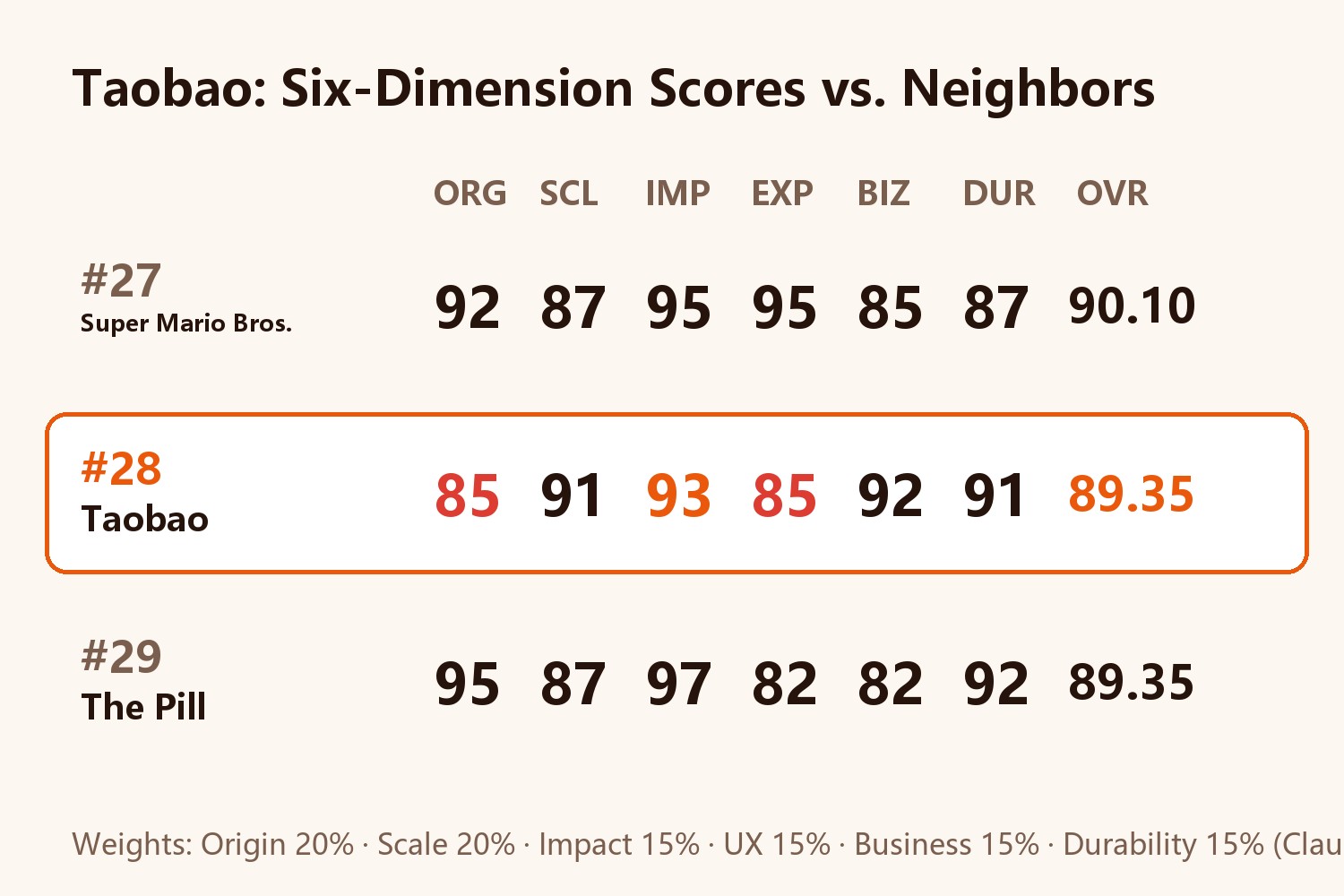
In our ranking of the 100 Products That Changed the World, Taobao stands at #28 with an overall score of 89.35 (scored by Claude AI under our unified six-dimension framework): 93 in Impact, 92 in Business, 91 in Scale, 91 in Durability, 85 in Originality, and 85 in Experience.
How did a seven-person apartment project defeat the richest e-commerce empire on earth? Because eBay imported an American garage-sale auction template, while Taobao built three product mechanisms tailored to Chinese reality: free storefronts, live IM haggling, and escrow payments.
1. Masterstroke #1: Zero Listing Fees Against eBay’s Pay-to-List Wall
To understand why eBay stumbled in China, you have to look at how eBay made money.
In the United States, brick-and-mortar retail was already dominated by Walmart, Target, and national mall chains. Americans used eBay primarily to auction off second-hand collectibles from their attics. Consequently, eBay charged sellers two mandatory fees:
- An upfront insertion fee just to list an item for 14 days (whether it sold or not);
- A final value commission of 2% to 8% when the item sold.
In 2003 China, however, national retail chains barely existed outside major coastal cities. The people who wanted to sell online weren’t suburban homeowners clearing out attics—they were millions of small family workshops and street-market vendors in Yiwu, Hangzhou, and Guangzhou looking for a digital storefront. Asking a small apparel vendor with 300 SKUs to pay upfront listing fees every two weeks before making a single sale was a non-starter.
In July 2003, Taobao dropped a bomb on the market: 100% free store creation, free item listings, and zero transaction commissions for three full years.
When eBay blocked Taobao from advertising on major portals, Taobao bought cheap banner slots across tens of thousands of grassroots Chinese bulletin boards (BBS), anime forums, and parenting communities—surrounding eBay’s castle from the bottom up.
| Product Dimension | eBay EachNet’s Silicon Valley Playbook (2003–2005) | Taobao’s Local Counter-Design | Market Chain Reaction |
|---|---|---|---|
| Listing & Transaction Fees | Upfront listing fee per item + 14-day expiry + sales commission | 100% Free for 3 Years (unlimited SKU listings, zero commission) | Millions of small shopkeepers and power sellers migrated en masse from EachNet to Taobao |
| Buyer–Seller Communication | Strictly blocked direct chat to prevent off-platform fee evasion | Built-in AliWangwang live IM with voice, emojis & instant price editing | Turned cold web forms into a bustling bazaar where buyers could haggle in real time |
| Stranger Payment Trust | Wire money or mail a postal order first, then pray the seller ships | Alipay Escrow (Oct 2003): platform holds funds until buyer confirms delivery | Conversion rates leapt from <30% to 80%+, birthing China’s digital payment infrastructure |
| Storefront Architecture | Global “Morgan” migration to US servers; auction-countdown sorting | Persistent merchant storefronts ranked by hearts, diamonds & crowns | Enabled full-time “Taobao villages” and spawned Double 11, Cainiao logistics & Alibaba Cloud |
2. Masterstroke #2: Why eBay Forbade Buyers and Sellers From Talking—While Taobao Built AliWangwang
If you ask veteran Chinese sellers what finally drove them off eBay EachNet in 2004, they point to two things: eBay’s decision to migrate China’s servers onto its unified global platform in the US (which made pages load at a crawl across the Pacific), and eBay’s refusal to let buyers and sellers chat in real time.
Why did Silicon Valley product managers forbid live chat on eBay? Because eBay charged a transaction commission. If buyers and sellers could message each other freely in real time, they would immediately exchange phone numbers and settle the deal off-platform to dodge eBay’s cut.
Because Taobao charged zero commission, it had no fear of off-platform leakage. Instead, Taobao recognized a fundamental truth of Chinese commerce: in China, shopping is a social sport—nobody buys a jacket from a stranger without asking three questions and haggling five yuan off the shipping fee.
Taobao embedded a real-time instant messenger—AliWangwang—directly onto every product page:
- A buyer could click a glowing blue icon, ask the shopkeeper for real-life photos, bargain over bundle discounts, and watch the seller adjust the checkout price on the fly;
- The iconic “Ding-Dong!” notification chime of AliWangwang became the soundtrack of millions of Chinese living-room entrepreneurs;
- Customer service reps on Wangwang invented the affectionate “Qin” (Dear) slang that defined Chinese internet culture for a decade.
eBay policed its marketplace like a quiet Sotheby’s auction room; Taobao designed a noisy, vibrant night market.
3. Masterstroke #3: A 750-Yuan Used Camera and the Birth of Alipay Escrow
Even with free listings and live chat, Taobao hit a brick wall in autumn 2003: people window-shopped, chatted for hours, and then walked away at checkout because nobody trusted a stranger on the internet.
In October 2003, a Xi’an university student named Jiao Zhenzhong wanted to buy a used Fujifilm FinePix 2600 digital camera listed for 750 yuan ($90) by Cui Weiping, a Chinese student studying in Yokohama, Japan. Neither dared go first.
On October 15, 2003, Taobao launched Alipay Escrow:
- Jiao wired 750 yuan to Taobao’s escrow account;
- Taobao notified Cui in Japan that the funds were locked in custody and safe to ship;
- Only after Jiao received the camera and clicked “Confirm Receipt” did Taobao release the 750 yuan to Cui.
When Jiao got cold feet midway and called customer support asking for his money back, a Taobao operator personally guaranteed that Taobao would reimburse him out of pocket if the camera didn’t arrive. That single 750-yuan receipt (#200310156442565) unlocked Chinese e-commerce—and spun off into Alipay (#13 on our Products leaderboard).
4. Why Taobao Ranks #28 (OVR 89.35)
In our 100 Products That Changed the World framework, Taobao’s six-dimension profile captures an ecosystem engine:
- Impact 93, Business 92, Scale 91, Durability 91: Taobao didn’t just digitize retail; it forced three entire industries into existence from scratch—express parcel logistics (delivering 100B+ parcels a year for pennies), digital escrow payments (Alipay), and hyperscale cloud computing (Alibaba Cloud was born to survive Taobao’s Double 11 traffic spikes);
- Originality 85 & Experience 85 (Why #28): Online C2C marketplaces were pioneered by eBay (#28 Originality 85), and over two decades Taobao’s interface has grown notoriously dense with gamified promotions, coupon math, and algorithmic clutter (Experience 85)—leaving it tied at 89.35 OVR with #29 The Pill (whose shape is the exact inverse: Originality 95 & Impact 97, Business 82 & Experience 82).
See Taobao’s live position on the leaderboard: 100 Products That Changed the World (#28 · Taobao), and read the profile of its chief architect: Jack Ma (#17 · Solving the Trust Problem).
Discussion