Super Mario Bros.: How a 40-Kilobyte Cartridge Taught Humanity to Play in 30 Seconds Without a Single Word of Text
A single animated GIF reaction you send in Slack or iMessage today weighs roughly 500 kilobytes to 2 megabytes.
On September 13, 1985, Nintendo shipped a Famicom (NES) cartridge that contained eight distinct worlds, thirty-two levels, warp zones, swimming and jumping physics, dozens of enemies, and Koji Kondo’s immortal soundtrack—and the entire game fit inside 40 kilobytes of memory (32KB of program ROM plus 8KB of character graphics).
Armed with those 40 kilobytes, Super Mario Bros. single-handedly resurrected the Western video game industry from the ashes of the 1983 Atari crash, sold over 40.24 million copies on the NES alone (58M+ across re-releases), and launched the highest-selling game franchise in human history (830+ million copies).
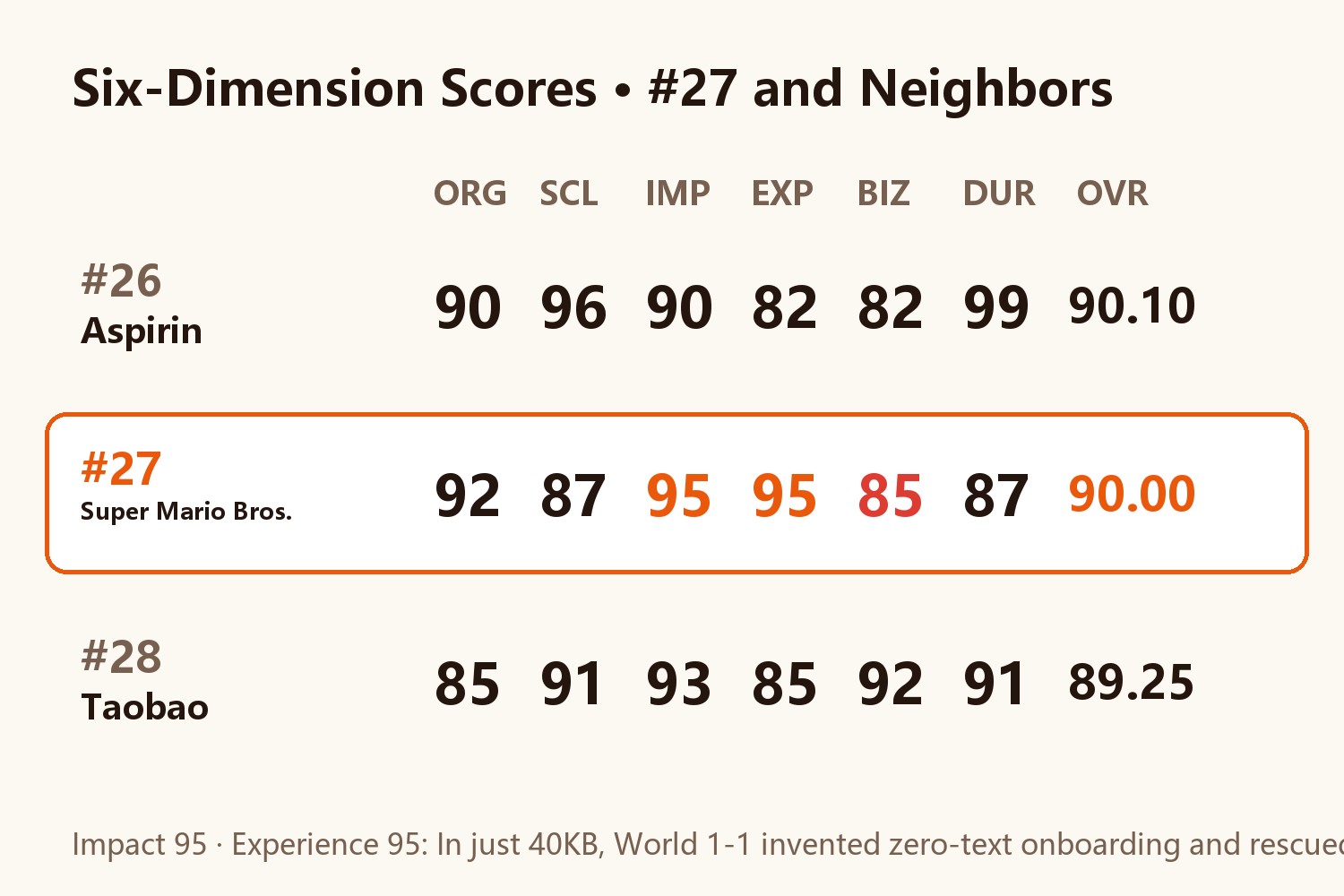
In our ranking of the 100 Products That Changed the World, Super Mario Bros. stands at #27 with an overall score of 90.00 (scored by Claude AI under our unified six-dimension framework): 95 in Impact, 95 in Experience, 92 in Originality, 87 in Scale, 87 in Durability, and 85 in Business.
Forty-one years later, why do SaaS founders, mobile app designers, and AI product managers still study World 1-1 frame by frame? Because in thirty seconds of silent pixel art, Shigeru Miyamoto and Takashi Tezuka solved the hardest problem in software: how to onboard a complete beginner without writing a single word of instruction.
1. World 1-1: The Greatest 30-Second Onboarding Flow Ever Engineered
Every software product manager knows the tragedy of the modern onboarding modal: you build a complex product, panic that users won’t understand it, and slap a five-step carousel of tooltip pop-ups over the interface on first launch.
What do users do? Ninety-nine percent of them mash “Skip” five times without reading a word, stare blankly at the dashboard, and churn.
In 1985, Miyamoto operated under a ruthless constraint: if a player had to read a manual or a wall of text to figure out what to do, the design had failed.
Look at the opening thirty seconds of World 1-1, broken down as a masterclass in zero-text UX onboarding:
| Timestamp | On-Screen Spatial Setup | User Instinct & Reaction | Silent Onboarding Lesson Completed |
|---|---|---|---|
| Seconds 0–2 | Mario spawns on the far left edge of the screen facing a wide expanse of empty sky | With nowhere to go left, the player’s thumb naturally presses Right on the D-pad | Establishes left-to-right spatial progression without a single arrow icon |
| Seconds 3–5 | A lone, scowling brown Goomba strolls slowly toward Mario | Threat is unmistakable; the player presses the primary A button to jump over or land on it | Lesson 1: Teaches the jump button, collision danger, and stomping enemies |
| Seconds 6–12 | Five overhead blocks appear; the second block and top block are flashing gold Question (?) blocks | Visual contrast triggers curiosity; the player jumps to bonk the flashing block, spawning a Super Mushroom | Rewards curiosity and introduces interactive environmental blocks |
| Seconds 13–18 | The mushroom slides right, bounces off a short green pipe, and rolls straight back at Mario underneath a low ceiling of bricks | Trapped by the low bricks, the player can barely dodge it—colliding with the mushroom and growing twice as tall! | Lesson 2 (Pure Genius): Uses geometry to force the player into a power-up so they learn mushrooms are good, not fatal |
| Seconds 19–30 | Three green pipes of progressively taller heights followed by a narrow two-tile bottomless pit | The player discovers holding A longer produces a higher jump, and holding B sprints across gaps | Lesson 3: Masters variable jump height and momentum physics before facing real danger |
Pause on that thirteen-second mark—the Super Mushroom bouncing off the pipe.
In early playtests, novices saw the mushroom pop out of the question block, assumed it was another monster like the Goomba, and tried to jump over it. Instead of pausing the game with a text box reading “Eat the Mushroom to Grow Big!”, Miyamoto placed a short pipe to bounce the mushroom back toward the player and lowered the brick ceiling above Mario’s head so jumping over it was almost impossible.
The moment the mushroom touches you, a triumphant arpeggio plays, Mario doubles in size, and the next time you jump you shatter solid bricks into dust. In three seconds of forced spatial choreography, the player experiences pure epiphany.
2. How Brutal Hardware Constraints Created a Multi-Billion-Dollar Cultural Icon
Designers love to complain when engineering budgets or screen real estate feel tight. Consider the canvas Miyamoto was handed: a 256 × 240 television display where the protagonist had to fit inside a 16 × 16 pixel grid using at most three colors.
Every single iconic feature of Mario’s appearance was invented not for fashion, but to solve a 16-pixel rendering limitation:
- Why does Mario wear a cap? Because animating hair in 16 pixels looked like aglitchy smudge; a cap saved forehead and hairline pixels;
- Why the big nose and bushy mustache? At 16×16 resolution, drawing a recognizable mouth with facial expressions was impossible; a prominent nose and mustache made his face direction instantly readable;
- Why red overalls over a blue shirt? Without contrasting straps separating his torso from his arms, Mario’s swinging arms vanished into his body whenever he ran!
The cap, the mustache, the overalls—an aesthetic worth tens of billions of dollars in box-office films and theme parks—was born entirely from functional problem-solving inside a 256-pixel box.
3. The Physics of Joy: Why 40 Years of Platformers Still Copy Miyamoto’s Momentum
Before Super Mario Bros., video game movement was binary. In arcade classics like Pac-Man or even Miyamoto’s own Donkey Kong (1981), pressing right moved your character at a fixed constant speed; releasing the joystick stopped you dead on a dime; and once you jumped, your parabolic arc was locked in mid-air like a cannonball.
Miyamoto and lead programmer Toshihiko Nakago revolutionized digital tactility by programming sub-pixel velocity, acceleration, friction, and mid-air control on an 8-bit 1.79MHz processor:
- Inertia and skidding: Mario takes a few steps to build up speed, hits top sprint when you hold the B button, and visibly skids with a puff of traction when you reverse direction;
- Variable jump physics: Tap A for a hop; hold A to sustain upward lift for a high jump; and steer slightly left or right in mid-air to stick a landing on a single brick.
Miyamoto and Nakago spent months tweaking those hexadecimal acceleration constants by hand before building the rest of the levels—because Miyamoto understood a truth that Apple later proved with the iPhone’s inertial touch scrolling: before a product is useful, the sheer physical sensation of touching and moving it for three seconds must feel magical.
4. Six-Dimension Breakdown: Why a 40KB Cartridge Ranks #27 in History
Under the unified six-dimension framework of 100 Products That Changed the World (Originality 20%, Scale 20%, Impact 20%, Experience 15%, Business 15%, Durability 10%), Super Mario Bros. scores as follows:
| Dimension | Weight | Score | Key Rationale |
|---|---|---|---|
| Originality | 20% | 92 | Invented modern side-scrolling level design (kishōtenketsu four-act structure), momentum platforming, and secret warp discovery |
| Scale | 20% | 87 | 58M+ copies sold for the original title, anchoring a franchise with 830M+ lifetime game sales and billions of players |
| Impact | 20% | 95 | Ended the 1983 North American video game crash and wrote the universal grammar of interactive software onboarding |
| Experience | 15% | 95 | Flawless 60fps tactile physics, Koji Kondo’s earworm score, and World 1-1’s invisible tutorial inside 40KB |
| Business | 15% | 85 | Sold 61.9M NES consoles and spawned a transmedia empire spanning a $1.36B feature film and Universal theme parks |
| Durability | 10% | 87 | 41 years after release, World 1-1 remains instantly playable and studied in every game and UX design program on earth |
| Overall (OVR) | 100% | 90.00 | Ranked #27 Overall (just behind #26 Aspirin at 90.10, ahead of #28 Taobao at 89.25) |
The next time your team is tempted to add a three-paragraph pop-up tutorial explaining how to use your app, load up World 1-1 of Super Mario Bros. instead.
That flashing question block and bouncing mushroom from 1985 still hold the ultimate lesson in product craft: never lecture the user with text when you can let them discover their own superpower in the first fifteen seconds.
Discussion