Aspirin: How an 1899 Fever Pill Scored 99 in Durability by Pulling Off the Greatest Second-Act Pivot in Product History
On July 20, 1969, when Neil Armstrong and Buzz Aldrin touched down on the Sea of Tranquility aboard the Apollo 11 Lunar Module, tucked inside their spacecraft medical kit was a bottle of small white tablets humanity had already been taking for seventy years: Aspirin.
If you had to guess the longest-lived, highest-volume standardized industrial product in human history, what would it be?
It is not Coca-Cola, nor the Gillette razor blade. It is a simple nine-carbon molecule—acetylsalicylic acid ($\text{C}_9\text{H}_8\text{O}_4$). Since German chemical maker Bayer registered the Aspirin trademark on March 6, 1899, this little white tablet has remained in continuous mass production for 127 years. Even today, humanity manufactures roughly 40,000 metric tons of aspirin every year—between 40 billion and 100 billion tablets swallowed annually across the globe.
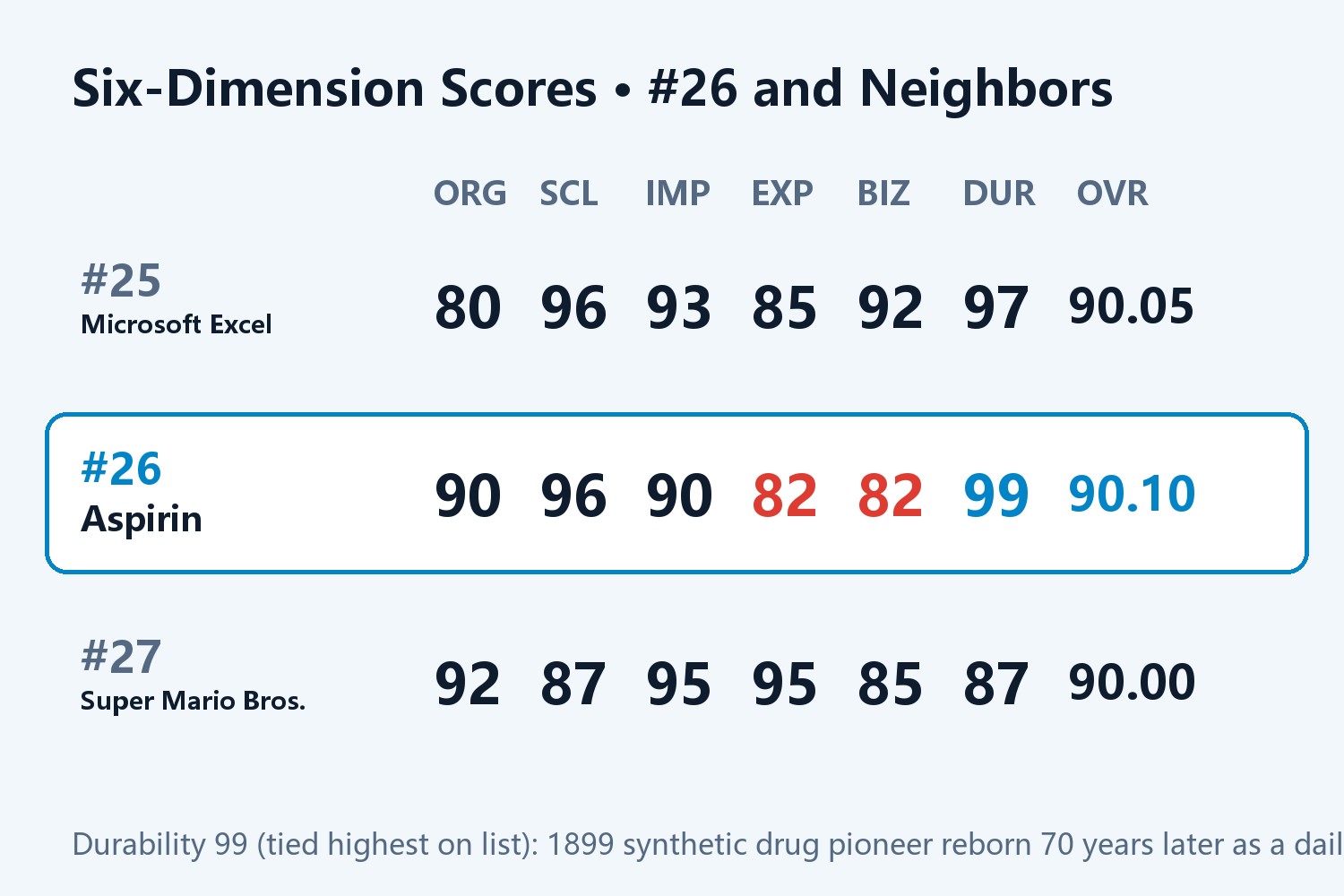
In our ranking of the 100 Products That Changed the World, Aspirin stands at #26 with an overall score of 90.10 (scored by Claude AI under our unified six-dimension framework): a ceiling-tying 99 in Durability, 96 in Scale, 90 in Originality, 90 in Impact, 82 in Experience, and 82 in Business.
For product builders, Aspirin is more than the birth certificate of the modern pharmaceutical industry. It is the ultimate case study in how a legacy product survives disruption: stripped of its patents after World War I and outflanked in the 1960s by safer painkillers like Tylenol and Ibuprofen, Aspirin staged a breathtaking second act at age seventy—transforming from an occasional headache remedy into a daily life-saving shield against heart attacks.
1. Fixing the “Willow Bark UX Disaster”: How One Acetyl Group Created Big Pharma
For more than three millennia—from ancient Egyptian papyri and Hippocrates to traditional Chinese herbalists—healers knew that chewing willow bark eased fevers and joint pain.
By the mid-19th century, European chemists isolated the active compound in willow bark and meadowsweet: salicylic acid.
From a product perspective, however, pure salicylic acid had a catastrophic user experience:
- It tasted like battery acid burning the throat;
- Worse, it tore up the stomach lining. Rheumatism patients who took salicylic acid for more than a few days suffered violent nausea, ulcers, and gastric bleeding.
In the summer of 1897, inside the laboratories of German dye maker Bayer, a 29-year-old chemist named Felix Hoffmann (working under the direction of pharmaceutical head Arthur Eichengrün) sought a gentler alternative for his rheumatic father, who could no longer stomach raw salicylic acid.
On August 10, 1897, Hoffmann acetylated salicylic acid—swapping a single hydroxyl hydrogen for an acetyl group—to produce chemically pure, stable acetylsalicylic acid (ASA).
That single molecular tweak unlocked two foundational breakthroughs in product design:
- Dramatically improved tolerability: It preserved the fever-reducing and anti-inflammatory punch while sparing the mouth and esophagus from direct chemical burn;
- The standardized compressed tablet (1900): Before Aspirin, pharmacists weighed loose powders by hand and folded them into paper packets. Bayer pressed Aspirin into uniform, water-soluble 500mg tablets stamped with the Bayer cross—establishing the physical form factor of modern medicine.
History also recorded an astonishing twist of corporate judgment. Just eleven days after synthesizing Aspirin (on August 21, 1897), Hoffmann applied the exact same acetylation process to morphine, creating diacetylmorphine—which Bayer branded and sold as “Heroin.”
Unbelievably, Bayer’s head of pharmacology, Heinrich Dreser, initially rejected Aspirin as “weakening to the heart” while enthusiastically championing Heroin as a “non-addictive cough suppressant for children”! Only after Eichengrün secretly distributed Aspirin samples to Berlin physicians—who reported miraculous clinical results—did Bayer reverse course and launch Aspirin in 1899.
| Three Eras of Aspirin’s 127-Year Life | Core User Problem & Positioning | Existential Crisis Faced | Strategic Pivot & Market Outcome |
|---|---|---|---|
| Act I: The Synthetic Drug Pioneer (1899–1918) | Solved salicylic acid’s severe gastric burn; pioneered standardized 500mg tablets | Almost killed internally in favor of Bayer’s Heroin cough syrup | Became the world’s indispensable fever fighter during the 1918 Spanish Flu pandemic |
| Act II: Patent Loss & Painkiller Siege (1919–1970) | WWI Treaty of Versailles confiscated Bayer’s patents and trademarks in the US/UK | Tylenol (1955) and Ibuprofen (1969) offered pain relief with less stomach irritation and no pediatric Reye’s risk | Commoditized into a penny-a-pill generic; lost primary analgesic market share |
| Act III: The Cardiovascular Second Act (1971–Present) | Re-engineered as 81mg/100mg enteric-coated daily low-dose tablet | Shifted from an occasional fever pill to a lifelong daily anti-platelet regimen | Vane won the 1982 Nobel Prize; cuts secondary heart-attack risk by ~25–30%; 40B+ pills/year |
2. Midlife Crisis: Confiscated in WWI and Outflanked by Tylenol and Ibuprofen
Had Aspirin remained purely a painkiller, it would never have earned a 99 in Durability. By the late 1960s, its original value proposition was under siege from every direction.
First came geopolitical expropriation. Following Germany’s defeat in World War I, the 1919 Treaty of Versailles stripped Bayer of its Aspirin patents and trademarks in the United States, Britain, France, and Russia as war reparations. (In the US, Sterling Products bought Bayer’s North American rights at auction for $5.3 million; Bayer did not buy back its own name in America until 1994, for $1 billion.) Overnight, aspirin became a generic word in the English dictionary.
Then came superior competitors in the pain aisle:
- Acetaminophen / Paracetamol (Tylenol, 1955) delivered fever and pain relief without irritating the stomach—and after epidemiological studies linked pediatric aspirin use during viral illnesses to rare but fatal Reye’s syndrome, aspirin was virtually banished from children’s medicine cabinets;
- Ibuprofen (Advil / Nurofen, 1961–1969) matched or beat aspirin on inflammatory joint pain with gentler gastrointestinal profiles.
In software or hardware, a seventy-year-old generic product outclassed on safety and UX by two younger rivals is dead walking. Instead, at age 72, Aspirin pulled off the greatest second act in medical history.
3. Reborn at Age 72: From Occasional Headache Pill to Daily Heart Shield
Here is one of the most humbling facts in science: humanity swallowed hundreds of billions of Aspirin tablets between 1899 and 1970 without having the slightest idea how the drug actually worked inside the body.
AsEarly as 1948, a observant California general practitioner named Lawrence Craven noticed that tonsillectomy patients who chewed excessive aspirin gum suffered unusual bleeding. Connecting the dots, Craven hypothesized that if aspirin kept blood from clotting, a tiny daily dose might prevent coronary thrombosis—heart attacks.
In 1971, British pharmacologist Sir John Vane finally unlocked the molecular mechanism (winning the 1982 Nobel Prize in Physiology or Medicine): aspirin irreversibly blocks the cyclooxygenase (COX) enzyme, halting the production of prostaglandins (which cause pain and fever) and thromboxane A2 (which tells blood platelets to clump together into clots).
Massive randomized clinical trials in the 1980s—most notably the landmark ISIS-2 trial and the Physicians’ Health Study—confirmed that a tiny daily dose of aspirin (75mg to 100mg, less than afifth of a standard headache tablet) reduced acute heart-attack mortality by 23% and slashed recurrent cardiovascular events by roughly a third.
Look at that transformation through a product manager’s eyes:
- Right-sizing the dose and wrapper: By dropping the dose to 81mg (“Baby Aspirin”) or 100mg and adding an enteric coating that passes intact through stomach acid to dissolve in the small intestine, manufacturers minimized gastric irritation while locking in anti-platelet efficacy;
- Turning an episodic purchase into a daily subscription for life: A headache pill is taken a few times a year. Secondary cardiovascular prevention is taken every single morning for thirty years.
4. Six-Dimension Breakdown: Why 99 Durability Puts a Penny Pill at #26
Under the unified six-dimension framework of 100 Products That Changed the World (Originality 20%, Scale 20%, Impact 20%, Experience 15%, Business 15%, Durability 10%), Aspirin scores as follows:
| Dimension | Weight | Score | Key Rationale |
|---|---|---|---|
| Originality | 20% | 90 | The world’s first industrial synthetic drug created by modifying a natural molecule rather than extracting raw herbs |
| Scale | 20% | 96 | 40,000+ tons (40B–100B tablets) produced annually; stocked in virtually every hospital, pharmacy, and home on earth |
| Impact | 20% | 90 | Founded modern pharmaceutical manufacturing, inspired a Nobel Prize, and saved millions of lives from heart attacks and strokes |
| Experience | 15% | 82 | Standardized the 500mg tablet and later 81mg enteric-coated daily pill, though GI bleeding risk and Reye’s syndrome remain constraints |
| Business | 15% | 82 | Wartime patent confiscation turned it into a ultra-low-margin generic commodity—limiting corporate profit while maximizing human access |
| Durability | 10% | 99 | 127 years of uninterrupted global relevance, with ongoing clinical research into colorectal cancer prevention |
| Overall (OVR) | 100% | 90.10 | Ranked #26 Overall (clustered in the 90-point Legend tier alongside #25 Microsoft Excel at 90.05 and #27 Super Mario Bros. at 90.00) |
In 2026, in an age of $2 million gene therapies and AI-designed biologics, a tablet invented when horse-drawn carriages ruled Berlin still sits on hundreds of millions of nightstands. Aspirin’s 127-year journey proves a timeless product truth: great products don’t die when their first market matures—they find a deeper reason to exist.
Discussion