100 Products That Changed the World · #24: Honda Super Cub
If someone asked you to name the most-produced motor vehicle in human history, what would you guess?
Most people immediately think of Henry Ford’s Model T (15 million built), the Volkswagen Beetle (21.5 million), or the reigning king of four-wheeled passenger cars, the Toyota Corolla (roughly 50+ million).
The true #1 outsold all three of those automotive legends combined.
Since August 1958, across more than 160 countries, humanity has built over 110 million (110,000,000+) units of a single machine.
When the British television show Top Gear tried to kill one — draining its engine oil, filling the crankcase with used cooking grease from a fish-and-chips fryer, loading it with concrete bags, and finally dropping it off the roof of a 21-meter (70-foot) building onto concrete — the battered little machine started right up with a kick and rode away.
It is the AK-47 of two-wheelers, the machine that put half of Asia on wheels: the Honda Super Cub.
A Bowl of Buckwheat Noodles and the Ultimate Product Brief: “Rideable With One Hand!”
Travel back to Japan in 1956.
Soichiro Honda (#19) and his business partner Takeo Fujisawa had built a promising young motorcycle company, yet two-wheelers everywhere suffered from the same glaring problem: they were noisy, smoky, greasy contraptions built either by strapping crude two-stroke motors onto bicycle frames or by building heavy, intimidating machines for leather-jacketed enthusiasts.
Riding a motorcycle required squeezing a stiff left-hand clutch lever while coordinating a foot shifter and throttle — a daunting ritual for novices — while exposed chains flung hot grease onto the rider’s trousers.
After a month-long research trip observing scooters and mopeds in Germany and Austria in late 1956, Fujisawa sat down with Soichiro Honda and laid out one of the most brilliant Product Requirements Documents (PRDs) in industrial history:
- A housewife in a skirt must be able to mount and ride it with grace (no swinging a leg high over a gas tank, and zero oil stains on stockings);
- It must be quiet, clean, frugal, and strong (a high-revving 4-stroke engine rather than a smoky 2-stroke);
- And the legendary third requirement: “A soba noodle delivery boy must be able to ride it through Tokyo traffic with one hand while carrying a stacked tray of noodle bowls on his other shoulder!”
Honda’s engineers stared at him in disbelief: If the rider’s left hand is holding a tower of noodle bowls, how on Earth is he supposed to pull the clutch lever on the left handlebar to shift gears?!
Refusing to compromise on the soba-delivery scenario, Soichiro Honda and his engineers spent eighteen months inventing a package of mechanical breakthroughs that defined a new vehicle category:
- The Automatic Centrifugal Clutch: They eliminated the left-hand clutch lever entirely! Linked directly to a 3-speed foot pedal, the centrifugal clutch engaged automatically as engine RPM rose and disengaged the instant the rider pressed the foot shifter — making one-handed, stall-free riding effortless;
- Step-Through Spine Frame & Polyethylene Leg Shield: Moving the fuel tank beneath the hinged seat created a low step-through chassis anyone could mount in a skirt, while a white injection-molded polyethylene fairing shielded the rider’s legs from mud, wind, and engine heat;
- The 9,500-RPM 50cc Four-Stroke Engine: At a time when skeptics believed a tiny 50cc 4-stroke couldn’t pull a bicycle uphill, Honda wrung 4.5 horsepower out of a jewel-like overhead-valve single that delivered over 100 kilometers per liter (235+ mpg).
America, 1963: “You Meet the Nicest People on a Honda”
Launched in Japan in August 1958, the Super Cub C100 was an instant sensation at home.
When Honda expanded to the United States in 1959, however, it hit a cultural wall. In post-war America, motorcycles were synonymous with Marlon Brando in The Wild One and outlaw biker gangs like the Hells Angels. Total US motorcycle sales hovered at a tiny 50,000 units a year, and middle-class parents wouldn’t let their kids near a bike dealership.
Worse still, Honda’s larger twin-cylinder motorcycles initially suffered oil leaks and clutch failures on long American freeways.
While waiting for replacement parts from Tokyo, Honda’s young Japanese staff in Los Angeles began riding the tiny 50cc Super Cub on errands around town and up into the Santa Monica hills.
Everywhere they parked, ordinary Americans — college students, surfers, housewives — stopped them on the sidewalk to ask where they could buy that friendly, toy-like little red-and-white machine.
In 1963, seizing on a concept originally drafted by a UCLA advertising student, Honda bypassed traditional motorcycle magazines entirely and bought full-page color spreads in Life magazine with a slogan that rewrote marketing history:
“You Meet the Nicest People on a Honda.”
The ads showed zero leather jackets and zero grease: just sun-drenched illustrations of college students, mothers and daughters, and Santa Claus riding the Super Cub through suburban neighborhoods.
| Product & Cultural Dimension | Motorcycles Before 1958 | The Honda Super Cub Paradigm | Global Impact |
|---|---|---|---|
| Operating Barrier | Manual left-hand clutch + foot shift; easy to stall | Automatic centrifugal clutch — rideable one-handed | Unlocked riding for housewives, students, seniors, and delivery couriers |
| Cleanliness & Comfort | Exposed greasy chains, smoky 2-stroke exhaust | Fully enclosed chain case + plastic leg shield + clean 4-stroke | Riders could commute in office suits or skirts without a speck of oil |
| Mechanical Reliability | Finicky carburetors and fragile electronics | Bulletproof 50cc 4-stroke that runs on anything | Multi-generational family workhorse across 160+ countries |
| Cultural Identity | Outlaw biker subculture | ”You Meet the Nicest People” + 110M+ units built | First vehicle in Japan granted a national 3D Shape Trademark |
Instead of fighting Harley-Davidson for a slice of 50,000 hardcore bikers, the Super Cub created an ocean of millions of first-time riders. By 1964, nearly one out of every two motorcycles sold in America was a Honda, and The Beach Boys even recorded a hit song about it (“Little Honda”).
Becoming the Everyday Legs of Asia
If the Super Cub charmed suburban America, it completely transformed the socioeconomic fabric of Southeast and East Asia.
Across Vietnam, Thailand, Indonesia, Malaysia, and Taiwan, the Super Cub and its underbone descendants became the literal legs of hundreds of millions of families. In Vietnam, the word “xe Honda” became the generic noun for any motorbike — carrying families of four to school, hauling towers of produce to market, and powering the small-business economy of entire nations for sixty years.
In 2014, the Japan Patent Office bestowed a rare honor on the Super Cub: registering its physical silhouette as a protected 3D Trademark — the first vehicle in Japanese history recognized as unmistakable by shape alone, even without a badge.
Six-Dimension Score Breakdown
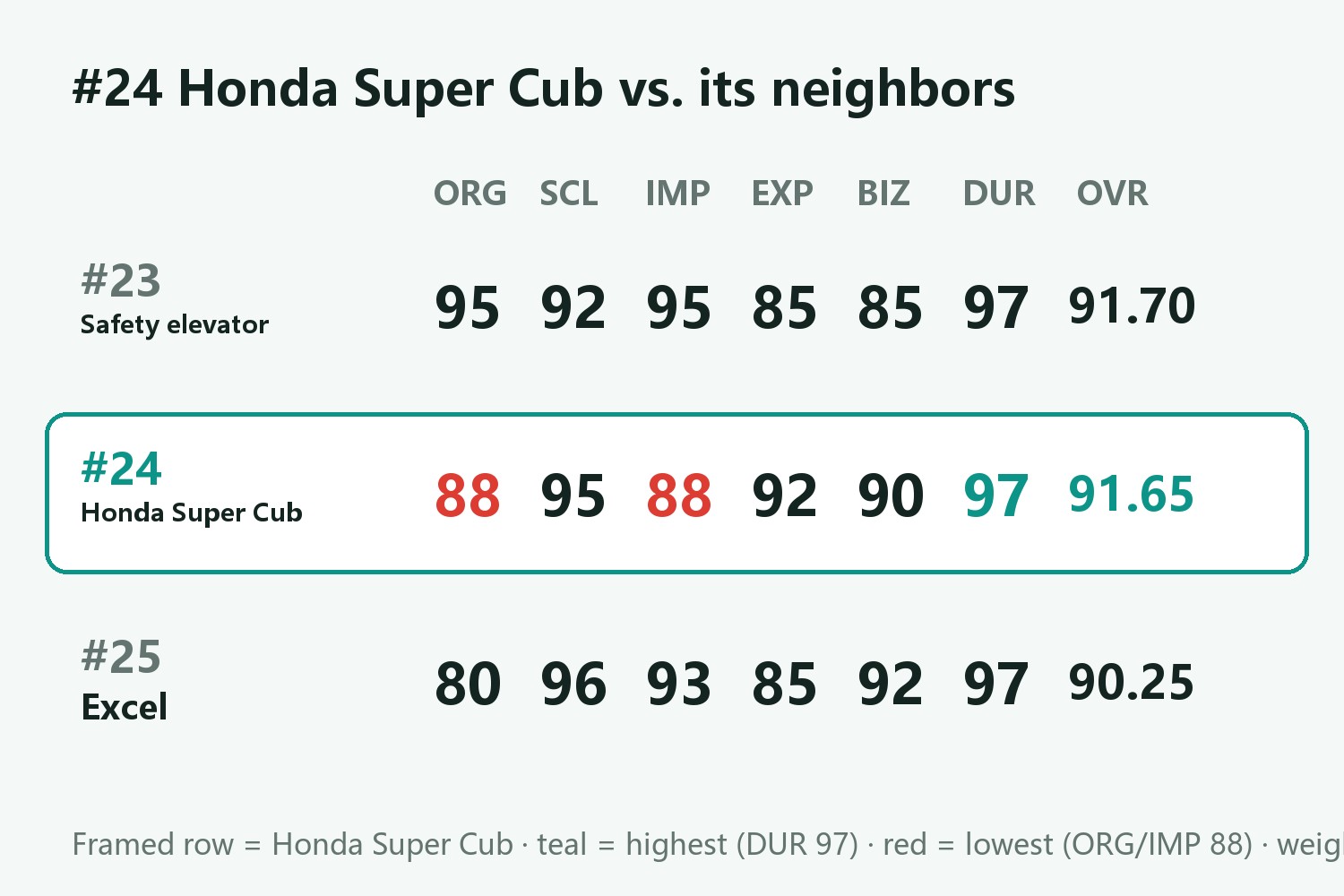
In the 100 Products That Changed the World framework, the Honda Super Cub earns a weighted overall score of 91.65 (displayed as 92), ranking #24 overall right behind the safety elevator (#23):
1. Durability: 97 (Highest Dimension)
A 97 in both senses of the word: continuously manufactured for 68 years (1958–2026) with its fundamental ergonomics intact, and famous for a mechanical indestructibility that survived being dropped off a seven-story building on Top Gear.
2. Scale: 95
With more than 110 million units built, it is the most-produced motor vehicle in the history of planet Earth — democratizing personal mobility for billions of people priced out of four-wheeled cars.
3. Experience: 92
Fujisawa’s “one-handed soba delivery boy + woman in a skirt” brief remains one of the greatest masterclasses in user empathy ever executed. The centrifugal clutch, enclosed chain guard, 17-inch wheels (sized to roll smoothly over unpaved gravel roads), and step-through frame solved real human friction at every touchpoint.
4. Business: 90
The Super Cub bankrolled Honda’s expansion into a global automotive titan, while its 1963 Nicest People campaign remains Harvard Business School’s canonical case study on blue-ocean market creation.
5. Originality: 88 & Impact: 88
While it did not invent the internal combustion engine, it created the entire underbone motorcycle category and erased the gender and social barriers of motorized transport — becoming the tireless mechanical heartbeat of Asian urbanization.
Epilogue
In 1958, when Soichiro Honda crouched on a factory floor in Saitama chalking the curve of a white plastic leg shield so a housewife’s skirt wouldn’t catch a splash of mud, he wasn’t trying to build a status symbol.
Sixty-eight years and 110 million machines later, exotic supercars gather dust in climate-controlled garages — while the little 50cc bike built for a soba noodle delivery boy still kicks to life every morning at dawn, carrying humanity to work.
Discussion