100 Products That Changed the World · #23: The Safety Elevator
If you traveled back to New York, London, or Paris in 1850 and walked into any apartment building, you would encounter a real-estate hierarchy that looks completely upside down compared to today:
The lower floors were the most expensive and prestigious — home to bankers and aristocrats — while the top floor (the fifth or sixth story) was the cheapest, most miserable part of the building, rented only to starving artists, seamstresses, and servants.
The reason was simple biological physics: human knees and lungs dictated how tall a city could grow. Hauling coal, water buckets, and groceries up five steep flights of stairs was the absolute limit of everyday human endurance. For thousands of years of civilization, nearly every city on Earth remained a flat carpet of five-story walk-ups.
It wasn’t that humans didn’t know how to build hoists. Steam-powered platforms and rope winches had existed in coal mines and factories for decades.
Yet no sane person would step onto one.
Hemp ropes frayed and snapped without warning. And if the single hoisting rope broke, the platform became a multi-ton guillotine plummeting in free fall to the bottom of the shaft.
Then, on a May afternoon in 1854, a 42-year-old Vermont farmer and struggling master mechanic named Elisha Graves Otis staged the most audacious live product demo in industrial history.
The Axe at the Crystal Palace, 1854: “All Safe, Gentlemen!”
In 1852, Otis was working as a master mechanic at a bedstead factory in Yonkers, New York, when he was asked to rig up a freight hoist to haul heavy lumber to the second floor.
Knowing how often hoisting ropes snapped, Otis stared at a rugged wagon leaf spring and engineered a brilliant piece of fail-safe mechanical inversion:
- Along both sides of the vertical guide rails, he mounted heavy iron ratchet teeth;
- Across the top of the elevator platform, he attached a tough steel wagon leaf spring, fastening the hoisting rope directly to the center of the spring;
- Under normal tension: the weight of the platform pulled the rope taut, bowing the leaf spring upward and drawing its two outer iron pawls inward so the platform glided smoothly up and down;
- The instant the rope snapped: tension vanished, the bowed steel spring snapped flat in milliseconds, and its iron pawls rammed outward into the ratchet teeth on both rails — locking the car in place automatically.
In short: the brake did not rely on a human operator or external power; the very failure of the rope triggered the lock.
Otis patented the mechanism and opened a tiny workshop. Over the next year, he sold barely three freight elevators. Nobody believed a falling platform could actually catch itself mid-air.
Facing bankruptcy in May 1854, Otis decided to bet his own life on stage at the New York Crystal Palace Exposition (America’s first World’s Fair).
He erected a towering, open-sided elevator shaft in the middle of the exhibition hall. At peak crowd hours, wearing a formal frock coat and a tall stovepipe hat, Otis stepped onto the platform alongside heavy barrels and freight, and rode the hoist forty feet into the air above the gasping crowd.
At the top of the shaft stood an assistant gripping a gleaming broadaxe.
Looking down at hundreds of upturned faces, Otis calmly gave the order:
“Cut the rope!”
The axe flashed down and severed the thick hemp cable in a single blow.
Women screamed; men flinched. The platform dropped barely two inches before two thunderous metallic clanks echoed through the glass hall — CLACK! — as the spring-loaded pawls bit deep into the iron ratchets. The platform hung motionless in mid-air.
Otis calmly swept off his top hat, bowed to the stunned crowd, and called out five words that changed the skyline of planet Earth:
“All safe, gentlemen, all safe!”
Inverting Social Class and Allowing Cities to Grow Upward
Orders flooded into Yonkers immediately. On March 23, 1857, Otis installed the world’s first commercial passenger safety elevator inside the five-story E.V. Haughwout department store at 488 Broadway in Manhattan.
Soon afterward, the safety elevator converged with structural steel framing, triggering the greatest spatial transformation in urban history:
| Urban Dimension | Before 1853 (The Walk-Up Era) | After the Safety Elevator (Modern Metropolis) |
|---|---|---|
| Building Height Ceiling | Capped by human knees at 5–6 stories (~20 meters) | Uncapped: from the Empire State Building (381m) to Burj Khalifa (828m) |
| Vertical Real-Estate Value | Bottom floor richest, top floor poorest (garrets for servants) | Completely inverted: higher means pricier; birth of the luxury Penthouse |
| Urban Footprint | Forced to sprawl horizontally across farmland | Tens of thousands of workers packed into a single square kilometer (Manhattan, Central, Lujiazui) |
| Daily Passenger Volume | Freight-only factory hoists | 20+ million elevators moving the entire population of Earth (8B+ rides) every 72 hours |
Perhaps the most fascinating side effect was psychological and economic:
Once climbing stairs was removed from the equation, the formerly despised top floor suddenly became the quietest, brightest, cleanest sanctuary in the city — far above the horse manure and noise of the street. The servant’s garret transformed overnight into the billionaire’s penthouse, and the corporate CEO’s office migrated permanently to the top floor.
As architectural historians love to point out: Skyscrapers did not invent the elevator; Elisha Otis’s safety brake gave humanity permission to build skyscrapers.
The Product Psychology Inside the Box: Mirrors and the “Close Door” Button
Over the following century, the elevator also became a legendary laboratory for human-computer interaction and behavioral psychology:
- Why every elevator has a mirror: After World War II, as office towers grew taller, tenants complained relentlessly that elevators were too slow. Upgrading motor speeds across existing shafts would have cost millions. Instead, building engineers tried a psychological hack: installing mirrors inside the lobby and cab. Complaints dropped to near zero overnight — because once passengers had a mirror to check their hair, straighten their ties, or discreetly glance at fellow riders, their subjective perception of waiting time was cut in half;
- The illusion of control: When buildings transitioned from human elevator attendants to self-service push-buttons in the mid-20th century, riders initially felt acute claustrophobia inside a windowless metal box. Designers responded with crisp tactile buttons (including the famous Door Close button, which offers immediate psychological relief even when ADA dwell-timers delay the door), glowing floor counters, and the reassuring arrival chime.
Six-Dimension Score Breakdown
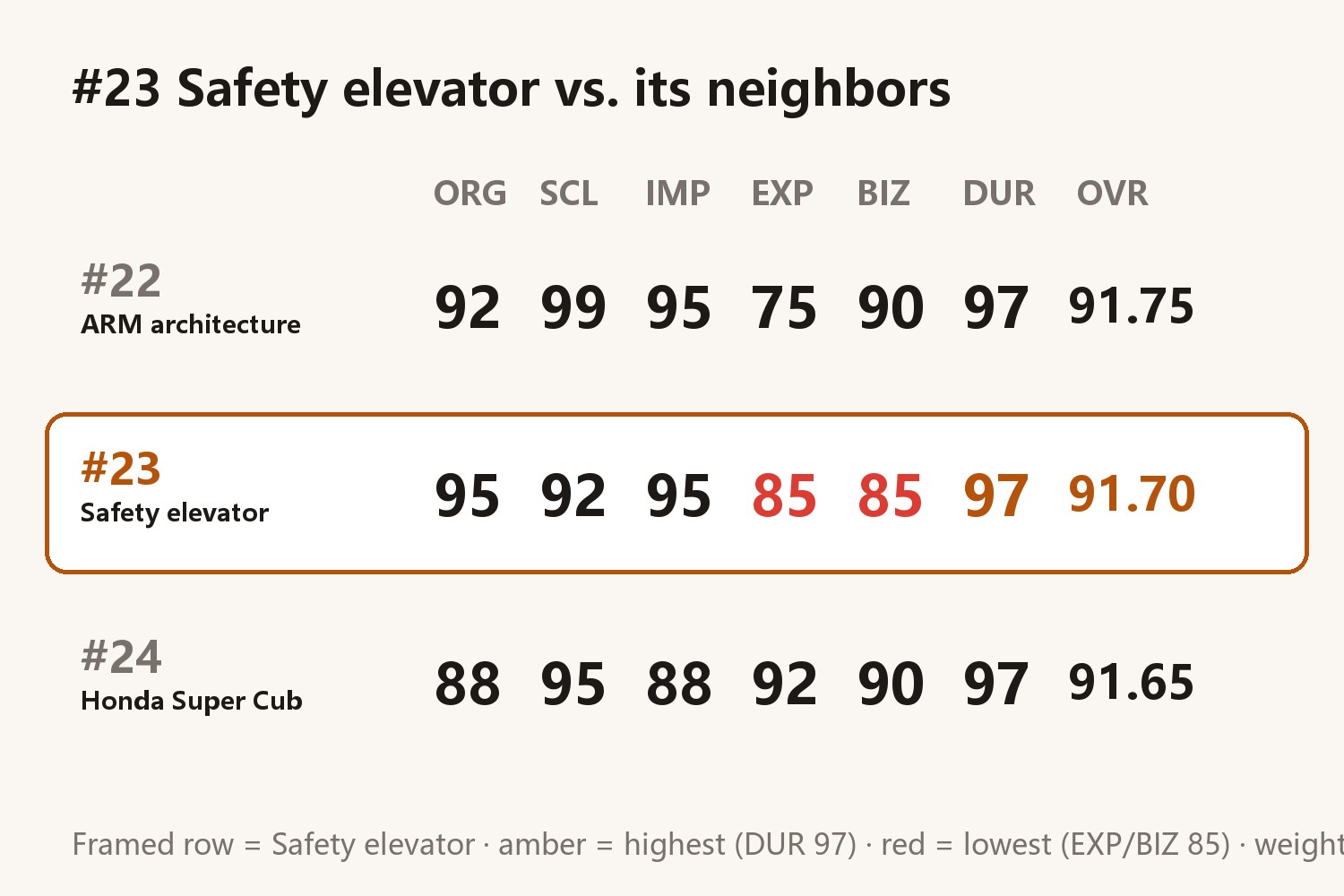
In the 100 Products That Changed the World framework, the safety elevator earns a weighted overall score of 91.70 (displayed as 92), ranking #23 overall right behind the ARM architecture (#22):
1. Durability: 97 (Highest Dimension)
More than 173 years after Elisha Otis sketched his leaf-spring ratchet in Yonkers, his core fail-safe principle — mechanical jaws that automatically clamp the guide rails the moment tension fails or overspeed occurs — still protects every high-speed elevator shaft from New York to Shanghai.
2. Originality: 95
Otis delivered a double masterpiece: a fail-safe mechanical design that turned the failure condition itself into the trigger for safety, and the greatest live product demonstration of the 19th century at the 1854 Crystal Palace.
3. Impact: 95
If every elevator on Earth stopped working tomorrow morning, modern civilization would freeze within minutes. Manhattan, Tokyo, Hong Kong, London, and Shanghai would become vertical ghost towns. Every modern skyline is a direct by-product of Otis’s wagon spring.
4. Scale: 92
Over 20 million elevators operate worldwide today, carrying more than 2 billion passengers every single day — moving the equivalent of the entire human population of Earth every 72 hours, while remaining statistically the safest form of mass transit ever built.
5. Experience: 85 & Business: 85
From steam winches to gearless permanent-magnet motors and AI destination-dispatch lobbies, the elevator turned a exhausting vertical climb into a 30-second button press. Commercially, Otis and its peers (Kone, Schindler, TK Elevator) pioneered one of industrial manufacturing’s most lucrative razor-and-blade recurring revenue models: selling the hardware once, then collecting high-margin maintenance subscriptions for thirty years.
Epilogue
On that May afternoon in 1854, when Elisha Graves Otis stood forty feet above the floor of the New York Crystal Palace and ordered his assistant to swing an axe through the only rope holding him up, the crowd thought they were watching a carnival stunt.
Nobody realized that the metallic clack of those iron pawls had just severed the ancient tether of gravity — allowing human cities to stand up and grow into the sky.
Discussion