100 Products That Changed the World · #22: The ARM Architecture
Nearly every entry on 100 Products That Changed the World that scores 99 on Scale — the iPhone, Windows, Google Search, Coca-Cola — is a household name you can spot from across the room.
Ranked at #22 is the ultimate exception.
You will never buy a box with its logo on a retail shelf. The company behind it does not own a single silicon foundry, nor does it manufacture a single physical microchip.
Yet at the exact second you are reading this sentence:
- The processor inside the smartphone in your hand — whether an Apple iPhone, a Samsung Galaxy, or a Xiaomi — is built on it;
- The wireless earbuds in your ears, the smartwatch on your wrist, the Wi-Fi router in your hallway, and the dozens of microcontrollers inside your car run on it;
- The Apple Silicon M-series chip inside a MacBook and the Grace CPU inside NVIDIA’s latest AI superclusters are powered by it.
To date, partners have shipped more than 300 billion chips based on this architecture — nearly forty processors for every human being alive on Earth.
It is the invisible empire behind modern mobile civilization: the ARM architecture.
The Miracle in Cambridge: Running Without the Power Plugged In
The story of ARM begins in the early 1980s at Acorn Computers, a small microcomputer company in Cambridge, England.
After building the wildly successful BBC Micro for British schools, Acorn’s two technical masterminds — computer scientist Sophie Wilson and hardware engineer Steve Furber — began searching for a 16-bit or 32-bit microprocessor to power their next generation of machines.
Every commercial chip they tested from Motorola, National Semiconductor, and Intel disappointed them. Built on Complex Instruction Set Computing (CISC) philosophies, those chips were expensive, hot, bloated, and painfully slow at handling real-time interrupts.
Worse still, when Wilson and Furber visited a chip design center in Phoenix, Arizona, they saw hundreds of engineers spending tens of millions of dollars over several years just to tape out a single CISC processor.
On the flight back to Britain, a radical thought took hold: If the giants’ chips were too bloated, why not design our own processor from scratch using the new Reduced Instruction Set Computing (RISC) papers coming out of UC Berkeley?
Acorn had no army of engineers and no Silicon Valley war chest. Essentially, the core design team was just the two of them:
- Sophie Wilson designed the instruction set architecture (ISA) and wrote the simulator in BBC BASIC;
- Steve Furber designed the microarchitecture, datapath, and pipeline.
Because they had almost no money or silicon budget, scarcity forced them into breathtaking minimalism. At a time when Intel’s 80286 packed 134,000 transistors, Wilson and Furber pared the first ARM1 (Acorn RISC Machine) down to a mere 25,000 transistors.
On April 26, 1985, the first silicon wafers fabricated by VLSI Technology arrived in Cambridge. Furber plugged the chip into a test board and ran a small program to calculate $\pi$.
It worked on the very first try.
Then, as champagne corks were about to pop, an engineer looking at the bench instruments froze and uttered a line that became semiconductor legend:
“Wait a minute… we forgot to turn on the power supply!”
Everyone crowded around the bench. The ammeter on the main power rail read zero.
Because Wilson and Furber’s 25,000-transistor design consumed so little energy, the ARM1 chip was running at full speed purely on the tiny leakage current trickling through its input/output signal pins — drawing less than a tenth of a watt!
In 1985, when computers were beige boxes plugged into wall sockets, low power was just a charming side effect of having no budget. Ten years later, when humanity decided to put computers inside pockets powered by lithium-ion batteries, that accident became the most valuable property on Earth.
Too Poor to Build a Fab: The Birth of the IP Licensing Flywheel
Had Acorn kept the chip to itself, ARM might have ended up as a footnote in a British computing museum.
By 1990, Acorn’s personal computer business was struggling financially. At the exact same moment, Apple in Cupertino was secretly building the Apple Newton — the world’s first Personal Digital Assistant (PDA).
Apple needed a processor that was fast enough for handwriting recognition yet frugal enough to run on AA batteries. Acorn’s RISC chip was the only design on the planet that fit the bill, but Apple refused to rely on a chip owned by a rival computer maker.
So in November 1990, Acorn (contributing 12 engineers and the architecture), Apple (investing £1.5 million), and VLSI Technology (providing tools and silicon expertise) spun out a joint venture into a converted turkey barn outside Cambridge: Advanced RISC Machines (ARM).
Newly appointed CEO Robin Saxby looked at his bank balance of £1.5 million and faced a brutal reality:
Building a semiconductor fabrication plant (fab) like Intel cost upwards of a billion dollars. ARM couldn’t even afford the air filtration system for a cleanroom.
Out of that constraint, Saxby devised one of the greatest business-model innovations in industrial history:
ARM would never manufacture a single physical chip, and would never compete with its customers. Instead, ARM would become the “Switzerland of semiconductors” — selling only blueprints.
The Upfront License + Per-Chip Royalty flywheel worked with devastating elegance:
- Radical Cost Sharing: Any chipmaker — Texas Instruments, Samsung, Qualcomm, or MediaTek — could pay a modest upfront licensing fee to get ARM’s verified CPU core blueprints, saving hundreds of millions of dollars in redundant R&D;
- Compound Royalties: For every physical chip shipped off the assembly line, the partner paid ARM a tiny royalty of 1% to 2% of the chip’s price (often just pennies per unit);
- The Unbreakable Ecosystem Moat: Because ARM was cheap and neutral, the entire global semiconductor industry standardized on its instruction set. Once every mobile chip ran ARM, both iOS and Android — along with millions of third-party apps — were compiled natively for ARM. When Intel later spent over $10 billion in subsidies trying to force x86 into smartphones, it shattered against that ecosystem wall.
From Nokia’s Snake to Apple Silicon and AI Supercomputers
The breakthrough came in 1993 when Texas Instruments licensed the ARM7 core to build digital baseband processors for a rising Finnish phone maker named Nokia.
When the Nokia 6110 — the iconic handset that introduced the world to the game Snake — sold tens of millions of units worldwide, the mobile industry learned an iron law: wherever there is a battery, x86 dies and ARM wins.
Over the next three decades, ARM executed a three-stage conquest of computing:
- Stage 1 (The Smartphone Era): Capturing over 99% of global smartphones, powering every iPhone A-series chip, every Qualcomm Snapdragon, and every MediaTek Dimensity processor;
- Stage 2 (The IoT and Automotive Era): Through its tiny Cortex-M microcontrollers, embedding itself into billions of smart sensors, appliances, wearables, and electric vehicles;
- Stage 3 (The Laptop and Cloud Invasion): In 2020, co-founder Apple shocked the PC industry by replacing Intel with its custom ARM-based M1 (Apple Silicon) chips, doubling MacBook battery life overnight. Today, AWS Graviton and NVIDIA’s Grace Hopper superchips are carrying ARM directly into the heart of cloud data centers and AI clusters.
Six-Dimension Score Breakdown
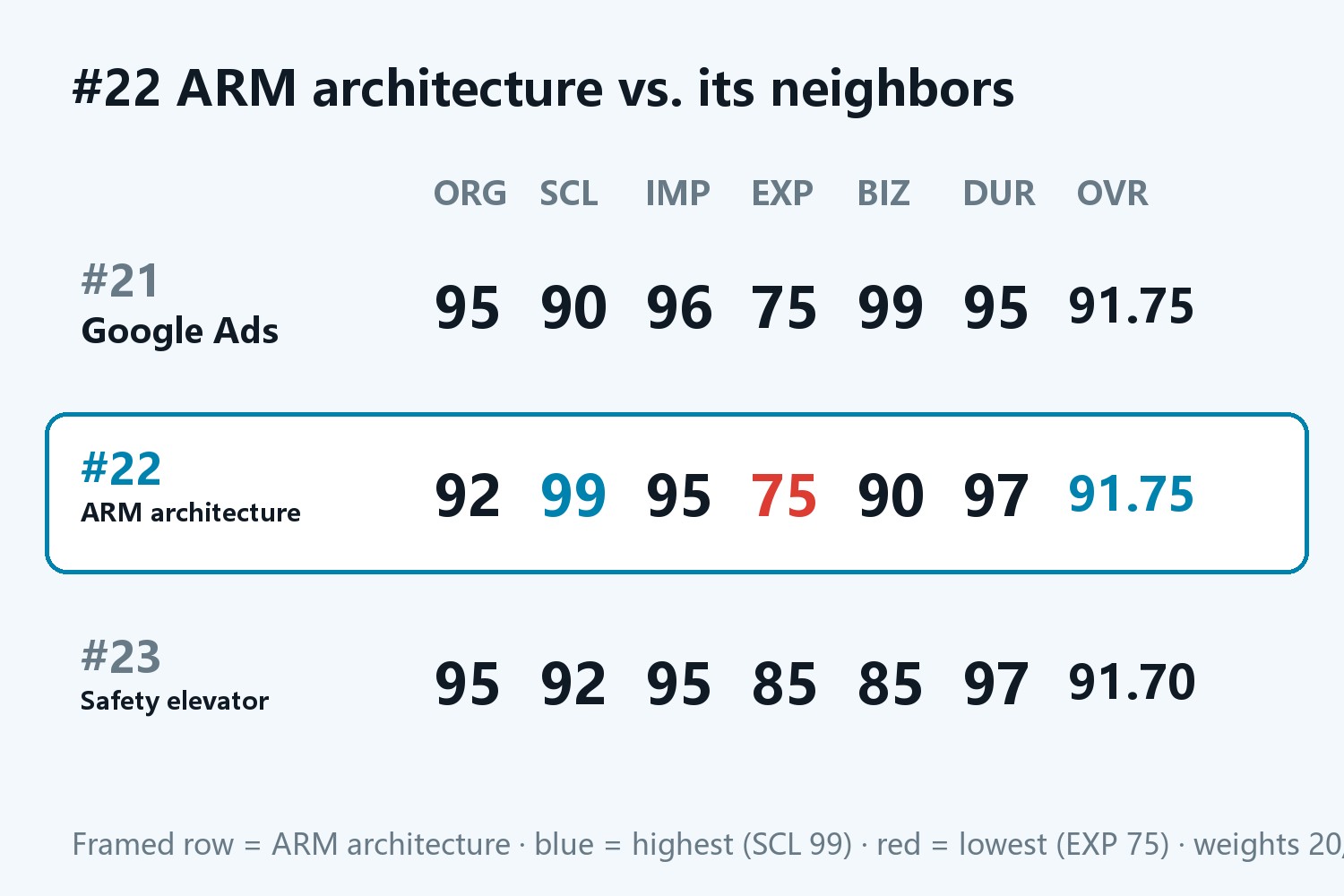
In the 100 Products That Changed the World framework, the ARM architecture earns a weighted overall score of 91.75 (displayed as 92), tying with Google Ads (#21) and ranking #22 overall:
1. Scale: 99 (Highest Dimension)
Very few human creations ever reach a 99 on scale. With 300+ billion chips shipped cumulative and nearly 30 billion new chips shipping every single year, ARM sits inside virtually every battery-powered screen and smart sensor on the planet.
2. Durability: 97
First powered on in April 1985, the architecture has thrived for 41 years. In an industry grave-site littered with once-dominant instruction sets — MIPS, DEC Alpha, SPARC, PowerPC, Itanium — ARM is stronger in itsfourth decade than ever before, expanding from mobile phones into laptops and AI data centers.
3. Impact: 95
Without ARM’s obsessive focus on performance per watt, the all-day pocket smartphone could not exist — and without the smartphone, neither would mobile payments, ride-hailing, short video, or modern digital life.
4. Originality: 92
While David Patterson and John Hennessy pioneered the academic theory of RISC, ARM delivered two historic innovations: an ultra-minimalist hardware implementation that ran on milliwatts, and the pure-play semiconductor IP licensing model that reorganized how the global chip industry collaborates.
5. Business: 90
ARM’s architecture underpins trillions of dollars of market capitalization across Apple, NVIDIA, Qualcomm, and TSMC. It scores 90 rather than Google Ads’ 99 only because ARM historically kept its per-chip royalty rate remarkably low (often pennies per chip, yielding a few billion dollars in annual revenue) — deliberately sacrificing short-term extraction to maintain neutrality and 99% market share.
6. Experience: 75 (Lowest Dimension)
Like TCP/IP or the Linux kernel, an instruction set architecture is invisible to end consumers. Meanwhile, for low-level systems engineers, navigating fragmented SoC vendor board-support packages (BSPs), non-standardized bootloaders, and architecture transitions (ARMv7 to ARMv8/v9) has historically demanded significant engineering effort.
Epilogue
In April 1985, when Sophie Wilson and Steve Furber watched a tiny 25,000-transistor chip calculate $\pi$ in a Cambridge room without its power supply even switched on, Intel stood at the undisputed zenith of the PC revolution.
Forty years later, the seed planted in that converted English barn quietly powers ninety-nine percent of the computers humanity carries in its pockets — proving that the ultimate way to rule an industry is not to own the factory, but to write the grammar everyone else builds upon.
Discussion