100 Products That Changed the World · #21: Google Ads (AdWords)
In 1998, when Larry Page and Sergey Brin published their seminal Stanford paper introducing the prototype of the Google search engine, they included an appendix that business historians still quote with irony:
“We believe the issue of advertising causes enough mixed incentives that it is crucial to have a competitive search engine that is transparent and in the academic realm… Advertising-funded search engines will be inherently biased towards the advertisers and away from the needs of the consumers.”
Neither graduate student could have imagined that just four years later, the product they built — Google AdWords (now Google Ads) — would become the single most lucrative cash machine in the history of capitalism, generating over $200 billion a year for Google’s parent company, Alphabet.
More importantly, the auction code humming silently behind that minimalist search box wrote the foundational social contract of the modern web.
The reason you can watch videos, navigate traffic, use email, and read articles across the internet for free today rests almost entirely on a mathematical equation AdWords introduced in 2002.
The Original Sin of Search Ads: When Highest Bidder Meant Worst Trash
Google did not invent search advertising, nor did it invent Pay-Per-Click (PPC).
In 1998, Silicon Valley entrepreneur Bill Gross founded GoTo.com (later renamed Overture and acquired by Yahoo!), introducing two revolutionary ideas: keyword bidding and paying only when a user actually clicked the ad.
In the era of print newspapers and portal banner ads, marketers paid per impression (CPM) and prayed for results — living out John Wanamaker’s famous lament: “Half the money I spend on advertising is wasted; the trouble is I don’t know which half.”
GoTo.com offered radical clarity: whoever bid the highest price per click for a keyword got the #1 spot at the top of the page. No click, no charge.
Wall Street loved it, but user experience quickly spiraled into disaster:
Because rank was determined purely by who wrote the biggest check, high-margin bottom-feeders — payday lenders, miracle diet pills, dubious ringtone peddlers — bid aggressively to hijack popular search terms. Legitimate businesses offering what users actually wanted were pushed pages down.
Worse still, a spammy advertiser bidding $5.00 per click on an irrelevant keyword might receive zero clicks out of ten thousand impressions — the user found nothing useful, the merchant got no customers, and the search engine collected zero revenue.
Page and Brin’s 1998 fear was coming true: if you sell the top of the search results to the fattest wallet, your search engine rots into a classified-ad junkyard within ninety days.
The 2002 Breakthrough: How “Bid × Click-Through Rate” Saved Search
By early 2000, after the dot-com bubble burst, Google was burning through its venture capital with no clear path to profitability. Having the world’s best PageRank algorithm meant nothing if the company ran out of cash to buy servers.
On October 23, 2000, Google launched the first version of AdWords with 350 advertisers, initially charging by impressions. The true revolution arrived in February 2002, when Salar Kamangar, Eric Schmidt, and Chief Economist Hal Varian rolled out AdWords Select.
To cure the disease of deep-pocketed spam, Google rewrote the rules of the auction:
On Google, the highest bidder would no longer automatically win the #1 spot.
Instead of ranking ads by bid alone, AdWords determined placement (Ad Rank) using a deceptively simple multiplication formula:
Ad Rank = Maximum CPC Bid × Quality Score (Expected Click-Through Rate & Relevance)
Look at how the math flipped the incentives overnight:
- Suppose Advertiser A (peddling shady diet tea) bids a massive $4.00 per click, but because users hate the irrelevant ad, its click-through rate (CTR) is only 1%. Its Ad Rank is
4 × 1 = 4. - Suppose Advertiser B (selling genuine running shoes) can only afford to bid $2.00 per click, but because the ad directly answers the user’s query, its CTR is 4%. Its Ad Rank is
2 × 4 = 8.
The result: Advertiser B, bidding half as much, wins the #1 spot at the top of the page. Advertiser A is pushed below — and if its quality score falls too low, Google refuses to show the ad even at $100 a click.
Next, Google paired this formula with a Generalized Second-Price (GSP) Auction:
When Advertiser B wins the #1 spot, they do not even pay their full $2.00 bid. They pay only the minimum price required to beat the runner-up’s score, plus one cent (in this case, 4 ÷ 4% + $0.01 = $1.01).
For the first time in advertising history, one equation aligned all three parties:
- For Users: Every click (or refusal to click) became a ballot. Irrelevant ads were mathematically starved of oxygen, turning ads from visual pollution into genuinely useful commercial answers;
- For Advertisers: Second-price bidding eliminated blind overpaying, and writing better, more relevant copy directly lowered the cost per click;
- For Google: Expected revenue per impression (
Bid × Probability of Click) reached its mathematical maximum.
Following the 2002 overhaul, Google’s revenue went vertical, crushing Yahoo’s Overture and powering Google’s blockbuster 2004 IPO.
Smashing the Floor: Self-Serve Ads with a $5 Credit Card
Beyond auction theory, AdWords made a second product decision that reshaped global commerce: it fired the human ad salesperson and turned media buying into self-serve software.
Before 2000, buying an online ad on Yahoo!, MSN, or AOL required signing Insertion Orders through an agency, negotiating with account executives, and committing tens of thousands of dollars upfront. Ninety-nine percent of small businesses — local plumbers, florists, indie software developers — were locked out of the market.
Google AdWords compressed that entire bureaucracy into a five-minute web form:
Any business owner on earth could log in at midnight, type in five keywords (e.g., “24-hour emergency plumber Mountain View”), write three lines of plain text, swipe a credit card with a $5.00 activation fee, and go live within thirty seconds.
By dropping the entry barrier from $10,000 to $5, Google unlocked the Long Tail of global commerce — millions of micro-businesses that Madison Avenue didn’t even know existed.
Soon after, led by Susan Wojcicki (#42 on our PM list), Google extended the engine outside the search page with AdSense: any independent blogger, forum owner, or niche website could paste a few lines of JavaScript onto their page and start earning revenue from contextually matched AdWords listings.
Together, AdWords and AdSense provided the economic oxygen that kept independent journalism, tutorials, forums, and free web tools alive for two decades.
Six-Dimension Score Breakdown
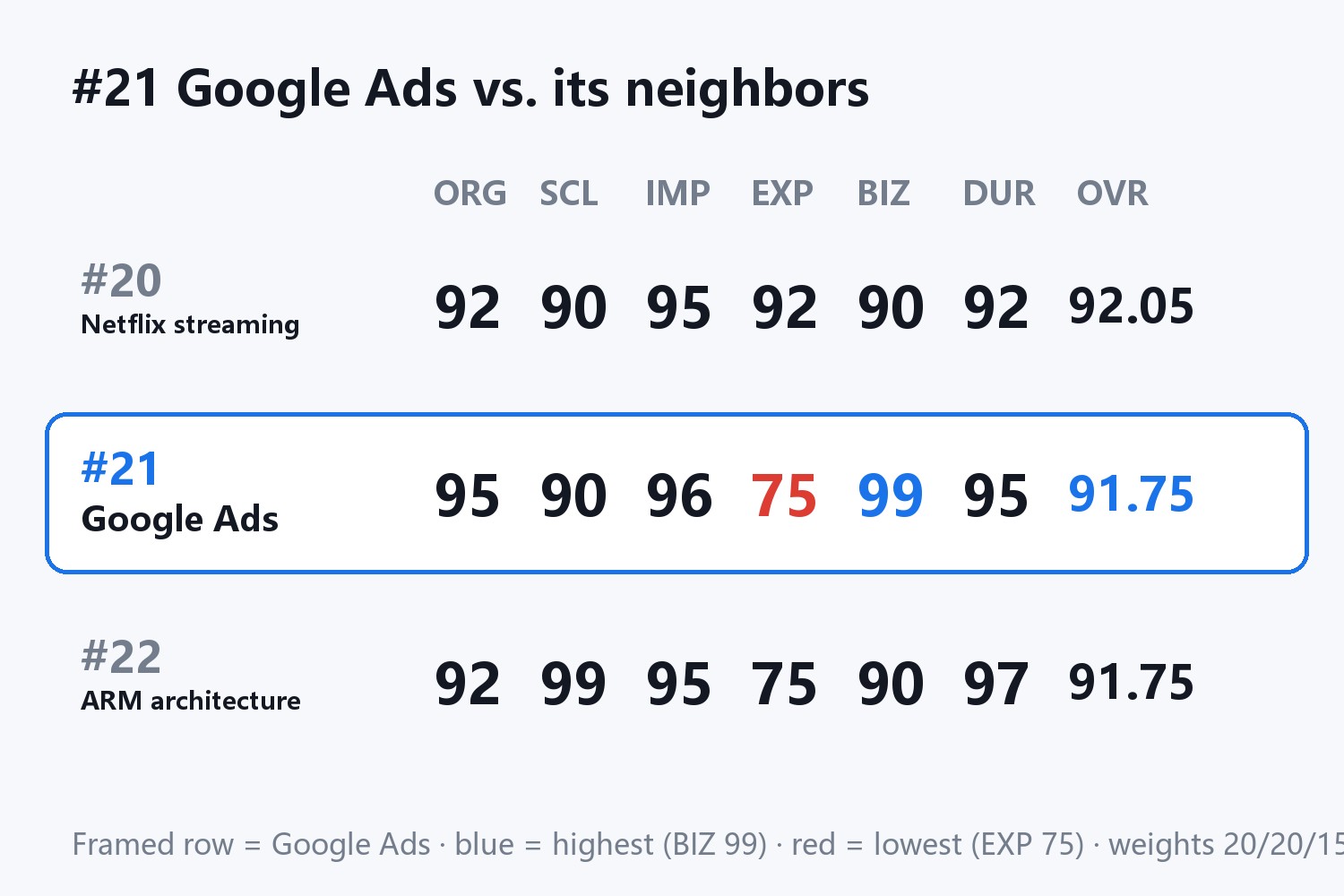
In the 100 Products That Changed the World framework, Google Ads (AdWords) earns a weighted overall score of 91.75 (displayed as 92), ranking #21 overall in the “Legend” tier:
1. Business: 99 (Tied for Highest Score on the Entire List)
If any product in human history deserves a 99 in Business, it is Google AdWords. Not only does it generate over $200 billion in annual revenue with extraordinary operating margins, it transformed marketing from a speculative art into a deterministic vending machine: put $1.00 of ad spend in, measure $3.00 of sales coming out, and scale infinitely.
2. Impact: 96
It financed the free internet. Without the cash flow generated by AdWords, Gmail, Google Maps, Chrome, YouTube, Android, and millions of independent websites across the open web could never have been offered to humanity for free.
3. Originality: 95
While GoTo.com invented pay-per-click (accounting for the 5-point deduction), AdWords invented Quality Score ranking (Bid × CTR), industrialized the Generalized Second-Price auction, and pioneered self-serve micro-budget ad buying. Every modern performance ad platform — from Meta Ads to TikTok and Amazon Sponsored Products — is built on the mathematical skeleton AdWords created in 2002.
4. Durability: 95
Across a quarter-century spanning desktop web, mobile smartphones, and now the rise of generative AI, AdWords has remained the undisputed profit engine of the digital economy.
5. Scale: 90
Processing billions of real-time auctions every day across the globe, it touches nearly every internet user. The 10-point deduction reflects its nature as a B2B merchant engine (used directly by millions of advertisers rather than billions of direct consumer operators) and its absence in certain geopolitically walled markets.
6. Experience: 75 (Tied for Lowest Score in the Top 25)
This is the starkest contrast on the scorecard: Business 99 vs. Experience 75 — a 24-point chasm. Why does a masterpiece of economic engineering score 75 on Experience? Because no matter how relevant the algorithm makes it, an ad is still a tollbooth placed between a human being and their answer. In its early years, AdWords was famous for austere, clearly shaded plain-text boxes. Over the past decade, driven by Wall Street’s relentless demand for quarterly growth, sponsored results have expanded to fill the entire first screen on mobile devices, while the visual distinction between paid ads and organic results has grown increasingly subtle. Meanwhile, the advertiser dashboard itself has ballooned into an intimidating labyrinth of automated bidding toggles. It conquered the world with 99-point commercial brilliance — and those 24 missing points in Experience are the exact hidden tax we pay for a “free” internet.
Epilogue
Most great products in history solved the problem of how to create value. Google AdWords solved an equally hard, indispensable problem: how to pay for it.
By marrying game theory, real-time click feedback, and self-serve software, it proved that monetization did not have to destroy utility — turning three lines of plain text into the economic engine of the digital age.
Discussion