100 Products That Changed the World · #20: Netflix Streaming
If you wanted to watch a Hollywood movie before 2007, your standard Friday evening ritual looked like this:
You drove to the nearest Blockbuster store, wandering through aisles of plastic cases. If you were lucky, the VHS or DVD of The Matrix wasn’t checked out. You presented your membership card and promised to return it by Sunday night — or face steep late fees that often exceeded the rental price itself.
If you followed a weekly broadcast TV drama, you had to be seated in front of your living room sofa at precisely 8:00 PM on Thursday. For every ten minutes of plot, you were subjected to four minutes of shampoo and pickup truck commercials. If you worked late or got stuck in traffic, the episode was lost until reruns aired months later.
On January 16, 2007, a Silicon Valley company known for mailing DVDs in distinctive red envelopes quietly placed an unassuming gray button in the top right corner of its website: “Watch Now.”
For under ten dollars a month, users no longer waited for the mail carrier. A single click in a web browser began streaming thousands of hours of movies straight across the internet.
From that moment, the half-century reign of the broadcast schedule and the brick-and-mortar video store entered irreversible decline.
The Fatal Move: Cannibalizing Your Own Golden Goose
The hardest decision in business history is rarely taking a desperate gamble in a crisis. It is deliberately strangling your most profitable business while you are at the absolute peak of your prosperity.
In 2007, Netflix was riding high. Its DVD-by-mail service with no late fees had decimated Blockbuster, generating over $1.2 billion in annual revenue from millions of loyal subscribers.
Yet founder Reed Hastings saw with total clarity that mailing physical discs was merely a physical compromise forced by narrow bandwidth. The company had been named “Net-flix,” not “DVD-by-mail.”
In late summer 2011, Hastings made an announcement that sparked widespread outrage and a public relations disaster:
He split Netflix into two separate businesses. Streaming would retain the Netflix brand at $7.99 per month, while physical DVD rental was spun off into a separate brand named “Qwikster,” also at $7.99 per month. For existing subscribers who wanted both, the monthly price jumped from $9.99 to $15.98.
Wall Street and subscribers reacted with fury. Within three months, over 800,000 customers canceled their subscriptions. Netflix’s stock plummeted by more than 75%, and media outlets mocked Hastings as arrogant and reckless.
Inside the company, executives pleaded with Hastings to roll back the split. But he held firm:
“If we hesitate to protect yesterday’s DVD profits, external competitors will tear us apart from the streaming flank. Rather than being disrupted by someone else, we must disrupt ourselves.”
That painful amputation proved to be the single most consequential strategic pivot in Netflix’s history:
While the physical disc business shrank, it freed the company entirely from the drag of warehouses, sorting machines, and postal logistics. The engineering and product teams focused all their compute, capital, and talent on the player experience and global cloud infrastructure. Five years later, Blockbuster filed for bankruptcy, while the unencumbered Netflix blew past 100 million subscribers.
Tearing Up the Schedule: Binge-Watching and Releasing Full Seasons
In the playbook of traditional television, “programming” was sacred.
TV network executives operated like ancient priests, deliberately doling out one episode per week and ending on cliffhangers to force audiences back to their sets week after week, so they could sell high-priced commercial slots to advertisers.
On February 1, 2013, Netflix released its $100 million political thriller House of Cards.
In the early morning hours, Netflix upended Hollywood’s rules: instead of airing one episode per week, it dropped all 13 episodes of Season 1 simultaneously.
Hollywood insiders ridiculed the move as suicidal: “If you give it all away at once, viewers will watch it in a weekend and cancel on Monday!”
The reality humbled the critics:
Millions of Americans spent the entire weekend glued to their screens, bingeing all 13 hours in a single sitting. Lexicographers officially codified “binge-watching” as the word of the year.
With that single product choice, Netflix declared that control of viewing time belongs to the audience, not the broadcast network.
Instead of holding viewers hostage to a calendar, Netflix trusted that handing over the complete work and providing deep immersion would create unmatched long-term retention.
Netflix followed up with critical quality-of-life innovations:
- Skip Intro: Audio and video recognition algorithms detect title sequences and surface a button, saving subscribers tens of millions of minutes of idle waiting every day.
- Post-Play: As end credits roll, the screen shrinks to the corner and a five-second countdown cues the next episode, reducing viewing friction to zero.
From Distribution Pipe to Original Creator: Algorithms and Open Connect
Early on, Netflix served as a cheap digital dumping ground for the major Hollywood studios’ back-catalogs.
When media conglomerates realized the existential threat of streaming and threatened to claw back their licenses, Netflix executed a high-wire leap into original production.
First, data-driven greenlighting replaced Hollywood guesswork.
House of Cards wasn’t approved based on a producer’s gut feeling. Netflix’s data showed that audiences who loved director David Fincher, audiences who favored Kevin Spacey films, and fans of the original British political miniseries intersected tightly. The production was greenlit based on a mathematically calculated return on investment.
Second, hyper-personalized artwork generation.
Even for the same title, different users see completely different thumbnail artwork on their home screens. A viewer with an affinity for romantic comedies sees a shot of the romantic leads, while an action movie enthusiast sees a high-octane chase or weapon close-up. Netflix’s contextual multi-armed bandit algorithms continuously A/B test artwork variations in real time to maximize click-through rates.
Third, custom global infrastructure: Open Connect.
Video streaming’s greatest technical nightmare is buffering and bandwidth cost. Rather than relying solely on expensive public cloud CDNs, Netflix designed its own high-density caching appliances and distributed them free of charge to thousands of Internet Service Providers (ISPs) worldwide, placing content within edge networks near neighborhoods.
Today, even when tens of millions of households hit play on 4K HDR streams on Friday nights, playback starts in milliseconds, handling roughly a third of all downstream fixed-broadband traffic in North America.
Six-Dimensional Score Breakdown
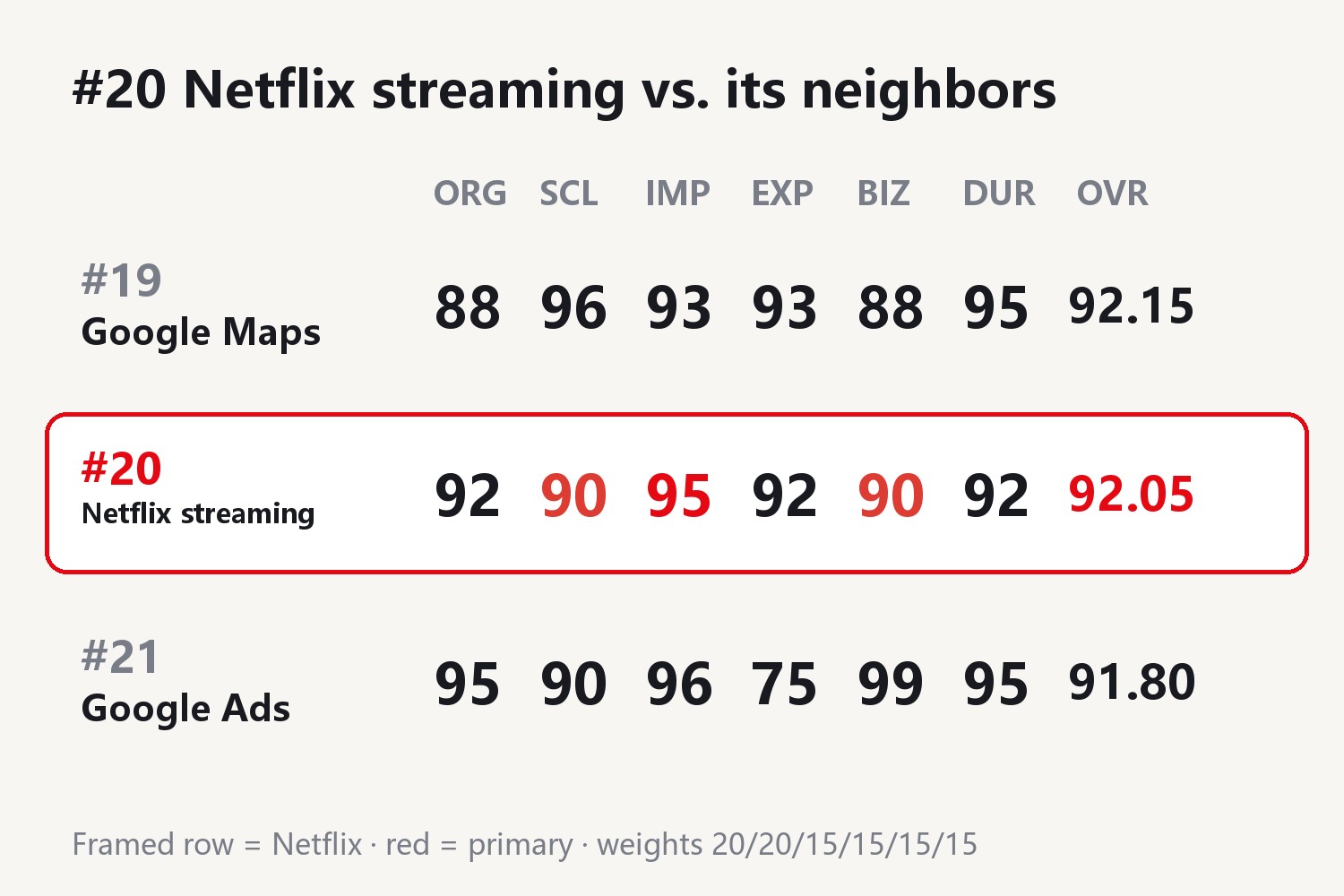
In the 100 Products That Changed the World scoring framework, Netflix streaming earns an overall score of 92.05, placing it at #20 in the heart of the “Legend” tier:
1. Impact: 95
It overhauled the entire production, distribution, and consumption model of filmed entertainment. It killed the video store and forced every legacy media giant (Disney, Warner, Paramount) into costly, high-stakes streaming transformations. Furthermore, it gave creators across 190+ countries a direct pipeline to 280+ million global households — turning non-English titles like Korea’s Squid Game and Spain’s Money Heist into worldwide cultural phenomena.
2. Originality: 92
It was not the first service to stream video over the internet, but it was the pioneer that proved an ad-free, all-you-can-eat monthly subscription model could scale into a multi-billion-dollar juggernaut. Full-season drops, skip-intro toggles, and algorithmic commissioning set the baseline for every modern streaming competitor.
3. User Experience (UX): 92
For over a decade, Netflix represented the gold standard of digital restraint: no pop-ups, no pre-roll ads, no pay-per-view upselling. Ultra-smooth cross-device resume and adaptive bitrate delivery made switching between mobile, tablet, and TV effortless. The 8-point deduction reflects recent concessions to growth pressures: the introduction of an ad-supported tier and the aggressive clamping down on password sharing outside households.
4. Durability: 92
Since 2007, Netflix has survived four distinct technological and market cycles: web streaming, mobile, smart TVs, and proprietary studio production, holding off well-funded assaults from Apple TV+, Prime Video, and Disney+. The deduction stems from the brutal reality of the content treadmill: its competitive moat requires continuous, capital-intensive content reinvestment, keeping its defensibility under constant strain.
5. Business: 90
Generating over $35 billion in annual revenue with more than 280 million paying households and strong free cash flow. The reason for a conservative 90 score among the top 20: entertainment streaming remains heavy capital-intensive industry. Annual content spending tops $17 billion, meaning marginal costs do not approach zero in the way pure software platforms (Windows, Google Search, WeChat) enjoy. It is an engine that demands continuous fuel.
6. Scale: 90
Operating in over 190 countries and consuming a massive share of worldwide downstream bandwidth. The deduction reflects the natural ceiling imposed by language, cultural taste, and discretionary entertainment budgets: compared to smartphone operating systems or global social networks used by billions daily, a paid subscription tier faces stiffer resistance in lower-income emerging markets.
Conclusion
The true triumph of Netflix streaming is not that a tech company built a video player, but that it used software, data, and a deep respect for human attention to rewrite the rules of entertainment.
It proved that when technology is frictionless and respect for the audience’s time is uncompromising, people will gladly pay.
Its counterpart on the product manager ranking is #16 Reed Hastings. Only a leader willing to kill his own golden goose at the height of its power earns the right to define the next era of computing and culture.
Discussion