100 Products That Changed the World · #18: The LEGO brick
If you take a fresh box of LEGO bricks bought from a store today, dig up a dusty brick molded in 1958, and press them together, you will hear a satisfying click—
A seamless, rock-solid clutch.
In the history of consumer industrial design, almost no other plastic product has survived nearly seventy years and hundreds of billions of production cycles while preserving its exact original physical interface.
What changed the world was not a toy, but an immutable physical standard locked into a single brick.
A decade of failing hollow shells
LEGO did not start with plastic bricks.
In 1932, Ole Kirk Christiansen, a carpenter in Billund, Denmark, lost his job during the Great Depression and began making wooden ladders, ironing boards, and wooden toys. He condensed the Danish phrase “leg godt” (play well) into a single name: LEGO.
In 1942, his woodworking shop burned to the ground. In 1947, Ole made a daring gamble: purchasing Denmark’s very first plastic injection molding machine to experiment with synthetic toys.
In 1949, LEGO launched the “Automatic Binding Bricks.”
Yet those early bricks were essentially half-finished: they were hollow rectangular shells with no internal grip. Bricks stacked loosely, and the slightest bump from a toddler’s hand would send a miniature tower tumbling down.
Most contemporary toymakers dismissed this instability as an inherent flaw of cheap plastic. But Ole’s son, Godtfred Kirk Christiansen—the second-generation leader of LEGO—saw something fundamentally different.
January 28, 1958: three tubes that changed history
Godtfred realized that to elevate bricks into a serious language of construction, he had to solve a paradox of physics: bricks had to lock together with enough clutch power to hold heavy structures, yet separate easily enough that a four-year-old child could pull them apart with bare hands.
At 1:58 PM on January 28, 1958, LEGO filed a landmark patent with the Danish patent office (Patent No. 92683).
The heart of the patent was the architecture we know today: the Stud-and-Tube Coupling System, placing hollow cylinders inside the underside of the brick.
When the underside tubes slide between the studs on the brick beneath, three-point frictional pressure locks them together with exceptional rigidity.
To ensure this clutch feel never degraded across decades, LEGO held its injection molds to a tolerance of 0.002 millimeters (2 microns)—thinner than one-thirtieth of a human hair.
That obsessive engineering tolerance created the distinct, addictive tactile damping that made the LEGO brick legendary.
The System of Play: network effects in the physical world
With the coupling patent secured, Godtfred made his second defining product decision: never sell standalone toys; sell an infinitely compatible system.
He drafted the famous LEGO principles, the core of which was: every piece must click with every other piece across sets and across decades.
This gave the LEGO brick a rare physical “network effect”:
- With conventional toys, the more you buy, the faster older toys get discarded.
- With LEGO, every new box you bring home increases the value of every brick already in your toy bin, because the combinatorial possibilities explode exponentially.
Mathematically, just two standard 2x4 eight-stud bricks can be combined in 24 different ways. Six standard 2x4 bricks yield 915,103,765 possible combinations.
This philosophy—combining simple atomic building blocks into complex emergent systems—mentored generations of architects, engineers, and programmers. From object-oriented programming (OOP) and microservices to modular tools like Notion, modern software architecture draws directly from LEGO’s logic.
The 2003 near-death crisis: back to the brick
Even a miracle product can lose its way.
In the late 1990s, panicked by video games and the internet, LEGO’s leadership suffered corporate anxiety. They diversified recklessly: burning cash on proprietary theme parks, apparel, digital watches, and single-use, non-modular action figures.
The result was catastrophe: LEGO’s component count ballooned from 6,000 to over 12,000 unique parts, suffocating the supply chain and molding economics. In 2003, LEGO lost over $200 million, carried nearly $1 billion in debt, and hovered on the brink of bankruptcy.
In 2004, newly appointed CEO Jørgen Vig Knudstorp staged one of the most celebrated turnarounds in corporate history.
His core product mandate was simple: strip away everything that is not the brick, and return to 1958.
He sold off controlling stakes in theme parks, slashed the parts catalog by half, mandated that all new product lines build upon the core stud-and-tube system, and embraced adult fans (AFOLs) through crowdsourced co-creation (LEGO Ideas) alongside major IP partnerships like Star Wars and Harry Potter.
LEGO emerged as the most profitable toy company on the planet, surpassing Hasbro and Mattel.
Why it ranks #18
| Dimension | Score | Why |
|---|---|---|
| Originality ORG | 92 | Patented the stud-and-tube coupling system in 1958, transforming loose stacking blocks into a precision construction system |
| Scale SCL | 92 | Hundreds of billions of bricks molded; an estimated 100+ bricks for every human being on earth |
| Impact IMP | 88 | Mentored modular thinking across generations of architects, scientists, and software developers; the universal metaphor for composability |
| Experience EXP | 95 | The two-micron tolerance produces the iconic tactile clutch and effortless separation, a peak standard in physical product feel |
| Business BIZ | 90 | Rescued from the brink of bankruptcy to become the world’s most profitable toy empire via IP partnerships, modular network effects, and adult collector markets |
| Durability DUR | 98 | One of the highest durability scores on the entire ranking. The 1958 physical standard has survived nearly 70 years without being displaced by digital entertainment |
Overall OVR 92.45, ranked #18.
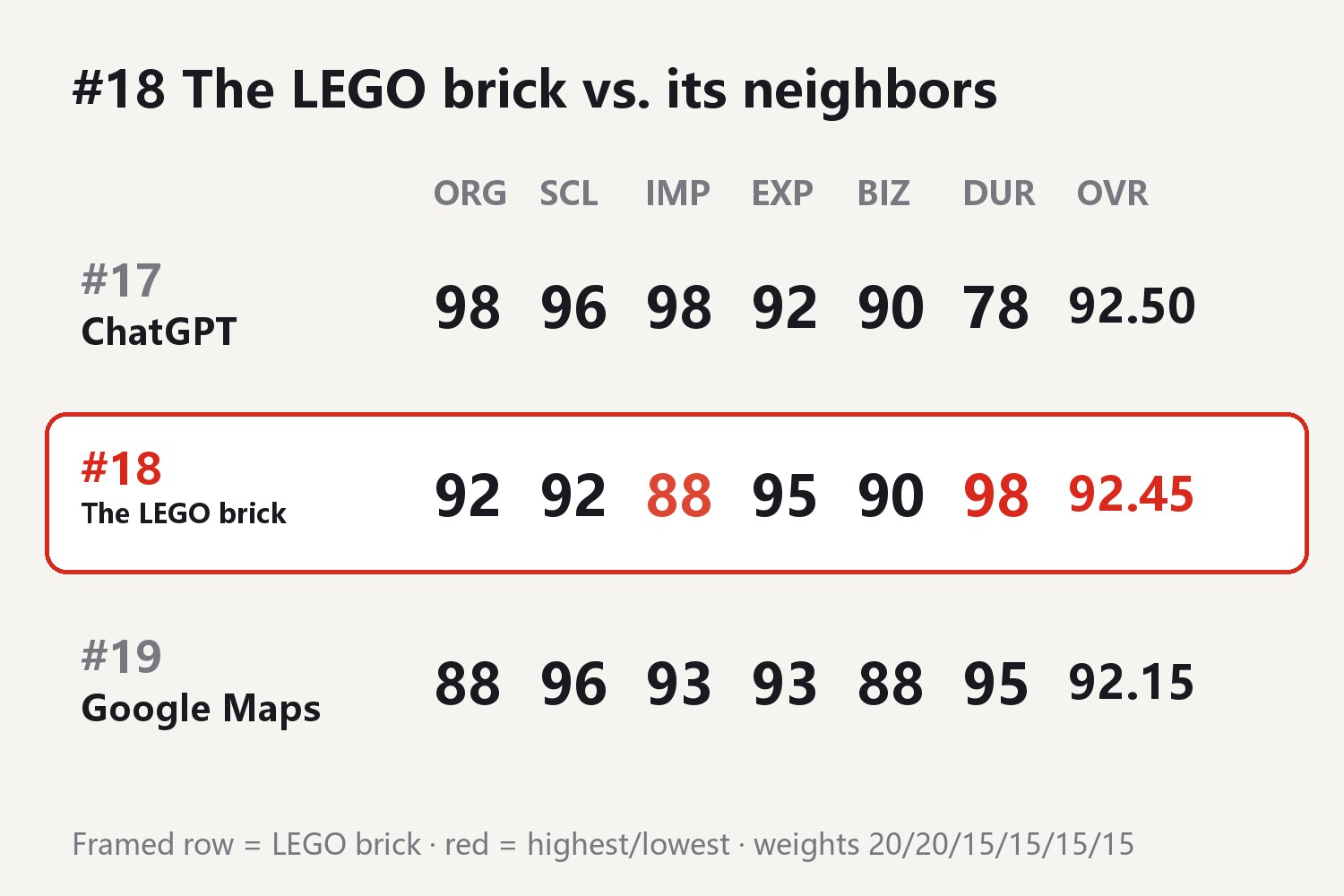
It ranks just behind #17 ChatGPT (92.50), separated by only 0.05. This pairing is one of the most revealing contrasts on the entire list. ChatGPT represents the explosive apex of modern AI, scoring near-perfect 98s in originality and impact, but holding only 78 in durability because it is not yet four years old. LEGO stands at the opposite pole: a 68-year unbroken physical legacy commanding a 98 in durability and a 95 in tactile experience. One is an overnight planetary breakthrough; the other is a living industrial fossil that never aged.
It leads #19 Google Maps (92.15) by 0.30. Google Maps boasts broader global scale (96 vs. 92) and navigation utility (93 vs. 88); but LEGO wins on foundational mechanical invention (92 vs. 88), tactile perfection (95 vs. 93), and seven uninterrupted decades of cultural endurance (98 vs. 95).
While countless digital software empires vanish across hardware cycles, the LEGO brick rests quietly on living room floors worldwide: press two pieces together, and the mechanical wonder engineered in 1958 clicks as perfectly as the day it was born.
All scores and rankings in this article were generated by Claude (AI).
Cover image is an original infographic illustrating the stud-and-tube coupling system and 0.002mm tolerance; contains no official LEGO trademarks or packaging artwork.
Facts and timeline: 1932 founding in Billund, 1942 fire, 1947 injection molding machine, 1949 Automatic Binding Bricks, January 28, 1958 patent (Danish No. 92683), 0.002mm manufacturing tolerance, 915,103,765 combinations for six 2x4 bricks, 2003 near-bankruptcy and expansion to 12,000 parts, and the 2004 turnaround led by Jørgen Vig Knudstorp, sourced from LEGO House historical archives, the corporate history Brick by Brick by David Robertson, and Encyclopædia Britannica.
Discussion