Duan Yongping: How China's Most Elusive Product Godfather Built Subor, BBK, OPPO, and vivo—and Mentored Pinduoduo's Founder—by 'Daring to Be Late'
In June 2006, a 45-year-old Chinese entrepreneur named Duan Yongping paid $620,100 to win Warren Buffett’s annual charity lunch. Under the auction rules, the winner could bring up to seven guests. Alongside his longtime hardware lieutenants, Duan invited an unknown 26-year-old computer science graduate who had just returned from the University of Wisconsin.
Ten years later, that young guest—Colin Huang (Huang Zheng)—founded Pinduoduo and Temu, tearing open a duopoly that Alibaba and JD.com thought was permanently sealed.
If you unroll a map of modern Chinese consumer electronics and e-commerce, a startling pattern emerges:
- OPPO (led by Tony Chen) and vivo (led by Shen Wei), which consistently rank among the world’s top five smartphone makers, along with OnePlus (Pete Lau) and Realme;
- BBK Education Electronics and imoo (Xiaotiancai) smartwatches (led by Jin Zhijiang), which have dominated Chinese K–12 educational hardware for twenty-five years;
- Pinduoduo / Temu (Colin Huang) and J&T Express (Jet Lee)…
All of these fiercely independent empires—generating hundreds of billions of dollars in combined annual revenue—trace their lineage back to one soft-spoken man who retired from day-to-day management at age 40 in 2001.
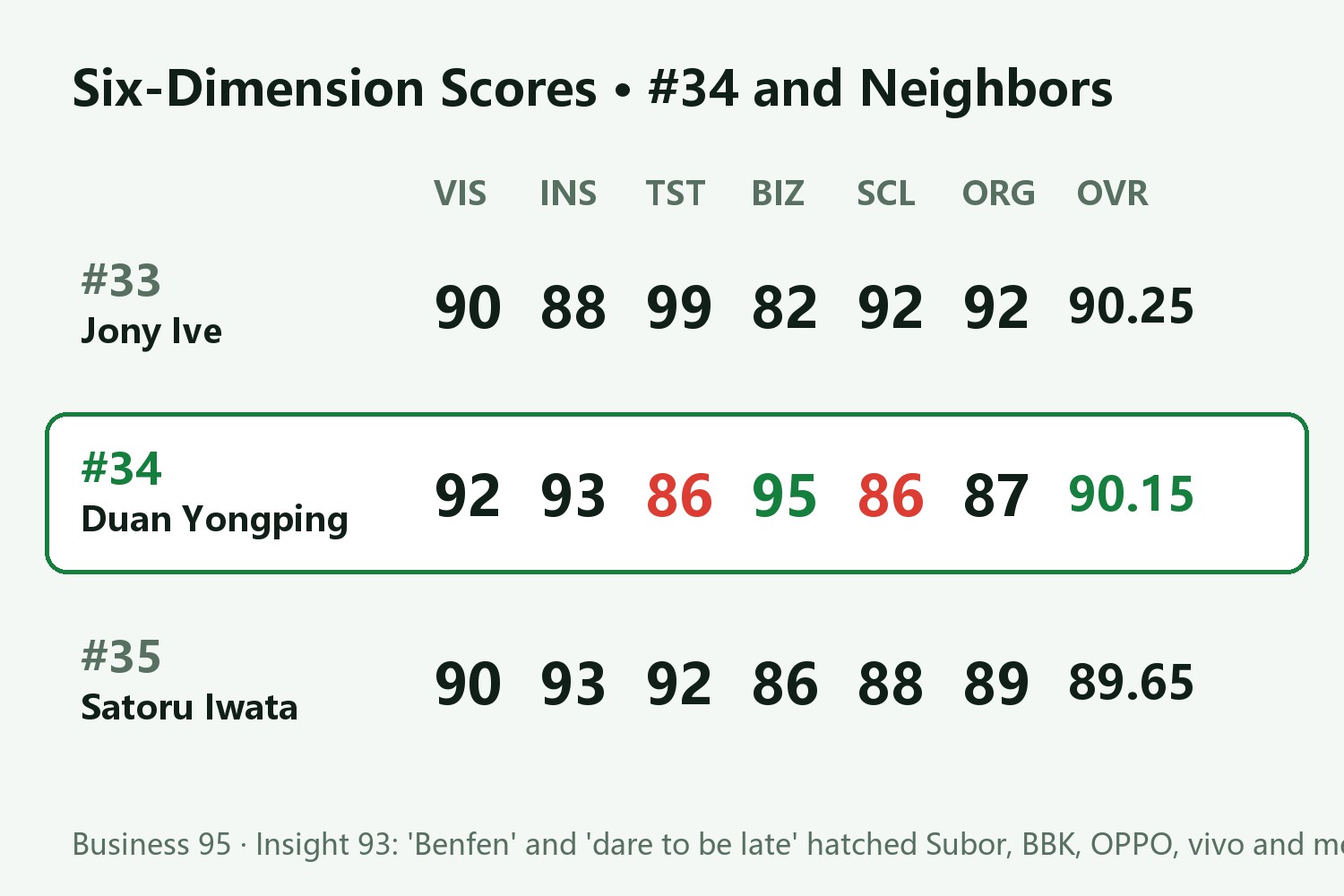
In our ranking of the 100 Product Managers Who Changed the World, Duan Yongping stands at #34 with an overall score of 90.15 (scored by Claude AI under our unified six-dimension framework): 95 in Business, 93 in Insight, 92 in Vision, 87 in Originality, 86 in Taste, and 86 in Scale.
He was never a design autocrat obsessing over a 1mm bevel like Jony Ive, nor a first-principles technologist like Elon Musk. Instead, Duan engineered something arguably rarer: a repeatable organizational and product operating system built on “Benfen” (staying true to duty), “Daring to Be Late,” and a ruthless “Stop Doing List.”
1. Turning a Clone Red Ocean into a National Brand: The Subor “Learning Machine” Insight
In March 1989, 28-year-old Duan Yongping took over a bankrupt electronics workshop in Zhongshan, Guangdong, carrying 2 million RMB in debt and a dozen soldering irons.
At the time, Nintendo’s Famicom (NES) was sweeping the globe. In early-1990s China, however, an imported Nintendo console cost over 1,000 RMB—nearly a full year’s wages for a factory worker—while street stalls overflowed with shoddy knockoff consoles that burned out after a week.
More importantly, Duan spotted a structural split between the user and the payer:
- The user was a ten-year-old child desperate to play Contra and Super Mario;
- The payer was a working-class Chinese parent terrified that video games would ruin their only child’s future.
Instead of competing in a race-to-the-bottom price war selling cheap game consoles, Duan redefined the category in 1993 with the Subor (Xiaobawang) Computer Learning Machine:
- A brilliant hardware graft: He housed the 8-bit console motherboard inside a full PC-style mechanical keyboard, bundling a cartridge that taught typing, BASIC programming, and classical poetry alongside game slots;
- Reframing the purchase for parents: In the early 1990s, Chinese parents were anxious that their children would be left behind in the computer age, yet a real 386 PC cost over 10,000 RMB. Duan spent 400,000 RMB—nearly all the factory’s cash—to hire Jackie Chan for a prime-time CCTV commercial with a slogan that every Chinese millennial still knows by heart: “All parents share the same heart; Subor helps your child become a dragon!”;
- Obsessive reliability: While rival workshops cut corners on capacitors and suffered 30%+ defect rates, Duan enforced strict drop and thermal burn-in testing, keeping Subor’s defect rate below 2%.
At roughly 300 RMB, children got their dream console and parents bought peace of mind. By 1995, Subor commanded nearly 80% of China’s market, turning a 2-million-RMB deficit into over 1 billion RMB in annual revenue.
| Four Generations of Duan-Linked Products | Market Timing vs. First Movers | The “Dare to Be Late” Edge | Ultimate Market Outcome |
|---|---|---|---|
| Subor Learning Machine (1991–1995) | 8 years after Nintendo’s Famicom | 8-bit console + PC keyboard + Jackie Chan ad reframed gaming as affordable computer literacy | 80%+ domestic share; 1B+ RMB revenue; onboarded China’s first generation of coders |
| BBK VCD & Cordless Phones (1996–2000) | Entered after Idall (Aiduo) & Siemens | Waited for laser-head supply maturity; won on error-correction quality + profit-sharing provincial dealers | First-mover Idall collapsed; BBK became #1 nationwide in VCDs, repeaters & cordless phones |
| BBK Point-Reading Pen & imoo Watch (2005+) | Entered after Noah & Ozing | Ultra-simple tap-to-read UX; imoo locked in elementary school kids via proprietary shake-to-add-friends social graph | Dominated Chinese K–12 educational hardware for 20 years |
| OPPO & vivo Smartphones (2011+) | Entered after Apple, Samsung & Xiaomi | Killed MP3/DVD lines overnight; bet on VOOC fast charging, selfie cameras, and 200,000+ lower-tier town stores | Consistently top 5 globally for a decade; ~40% combined share of China’s smartphone market |
2. “Dare to Be Late”: Why Duan Never Chased First-Mover Advantage
Silicon Valley worships First-Mover Advantage—the belief that whoever defines a category first takes the crown.
Across thirty years in hardware, Duan proved the exact opposite doctrine: “Dare to be late, then out-execute everyone” (敢为天下后,后中争先).
In the summer of 1995, after his equity-sharing proposal for Subor was rejected by the parent conglomerate, Duan left with six core lieutenants—including Tony Chen, Shen Wei, and Jin Zhijiang—and founded BBK (Bubugao) in Dongguan.
Over the next two decades, the BBK family navigated six brutal hardware transitions: VCD players, DVD players, MP3/MP4 players, feature phones, and smartphones. Remarkable as it sounds, BBK, OPPO, and vivo were never first to market in any of those six waves.
Why did waiting work every single time?
Because Duan understood a brutal law of mass-market hardware: pioneers spend 80% of their capital paying two tuition fees on behalf of the entire industry—first, debugging immature supply chains with high return rates; second, educating consumers on why the category needs to exist at all.
Under Duan’s playbook:
- Never bet the company on unproven categories while component yields are at 60%;
- Once consumer demand is proven and upstream silicon hits the maturity curve, enter with overwhelming force around one visceral user pain point (such as OPPO’s “Charge for 5 minutes, talk for 2 hours” VOOC flash charging) backed by China’s deepest profit-sharing retail distribution network;
- Never fight price wars: While early pioneers bled out from supply-chain crunches or cash-flow overextension, BBK consistently harvested the matured market with higher quality and healthier margins.
3. “Benfen” and the Stop Doing List: Designing an Anti-Fragile Organization
Visitors to OPPO and vivo headquarters in Dongguan are often baffled by the absence of Silicon Valley buzzwords. Instead of OKR dashboards or “wolf culture” slogans, executives talk endlessly about two deceptively simple concepts: “Benfen” (integrity / doing one’s proper duty) and a “Stop Doing List.”
Duan defines Benfen in one sentence: “Do the right thing, and do things right.”
How does an organization know what the “right thing” is? Duan argues that human beings are terrible at predicting the future three years out, but very good at recognizing what is fundamentally wrong. The moment you realize an action violates long-term health—no matter how much short-term profit it generates—you put it on the Stop Doing List and never touch it again:
- No OEM / contract manufacturing: Even when factory lines sat idle and Walmart offered tens of millions for white-label orders, BBK refused—because easy OEM money destroys a team’s discipline to build its own brand;
- No credit sales or supplier squeezing: BBK insisted on cash-on-delivery with dealers and timely payment to component suppliers, surviving every macro credit crunch that killed flashier rivals;
- Decentralized equity and dealer partnerships: In 1999, Duan split BBK into three independent companies (OPPO, vivo, and BBK Education), diluting his own stake to empower his protégés and binding provincial distributors as long-term equity partners. When smartphones wiped out billions in feature-phone inventory in 2011, not a single provincial distributor defected;
- Kill mistakes immediately, regardless of sunk cost: When OPPO spent over 100 million RMB building an internet content portal (NearMe) in 2011 and realized hardware companies lack pure portal DNA, Tony Chen and Duan shut it down within a week.
That self-correcting system allowed Duan to step down at age 40 in 2001, move to California, and apply the exact same product lens to public equities—investing $2 million in NetEase in 2002 when the stock traded below $1 (reaping over 100x), and pouring billions into Apple in 2011 right as Wall Street doubted Tim Cook’s transition, because his own smartphone supply-chain teams told him nobody on earth could match Apple’s ecosystem lock-in.
4. Six-Dimension Breakdown: Why a Retired Hardware Hermit Ranks #34
Under the unified six-dimension framework of 100 Product Managers Who Changed the World (Vision 20%, Insight 20%, Taste 15%, Business 15%, Scale 15%, Originality 15%), Duan Yongping scores as follows:
| Dimension | Weight | Score | Key Rationale |
|---|---|---|---|
| Vision | 20% | 92 | Authored the “Dare to Be Late” and “Stop Doing List” doctrines; nailed every platform shift from 8-bit consoles to smartphones and Apple’s ecosystem |
| Insight | 20% | 93 | Decoded the split between payer and user in Chinese families (Subor, imoo) and mainstream consumers’ desire for fast charging and camera beauty |
| Taste | 15% | 86 | Pragmatic mass-market roots that evolved into world-class industrial design in the OPPO Find and OnePlus flagship lines |
| Business | 15% | 95 | Engineered China’s most resilient equity-aligned distributor network and mentored four separate multi-billion-dollar founders |
| Scale | 15% | 86 | Over 200M annual devices across OPPO, vivo, and imoo, plus his mentorship imprint on Pinduoduo’s billion-user commerce engine |
| Originality | 15% | 87 | Rejected technical first-mover vanity to pioneer a uniquely Eastern school of decentralized governance and second-mover dominance |
| Overall (OVR) | 100% | 90.15 | Ranked #34 Overall (just behind #33 Jony Ive at 90.25, ahead of #35 Satoru Iwata at 89.65) |
In 2026—an era when AI startups panic if they are seventy-two hours late to a model release—Duan Yongping’s thirty-year track record offers the ultimate antidote to hype: Slow is fast. You do not need to be the first person to invent the category; you just need the discipline to stop doing short-term foolish things, and the patience to make the product people actually use every day.
Discussion