100 Product Managers Who Changed the World · #31: Marc Andreessen
In the winter of 1992, inside a basement lab at the National Center for Supercomputing Applications (NCSA) at the University of Illinois Urbana-Champaign, a 21-year-old undergraduate earning $6.85 an hour stared at a Unix workstation.
Tim Berners-Lee had already invented the World Wide Web at CERN, yet fewer than a hundred thousand people on Earth actually used it — almost all of them particle physicists and computer science professors.
Why didn’t ordinary human beings care about the internet?
The 6-foot-5 student from Wisconsin, Marc Andreessen, saw the bottleneck immediately: the early internet was a forbidding desert of command-line text. Reading a document required memorizing arcane protocols; viewing a photograph meant downloading a separate binary file and launching an external image viewer. Text and images could not even coexist inside the same window.
“If the Web remains rows of monochrome academic directories,” Andreessen realized, “it will stay a toy for university faculty forever.”
Teaming up with NCSA staff programmer Eric Bina and fueled by late-night Mountain Dew and Nabisco Sugar Wafers, Andreessen spent three months coding around the clock. In January 1993, they released a compact piece of software that detonated across human history: NCSA Mosaic.
A Single <img> Tag: Giving the Internet a Face
Reviewed through the lens of modern product management, three decisions Andreessen made at age twenty-two defined how humanity would interact with information for the next thirty years:
- Inventing the inline
<img>tag: Before Mosaic, HTML had hyperlinks, not magazine-style layouts. Ignoring purists who complained that pictures would clog academic backbones, Andreessen proposed and shipped the<IMG>tag — allowing color photographs and text paragraphs to render side by side on the same page for the first time. When newspaper editors and merchants saw a webpage that looked like a living magazine, the commercial potential of the Web became self-evident overnight; - Point-and-click simplicity: He replaced terminal commands with underlined hypertext links and a clean toolbar featuring the Back and Forward buttons that billions of people still click by muscle memory today;
- Cross-platform, free distribution: While earlier browsers ran only on expensive NeXT or Unix workstations, Andreessen insisted on shipping Mosaic for everyday Windows PCs and Apple Macs, downloadable for free by anyone.
Within twelve months of Mosaic’s release, global Web traffic exploded by more than 10,000%.
Andreessen did not invent the underlying pipes of the internet, but he did something equally transformative in product history: he gave the internet a graphical face that ordinary people could understand at a glance.
Netscape and the Browser Wars: Losing the Battle, Winning the Modern Web
In 1994, fresh out of college, Andreessen flew to Silicon Valley and teamed up with legendary entrepreneur Jim Clark to found Mosaic Communications — soon renamed Netscape.
Rewriting the browser from scratch as Netscape Navigator, Andreessen made another brilliant user-experience call tailored to the brutal reality of 14.4 kbps dial-up modems:
Earlier browsers waited until an entire webpage and all its images finished downloading before drawing anything on screen, leaving users staring at a blank white window for a full minute. Andreessen insisted on progressive rendering (“on-the-fly layout”) — painting the text immediately so users could start reading and clicking links while images filled in progressively line by line.
Within months, Netscape captured over 80% of the global browser market.
On August 9, 1995 — just sixteen months after incorporation and without a dime of profit — Netscape went public on NASDAQ. Its stock soared from $28 to $75 on day one, valuing the young company at $2.9 billion. A barefoot 24-year-old Marc Andreessen graced the cover of Time magazine, firing the starting gun for the global dot-com boom.
Netscape’s meteoric rise woke up Microsoft’s Bill Gates (#8). In late 1995, Gates issued his famous Internet Tidal Wave memo and bundled Internet Explorer free inside every copy of Windows.
Crushed by Microsoft’s operating-system distribution monopoly in the First Browser War, Netscape was eventually acquired by AOL in 1998 for $4.2 billion.
Yet viewed from thirty years later, the product seeds Andreessen planted at Netscape ended up ruling the modern digital world:
- JavaScript: Convinced that the browser should become an application platform rather than a static document viewer, Andreessen hired Brendan Eich in 1995 to create JavaScript in ten frantic days — the language that powers virtually every interactive website on Earth today;
- SSL / HTTPS & Cookies: To make online shopping possible, Netscape engineered the Secure Sockets Layer (SSL) protocol (complete with the browser padlock icon) and HTTP Cookies, laying the technical foundation for trillions of dollars in global e-commerce;
- Open-Sourcing Mozilla: In early 1998, before handing the keys to AOL, Netscape open-sourced its entire codebase as the Mozilla Project — the phoenix that later gave birth to Firefox and kept the open Web alive until Chrome arrived.
”Software Is Eating the World” — The Man Who Funds Product Builders
After Netscape, Andreessen proved he was no one-hit wonder by co-founding data-center automation pioneer Opsware (acquired by Hewlett-Packard for $1.65 billion in 2007). Then, in 2009, he and longtime partner Ben Horowitz launched Andreessen Horowitz (a16z).
They redesigned venture capital itself as a product: replacing suited financiers with battle-tested technical founder-CEOs backed by a full-service operating platform for recruiting, marketing, and enterprise sales.
On August 20, 2011, while Wall Street was still shell-shocked from the 2008 financial crisis, Andreessen published his famous essay in The Wall Street Journal: “Why Software Is Eating the World.”
“Every company in every industry needs to assume that a software revolution is coming… In the next 10 years, iconic silicon-valley style software companies are going to overturn every traditional industry on Earth.”
Backing that thesis with over $40 billion in assets under management, he went on to fund Facebook, Twitter, GitHub, Instagram, Airbnb, Stripe, Coinbase, and today’s frontier AI wave from OpenAI and Mistral to Cursor and ElevenLabs.
Six-Dimension Score Breakdown
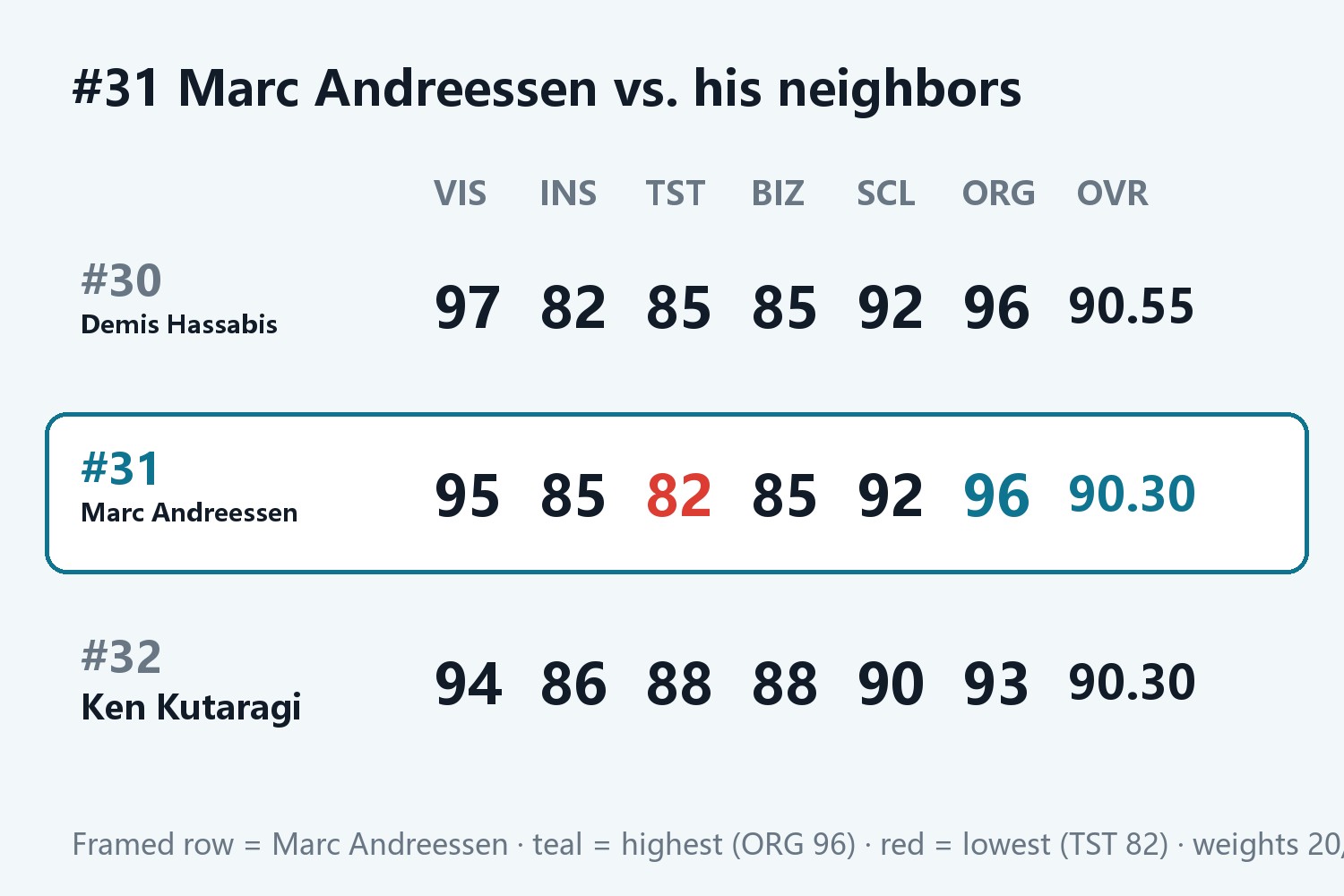
In the 100 Product Managers Who Changed the World framework, Marc Andreessen earns a weighted overall score of 90.30 (displayed as 90), ranking #31 overall right behind Demis Hassabis (#30):
| Dimension | Weight | Marc Andreessen Score | Key Rationale & Milestone Evidence |
|---|---|---|---|
| Originality | 15% | 96 | Co-created the inline-image graphical browser (Mosaic); catalyzed JavaScript, SSL/HTTPS, Cookies, and open-source Mozilla at Netscape |
| Vision | 20% | 95 | Predicted in 1995 that the browser would replace the OS (proven by SaaS/cloud 20 years later); penned Software Is Eating the World in 2011 |
| Scale | 15% | 92 | Netscape commanded 80%+ of the early Web; the graphical browser paradigm he defined now serves 5+ billion internet users daily |
| Insight | 20% | 85 | Saw immediately that inline images and progressive loading would unlock mass consumer adoption; underestimated OS-level bundling moats |
| Business | 15% | 85 | Netscape’s 1995 IPO invented modern tech capital markets; $1.65B Opsware exit; built a16z into Silicon Valley’s premier VC powerhouse |
| Taste | 15% | 82 | Championed move-fast, ship-everything engineering pragmatism over minimalist restraint (famously birthing the <blink> tag) |
1. Originality: 96 (Highest Dimension)
Take apart any modern webpage and you are looking at Netscape’s workshop: inline images (<img>), client-side scripting (JavaScript), encrypted transactions (SSL/TLS), stateful sessions (Cookies), and open-source browser engines (Mozilla). Few individuals in history have Midwifed so many foundational primitives of digital life.
2. Vision: 95
Andreessen’s superpower has always been seeing a decade ahead of consensus. When he declared in 1995 that Windows would eventually be reduced to “a mundane set of poorly debugged device drivers” beneath the browser, critics laughed — until cloud apps from Google Docs and Figma to ChatGPT proved him right.
3. Scale: 92
Beyond Netscape’s 80% market share in the 1990s, the graphical browser interface he popularized at age 22 remains the universal portal through which more than 5 billion humans access the internet every single day.
4. Insight: 85 & Business: 85
He understood instantly what non-technical humans needed to fall in love with the Web, and his 1995 Netscape IPO wrote the playbook for how modern technology companies go public. He scores 85 rather than 95 because young Netscape struggled to defend its commercial moat against Microsoft’s bundling war and bloated its later releases into the heavy Netscape Communicator suite.
5. Taste: 82 (Lowest Dimension)
Unlike Steve Jobs (#1) or Jony Ive (#32), Andreessen never worshipped minimalist restraint. His philosophy at Netscape was unrelenting speed and feature maximalism — best captured by the infamous <blink> tag, born during a late-night bar conversation and shipped into Netscape Navigator to the eternal agony of graphic designers everywhere.
Epilogue
In January 1993, when a 22-year-old Marc Andreessen compiled the first version of Mosaic in a freezing Illinois basement, the entire World Wide Web consisted of a few hundred text directories.
Thirty years later, the kid who gave the internet its face sits on Sand Hill Road — watching the software seeds he planted finish eating the world.
Discussion