100 Product Managers Who Changed the World · #30: Demis Hassabis
On October 9, 2024, the Royal Swedish Academy of Sciences awarded the Nobel Prize in Chemistry to an artificial intelligence builder from London — Demis Hassabis.
The announcement sent a rare tremor through both Silicon Valley and the global scientific establishment. Never before had the chief executive of a software lab stood on the Nobel stage in Stockholm because of a computer program his team had shipped.
To the public, Hassabis looks like a pure scientist. Yet if you examine his thirty-year trajectory closely, he represents one of the rarest archetypes in technology history: the milestone-driven product leader of frontier science.
Rather than optimizing conversion funnels or A/B-testing button colors, Hassabis excels at packaging reinforcement learning and neural architectures into unmistakable, civilization-scale product moments:
- In 2016, he turned deep reinforcement learning and Monte Carlo tree search into AlphaGo, defeating world champion Lee Sedol in Seoul with the legendary “Move 37” and awakening the world to modern AI in a single afternoon;
- Between 2020 and 2024, he turned geometric attention networks into AlphaFold, compressing a protein-structure discovery process that once took PhD students years and hundreds of thousands of dollars into minutes — and open-sourcing the 3D structures of all 200 million known proteins;
- Today, following the merger of Google Brain and DeepMind under his sole command, he leads the Gemini model family and serves as the chief architect of Google’s AI empire.
Chess Master at 13, Million-Selling Game Designer at 16
To understand why Hassabis approaches fundamental science like a sequence of boss levels in a video game, you have to return to his childhood in North London.
Born in 1976 to a Greek-Cypriot father and a Singaporean-Chinese mother, Hassabis learned chess at age four. By thirteen, he was a chess master with an Elo rating of 2300 — ranked second in the world for his age group behind only Judit Polgár.
At age eight, Hassabis used his chess tournament winnings to buy his first computer, a ZX Spectrum 48K.
Playing chess and writing code side by side planted the question that would define his life: Why could his own brain learn to play chess from scratch, while computers could only execute rigid heuristics programmed by humans? Could a machine be built to learn how to think on its own?
After finishing high school two years early and winning a place at Cambridge University at age fifteen, he was told by the university to take a mandatory gap year because he was too young to matriculate. Hassabis entered a coding competition, won an internship at the legendary British studio Bullfrog Productions, and spent his gap year co-designing and lead-programming Theme Park alongside Peter Molyneux.
He was sixteen years old.
Inside Theme Park, every visitor was simulated as an autonomous agent with its own hunger, excitement, and spending habits. Make the fries slightly saltier, and visitors bought more soda; build a roller coaster with too many loops, and they got sick on the pavement.
Theme Park sold millions of copies worldwide, paid for Hassabis’s entire Cambridge education, and gave him his first taste of building intelligent worlds inside silicon.
After graduating from Cambridge with a Double First in Computer Science and running his own game studio, Hassabis made a move no typical tech founder would consider: he shut down his company and enrolled at University College London (UCL) to earn a PhD in cognitive neuroscience.
His reasoning was classic product first-principles: if you want to engineer general intelligence, you should first inspect the only working prototype in existence — the human brain’s hippocampus.
London, 2010: The Two-Step Roadmap Nobody Believed
In 2010, while Silicon Valley venture capitalists werestampeding into mobile photo filters and local delivery apps, 34-year-old Hassabis co-founded DeepMind in London with Shane Legg and Mustafa Suleyman.
At the time, uttering the phrase “Artificial General Intelligence” in a pitch meeting was a guaranteed way to get shown the door. Yet on page one of DeepMind’s founding blueprint, Hassabis wrote the two-step mission statement that would guide the company for the next fifteen years:
Step 1: Solve intelligence. Step 2: Use it to solve everything else.
How do you prove you are solving intelligence? Hassabis used his game-designer instincts: turn 49 classic Atari 2600 games into a universal benchmark.
In late 2013, DeepMind unveiled its Deep Q-Network (DQN). The system was given zero game rules and zero domain code — only raw screen pixels and the score counter.
At first, the agent flailed randomly. After a few hours of playing Breakout against itself, however, it discovered a strategy that stunned even human veterans: carving a narrow tunnel up the far-left edge of the brick wall so the ball could bounce trapped above the ceiling, clearing the board automatically with minimal risk.
When Google co-founder Larry Page saw the Atari demo in London, he acquired DeepMind in January 2014 for $650 million. Hassabis turned down a higher offer from Facebook because Google agreed to his non-negotiable condition: an independent ethics board and unrestricted access to planetary-scale compute to pursue scientific grand challenges.
Move 37 and the Nobel Prize Moment
If Atari convinced computer scientists, AlphaGo in March 2016 was Hassabis’s masterclass in global product storytelling.
With $10^{170}$ possible board positions — more than the number of atoms in the observable universe — the ancient game of Go was universally regarded as at least twenty years beyond the reach of AI.
On March 10, 2016, during Game 2 at the Four Seasons Hotel in Seoul, AlphaGo played Move 37 — a fifth-line shoulder hit on the right side of the board that violated centuries of human Go doctrine. Commentators initially thought it was a mouse slip. Lee Sedol stared at the board in silence for fifteen minutes, stood up, and walked out to smoke a cigarette. A hundred moves later, that single stone proved to be the linchpin of a breathtaking victory.
Over 280 million people watched the match live.
Yet what Hassabis did next revealed his true product discipline:
In 2017, after shipping AlphaGo Zero — which discarded all human game records, trained purely via self-play from random stones for 72 hours, and defeated the Lee Sedol version 100 games to 0 — Hassabis immediately disbanded the Go project and pivoted his best minds to Step 2: the 50-year grand challenge of protein folding.
In biology, a protein’s 3D shape dictates its function. For half a century, determining the shape of a single protein via X-ray crystallography or cryo-electron microscopy could take a researcher years of lab work. After fifty years of human effort, science had mapped roughly 170,000 proteins out of more than 200 million known to exist across nature.
In late 2020, Hassabis and John Jumper unveiled AlphaFold 2, predicting 3D protein structures down to atomic accuracy in minutes.
Then came the product decision that earned the Nobel Prize:
Instead of locking AlphaFold behind an enterprise paywall for pharmaceutical giants, Hassabis partnered with EMBL-EBI to fold all 200 million known proteins in nature and release the entire database to humanity for free.
Today, over 2 million researchers across 190 countries query the AlphaFold Database like a public utility — accelerating drug discovery, malaria vaccines, and plastic-degrading enzymes by a decade or more.
Six-Dimension Score Breakdown
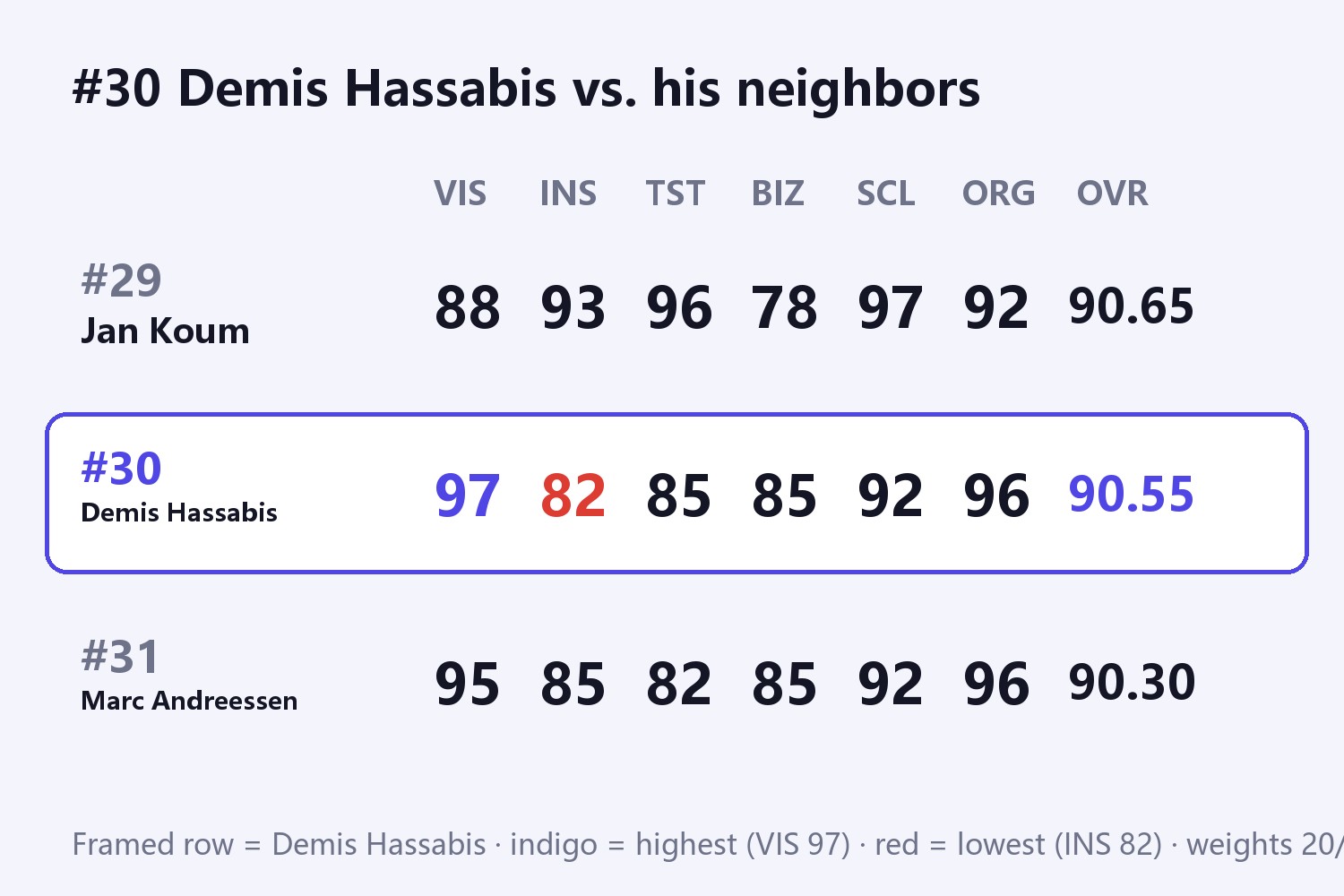
In the 100 Product Managers Who Changed the World framework, Demis Hassabis earns a weighted overall score of 90.55 (displayed as 91), ranking #30 overall in the “Legend” tier:
1. Vision: 97 (Highest Dimension)
In 2010 — years before AlexNet or the Transformer — Hassabis laid out an explicit roadmap combining deep neural networks, reinforcement learning, and neuroscience to conquer games first and fundamental science second. Executing a fifteen-year scientific thesis with near-zero drift places his vision alongside Jensen Huang (#13) and Elon Musk (#5).
2. Originality: 96
From pioneering deep reinforcement learning (DQN) and self-play tree search (AlphaZero) to inaugurating the entire field of AI for Science (AlphaFold), Hassabis repeatedly built categories where none existed. Even the Chinchilla scaling laws that govern how modern large language models balance compute and training tokens came out of DeepMind.
3. Scale: 92
AlphaGo reached a live audience of 280 million; AlphaFold is used by virtually every structural biologist on earth; and since taking command of Google DeepMind in 2023, his Gemini model family now powers Search, Workspace, and Android across more than 2 billion active devices.
4. Taste: 85
His aesthetic is the clean, uncompromising elegance of a physicist and chess master — visible in the breathtaking creativity of Move 37 and the frictionless simplicity of the AlphaFold web portal. He scores slightly lower than consumer obsessives like Steve Jobs or Jan Koum only because pixel-level consumer UI was never his primary canvas.
5. Business: 85
For nearly a decade, DeepMind operated as a billion-dollar R&D cost center inside Alphabet. Today, however, its breakthroughs form the defensive moat of Google Cloud and Search, while its spin-off Isomorphic Labs has signed multi-billion-dollar drug-discovery partnerships with Eli Lilly and Novartis.
6. Insight: 82 (Lowest Dimension)
This score captures the most fascinating contrast between Hassabis (#30) and Sam Altman (#4): Although Google and DeepMind possessed every underlying piece of the LLM revolution years early — including Transformers, scaling laws, and internal conversational agents — Hassabis’s rigorous scientific caution kept those models inside the lab. He missed the raw consumer insight that Altman seized in late 2022: that ordinary people did not need a scientifically flawless oracle — they just wanted a simple chat box they could talk to right now.
Epilogue
Most builders in technology dream of shipping an app that captures a billion hours of human attention.
Since age eight in North London, Demis Hassabis wanted to build something else entirely: an engine of intelligence capable of reading the source code of nature itself.
Discussion