100 Product Managers Who Changed the World · #29: Jan Koum
On February 19, 2014, outside a weathered white building on North First Street in Mountain View, California, one of the most staggering acquisitions in Silicon Valley history was signed.
Facebook CEO Mark Zuckerberg announced the purchase of mobile messaging app WhatsApp for $19 billion.
The signing did not take place in a glass-walled corporate headquarters or a Sand Hill Road law firm. They chose that dilapidated white building because, more than a decade earlier, it had housed the North County Social Services office.
Jan Koum, the co-founder of WhatsApp sitting at the table, had stood in line outside that very doorway in the cold morning air as a sixteen-year-old immigrant from Ukraine, waiting to collect food stamps to keep himself and his mother fed.
Even more astonishing than the $19 billion price tag was the anatomy of the company Facebook had just bought:
On the day of the acquisition, WhatsApp served 450 million monthly active users and processed 50 billion messages every single day — matching the entire global volume of traditional carrier SMS.
Yet the entire company consisted of just 55 employees, only 32 of whom were engineers. There was no sign outside their office door, zero marketing staff, zero public relations personnel, and not a single line of advertising code in the product.
In an era obsessed with growth hacking, viral loops, and ad monetization, Jan Koum achieved the most complete victory minimalism has ever won against feature bloat.
A Childhood Behind the Iron Curtain: Why He Despised Ads and Logs
To understand the uncompromising product rules of WhatsApp, you have to start in Soviet-era Ukraine.
Born in 1976 in Fastiv, outside Kyiv, Koum grew up in a house without hot water or central heating. More formative than material scarcity was the pervasive atmosphere of state surveillance. His parents rarely spoke on the telephone; everyone knew that the line could be tapped at any moment, and a careless sentence could bring devastating consequences.
In that world of scarcity, there was also no Madison Avenue advertising. Everyday objects existed for one reason alone: to be durable, functional, and stay out of the way.
In 1992, at age sixteen, Koum emigrated with his mother to Mountain View, California. His mother worked as a babysitter while Koum swept floors at a local grocery store after school. When his mother was diagnosed with cancer, they survived on disability payments and food stamps.
Those years forged two unshakable convictions in Koum’s mind:
First, a visceral revulsion toward surveillance and data retention. He believed a conversation between two people belonged exclusively to those two people. No company — not even his own — had any business storing users’ private messages on corporate servers.
Second, an absolute contempt for advertising. In his view, advertising inevitably corrupts software engineering: to raise click-through rates, companies are forced to harvest personal data, spy on user behavior, and clutter screens with manipulative visual noise.
At eighteen, Koum taught himself computer networking from manuals rented from used bookstores (returning them when finished to save money). His self-taught security skills landed him an infrastructure engineering job at Yahoo!, where he met his lifelong friend and future co-founder, Brian Acton.
During nine years at Yahoo!, Koum and Acton watched a pioneering internet giant slowly suffocate under banner ads, pop-ups, and sales-driven bloatware. Koum swore to himself: if he ever built his own product, advertising would never touch a single pixel of the screen.
The Note on the Desk: “No Ads! No Games! No Gimmicks!”
In late 2007, exhausted by Yahoo!’s bureaucracy, Koum and Acton quit on the same day. Both applied for jobs at Facebook and Twitter; both were rejected.
In early 2009, Koum bought an iPhone. Looking at Apple’s newly launched App Store, a sharp insight struck him:
At the time, international SMS was exorbitantly expensive, and carrier MMS regularly failed across borders. Meanwhile, rival messaging apps like Skype, MSN, and BlackBerry Messenger required users to register custom usernames, remember passwords, and manually exchange IDs or PINs.
On February 24, 2009 — his birthday — Koum incorporated WhatsApp Inc.
After a rocky start, the turning point arrived in June 2009 when Apple introduced Push Notifications in iOS 3.0. Koum rewrote the app overnight so messages could wake up a recipient’s screen just like a native text message.
Then came his masterstroke of product design — eliminating registration friction to absolute zero:
Koum stripped out usernames, stripped out passwords, and stripped out friend requests.
Your phone number was your identity. Your existing address book was your social graph. The second you installed WhatsApp, everyone you knew in real life was already there waiting for you.
As user growth exploded exponentially across Europe, Latin America, and India, Silicon Valley venture capitalists lined up with term sheets, urging Koum to add game centers, sticker shops, and native ad feeds.
Koum’s response was to tape a handwritten note from Brian Acton onto the corner of his desk. It read simply:
No Ads! No Games! No Gimmicks!
Under the rule of that note, WhatsApp operated with monastic discipline:
- Ephemeral Server Architecture: Once a message was delivered to the recipient’s device, WhatsApp’s Erlang servers immediately deleted it. No cloud chat history meant zero server storage bloat and zero honeypots for hackers or subpoenas;
- Charging $1 Instead of Selling Users: To prove a messaging service could survive without advertisers, Koum charged users $0.99 per year after the first year — generating positive cash flow with zero marketing spend;
- 32 Engineers for 450 Million Users: Because there were no ad auctions, news feeds, or virtual currencies to maintain, the codebase remained extraordinarily lean. Running Erlang on custom-tuned FreeBSD servers, a single machine handled over two million concurrent connections.
Walking Away from $1 Billion: Minimalism Meets the Ad Empire
By 2014, WhatsApp was growing faster than Facebook itself had at the same stage. Recognizing an existential threat to his mobile empire, Mark Zuckerberg offered $19 billion and promised Koum total autonomy: zero pressure to monetize, zero forced ads, complete operational independence.
Instead of building a monetization team after the acquisition, Koum spent the next two years collaborating with cryptographer Moxie Marlinspike. In April 2016, WhatsApp turned on default end-to-end encryption based on the Signal Protocol for over 1 billion users.
With a single update, Koum ensured that neither hackers, telecom carriers, authoritarian regimes, nor Facebook’s own engineers could read a single message or listen to a single call passing through WhatsApp.
Yet pure product minimalism could not coexist forever with the quarterly revenue demands of a public advertising conglomerate.
Starting in 2017, as Facebook’s core feed began to saturate, Zuckerberg and Facebook executives pushed to unify user data across platforms, weaken encryption boundaries for business analytics, and inject targeted ads into WhatsApp’s Status tab.
Every proposal crossed the exact moral and product red lines Koum had drawn decades earlier.
In April 2018, after months of fierce boardroom clashes, Jan Koum made a decision that stunned Wall Street: he resigned immediately as CEO of WhatsApp and stepped down from Facebook’s board of directors.
Under his acquisition agreement, had Koum simply stayed quiet and kept his seat for a few more months, he would have vested nearly $1 billion in Facebook stock (Acton had left six months earlier over the same dispute, forfeiting $850 million).
For the Ukrainian kid who once queued for food stamps in Mountain View, the three lines taped to his desk were worth more than another billion dollars.
Six-Dimension Score Breakdown
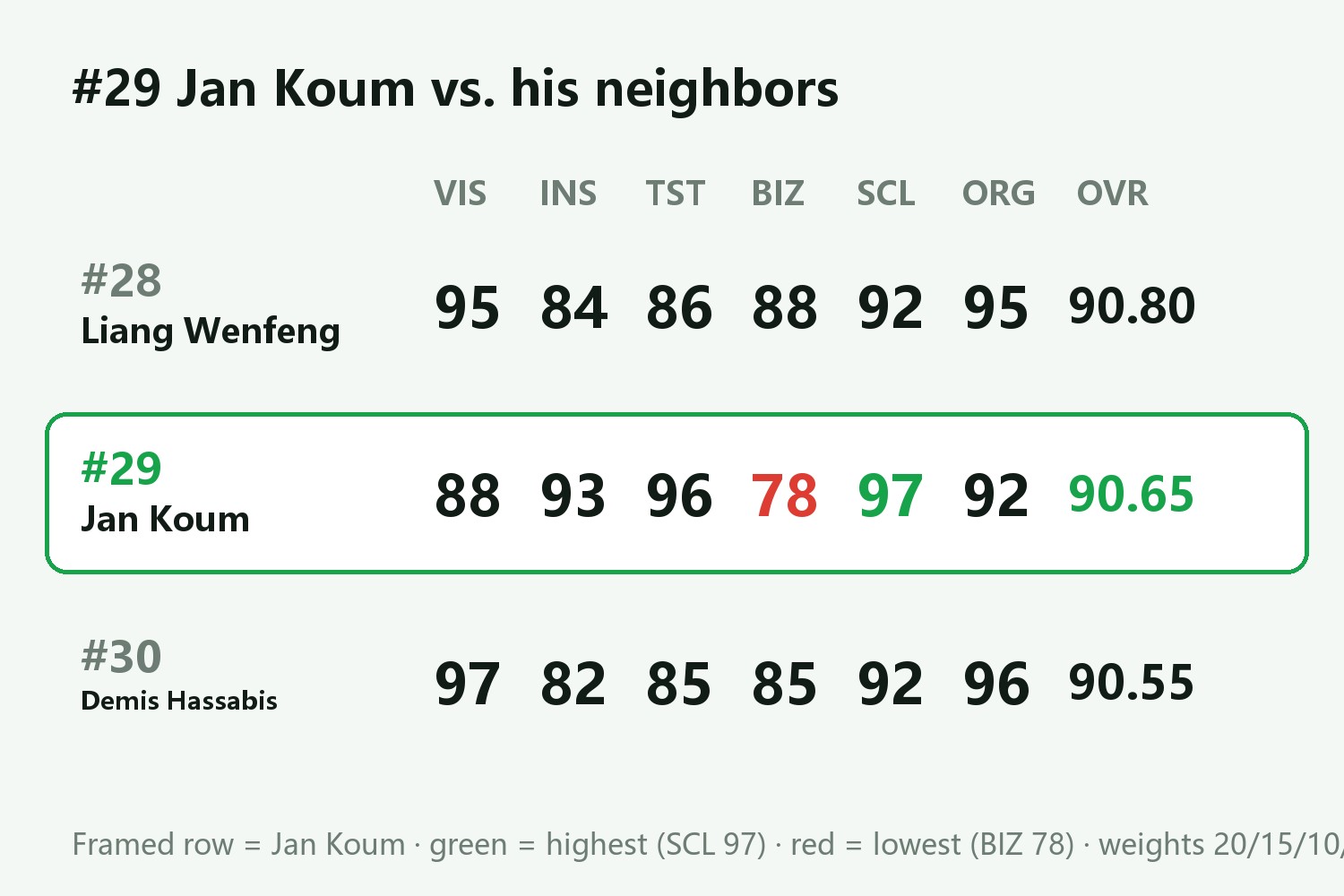
In the 100 Product Managers Who Changed the World framework, Jan Koum earns a weighted overall score of 90.65 (displayed as 91), ranking #29 overall in the “Legend” tier:
1. Scale: 97 (Highest Dimension)
Very few product leaders in history score 97 or above on scale. Today, WhatsApp serves well over 2.5 billion monthly active users, functioning as the de facto operating system of daily life across Latin America, Europe, India, Southeast Asia, and Africa. Built by a team that fit inside a small room, it connected nearly a third of humanity.
2. Taste: 96
If Steve Jobs expressed taste through glass, aluminum, and typography, Jan Koum expressed taste through ruthless subtraction. While competitors stuffed messaging apps with mini-games, livestreams, microloans, and pop-up banners, Koum kept WhatsApp as clean and dependable as a landline dial tone. No splash ads, no red-dot anxiety, no algorithmic manipulation — just instant, reliable human connection.
3. Insight: 93
He saw through the biggest illusion of early mobile social apps: that users wanted to build a brand-new social graph from scratch. By mapping directly onto the phone’s native address book and using the phone number as identity, he made onboarding invisible. A grandmother in rural Brazil or a shopkeeper in Mumbai could send a message within three seconds of installing the app.
4. Originality: 92
He did not invent instant messaging, but he pioneered the zero-registration, phone-number-as-identity mobile graph — a pattern immediately adopted by WeChat, Line, Telegram, and Signal. Furthermore, deploying seamless end-to-end encryption to over a billion everyday consumers remains the single largest cryptographic deployment in human history.
5. Vision: 88
He foresaw that mobile data and push notifications would obliterate the global telecom SMS cartel, and he anticipated the coming crisis of digital surveillance years before it became mainstream consciousness. The 12-point deduction reflects his deliberate refusal to evolve the product beyond point-to-point utility. Unlike Allen Zhang (#3), who expanded WeChat into a full digital ecosystem of payments and mini-programs while preserving core restraint, Koum viewed any platform expansion with deep suspicion.
6. Business: 78 (Lowest Score in the Top 30)
This is the sharpest — and most revealing — number on Koum’s scorecard. Although he delivered a historic $19 billion exit for his investors, Koum was ideologically hostile to monetization. The $0.99 annual fee struggled in developing markets without credit card penetration and was eventually dropped; after the acquisition, he chose resignation over building an ad business. He holds the lowest business score in the top 30 (78) precisely because he traded every ounce of commercial extraction for Taste (96) and Scale (97).
Epilogue
Today, nearly every mobile app greets us with a five-second splash ad, dark-pattern notifications, and an algorithmic feed engineered to harvest our attention.
Whenever the modern internet feels unbearably noisy, it is worth remembering that yellowed note taped to Jan Koum’s desk.
With 55 people and a billion-dollar walkout, he proved a timeless truth of product craft: restraint is not a lack of ambition — leaving the user in peace is the rarest feature of all.
Discussion