100 Product Managers Who Changed the World · #27: Kevin Systrom
In the sweeping wave of the mobile internet era, Kevin Systrom stands as the ultimate exemplar of turning aesthetic restraint and radical subtraction into world-conquering weapons.
In the autumn of 2010, alongside fellow Stanford graduate Mike Krieger, Systrom operated with a micro-team of just 13 people. In 18 months, they swept tens of millions of users worldwide and sold to Facebook for $1 billion. At the time, Wall Street and Silicon Valley elites openly scoffed at Mark Zuckerberg for wildly overpaying for a revenue-free photo app. Yet today, Instagram generates over $40 billion in annual high-margin advertising revenue and commands more than 2 billion monthly active users. It is universally recognized as the single most visionary and lucrative acquisition in tech history.
Systrom’s genius lay not merely in assembling a mammoth social empire, but in establishing two deceptively simple primitives — the 1:1 square aspect ratio and one-tap vintage filters — that completely redefined how humanity captures and curates visual memory.
A Plastic Toy Camera in Florence
Born in Holliston, Massachusetts in 1983, Systrom demonstrated an affinity for both computing and photography while studying Management Science and Engineering at Stanford University.
During his junior year, he traveled to Florence, Italy to study photography. He arrived equipped with a high-end, expensive Minolta SLR camera, eager to capture Renaissance architecture in pristine detail. His photography teacher took one look at his elaborate gear and made an unexpected move: he locked the expensive Minolta away in a cabinet and handed Systrom a cheap plastic toy camera costing a few dollars — a Holga.
The Holga featured a rudimentary plastic lens. Its photographs suffered from soft focus, severe corner vignetting, light leaks, and distorted saturation, all imprinted onto a rigid 1:1 square frame.
His professor delivered a piece of advice that permanently altered Systrom’s product DNA: “Don’t worship sterile technical perfection. Embrace flaws, because imperfection often evokes far deeper emotion and artistic resonance.”
Immersed in Florence with a plastic toy, Systrom experienced an epiphany: composition did not require agonizing over horizontal versus vertical orientations — the 1:1 square provided natural symmetry and immediate focus. Furthermore, grain, vignetting, and warm color shifts could instantly transform ordinary mundane snapshots into nostalgic, cinematic art.
From Bloated Burbn to Minimalist Instagram
After graduating from Stanford in 2006, Systrom spent two years in corporate development and as an Associate Product Manager (APM) at Google, contributing to early iterations of Gmail, Google Calendar, and Spreadsheets. He subsequently joined travel recommendation startup Nextstop.
Yet his entrepreneurial itch persisted. Teaching himself to code on nights and weekends, Systrom built an HTML5 prototype named Burbn, christened after his favorite Kentucky whiskey.
At the time, location-based check-in apps like Foursquare dominated tech headlines. Burbn stuffed in virtually every trendy social gimmick imaginable: location check-ins, loyalty points, meetup planning, status updates, and occasional photo uploads.
Armed with this demo, Systrom pitched Baseline Ventures and Andreessen Horowitz at a Silicon Valley gathering, securing $500,000 in seed funding. He resigned from his job and recruited Stanford peer and talented engineer Mike Krieger.
Once the seed round closed, the founders confronted a sobering reality: Burbn was a bloated, confusing mess. Users showed zero interest in complex check-in mechanics or event coordination. The only feature that elicited genuine user engagement was the photos people casually shared.
At that existential crossroads, Systrom executed one of the sharpest pivots in tech history: He scrapped Burbn entirely, stripping away check-ins, status updates, and points, reducing the product to just three primitives: take a photo, leave a comment, tap like.
To solve the friction holding back mobile phone photography in 2010, they tackled three fundamental pain points:
- Dismal smartphone camera hardware (The iPhone 4 suffered from poor white balance and muddy low-light noise): Drawing from his Florence lessons, Systrom engineered vintage filters such as X-Pro II, Earlybird, and Valencia. With a single tap, amateurish snapshots transformed into gorgeous, grainy, warm works of art. Suddenly, everyone looked like a professional photographer.
- Composition anxiety: Novices struggled with framing. By locking every upload into an unyielding 1:1 square, the camera eliminated framing guesswork. Whether it was a morning latte, a plate of pasta, or a friend’s smile, the square frame naturally pulled the eye to the center.
- Distribution friction: Broadcasting photos across fragmented networks was tedious. Instagram built frictionless, one-tap syndication to Twitter, Facebook, Flickr, and Tumblr, feeding the human desire for social recognition.
On October 6, 2010, Instagram launched on the Apple App Store. Within 24 hours, 25,000 users inundated the service, overwhelming their modest server. Within a week, they hit 100,000; within two months, they breached 1 million users.
Invisible Engineering: Uploading Before You Hit Send
While aesthetic filters provided Instagram’s alluring exterior, an ingenious piece of product psychology created its insurmountable competitive moat.
In 2010, mobile networks were notoriously slow and fickle 3G connections. Posting a high-resolution image to Facebook or Twitter required clicking submit, then staring helplessly at a spinning loader for 15 to 30 seconds. A brief drop in cell signal meant an aborted upload and user frustration.
Systrom and Krieger solved this by inventing Optimistic Uploads.
The moment a user selected an image and chose a filter, the app silently began uploading the image chunks to the cloud in the background. While the user lingered on the subsequent screen, typing a caption and tagging a location, the file had already crossed the wire. When the user finally tapped “Share,” the post appeared in the feed in milliseconds.
Users marveled: “Instagram is ten times faster than Twitter!” In reality, the cellular bandwidth was identical. Systrom had merely hidden the transmission latency inside human cognition and typing speed, transmuting a cold infrastructure limitation into magical delight.
13 People for $1 Billion: The Century’s Greatest Acquisition
By early 2012, Instagram had morphed into a global cultural juggernaut, attracting everyone from the Pope and heads of state to Hollywood celebrities.
On April 3, 2012, Instagram launched on Android, recording over 1 million downloads in its first 24 hours. Silicon Valley realized this was no mere utility — it was becoming the defining mobile social network of the decade.
Concurrently, Facebook was accelerating toward its historic IPO, plagued by Mark Zuckerberg’s acute mobile anxiety. Facebook’s desktop engagement was unrivaled, but its mobile app was clunky and bloated. Meanwhile, younger demographics were spending their screen time inside Instagram’s vintage camera viewfinder.
Zuckerberg recognized the existential threat. On April 5, 2012, he called Systrom directly, inviting him to his home in Palo Alto.
Zuckerberg made an unprecedented offer: $1 billion ($300 million in cash and 23 million shares of Facebook stock), combined with a commitment to preserve Instagram’s operational independence.
On April 9, 2012, the deal became public. Wall Street and tech pundits erupted in mockery: “A company just 18 months old, with only 13 employees and zero revenue, sold for a billion dollars? This is dot-com bubble absurdity all over again!”
History delivered the definitive verdict: Those 13 people handed Facebook the keys to mobile attention across two generations. As mobile traffic surged, Instagram expanded into a 2-billion-user powerhouse generating more than $40 billion in high-margin advertising annually.
It remains the most audacious and profitable acquisition ever made.
Aesthetic Restraint vs. The Algorithmic Feed
Inside Facebook, Systrom displayed the uncompromising conviction of an elite product manager.
He vigilantly guarded Instagram’s craft:
- Resisting feature bloat: While Facebook’s app cluttered every corner with prompts, Instagram preserved its pristine five-tab bottom navigation bar.
- Banning live hyperlinks in captions: Caption links were forbidden, instantly preventing spammers, affiliate schemes, and low-quality link farms from degrading the feed.
- Curating advertisements: In the early monetization phases, Systrom personally reviewed every commercial campaign pixel by pixel, rejecting ads that disrupted the feed’s artistic tone.
In 2016, facing an aggressive challenge from Snapchat, Systrom demonstrated decisive pragmatism: he unapologetically adopted the Stories format. Rather than a lazy imitation, he refined it with smooth full-screen gestures, circular tray indicators, and intuitive stickers, executing Stories with greater polish than Snapchat itself and blunting his rival’s momentum.
Yet as Facebook’s core growth slowed, Zuckerberg exerted tighter control: demanding cross-promotional notifications, cramming higher ad frequency into the feed, curbing Instagram’s autonomous communications, and substituting algorithmic engagement hacking for organic community connection.
For Systrom, Instagram’s soul resided in craft, human empathy, and restraint — not maximizing engagement metrics at all costs.
In September 2018, realizing they could no longer protect the product’s integrity from corporate encroachment, Kevin Systrom and Mike Krieger resigned, stepping away from the creation they nurtured.
In his farewell statement, Systrom left an enduring reflection: “We leave ready for the next chapter. To create new things, we have to understand what inspires us and match that with what the world needs; that’s what we plan to do.”
Scoring Rationale
| Dimension | Score | Rationale |
|---|---|---|
| Vision (VIS) | 90 | Anticipated the explosion of mobile smartphone cameras and visual-first social communication years ahead of incumbents |
| Insight (INS) | 94 | Mastered the psychological desire for personal curation; masked poor camera sensors with vintage filters, neutralized 3G latency with optimistic uploads |
| Taste (TST) | 95 | World-class aesthetic discipline. Pioneered the 1:1 square crop, preserved a clutter-free UI, resisted link spam, elevated everyday snapshots into art |
| Business (BIZ) | 85 | Lowest dimension. Zero revenue at acquisition; the multi-billion-dollar ad engine was constructed largely within Meta’s infrastructure |
| Scale (SCL) | 94 | Grew a 13-person startup into a 2-billion-user global network generating over $40B in annual revenue, permanently altering visual culture |
| Originality (ORG) | 89 | Defined the interaction models for smartphone filter photography and square feed social mechanics |
Overall Score (OVR): 90.95, Rank #27.
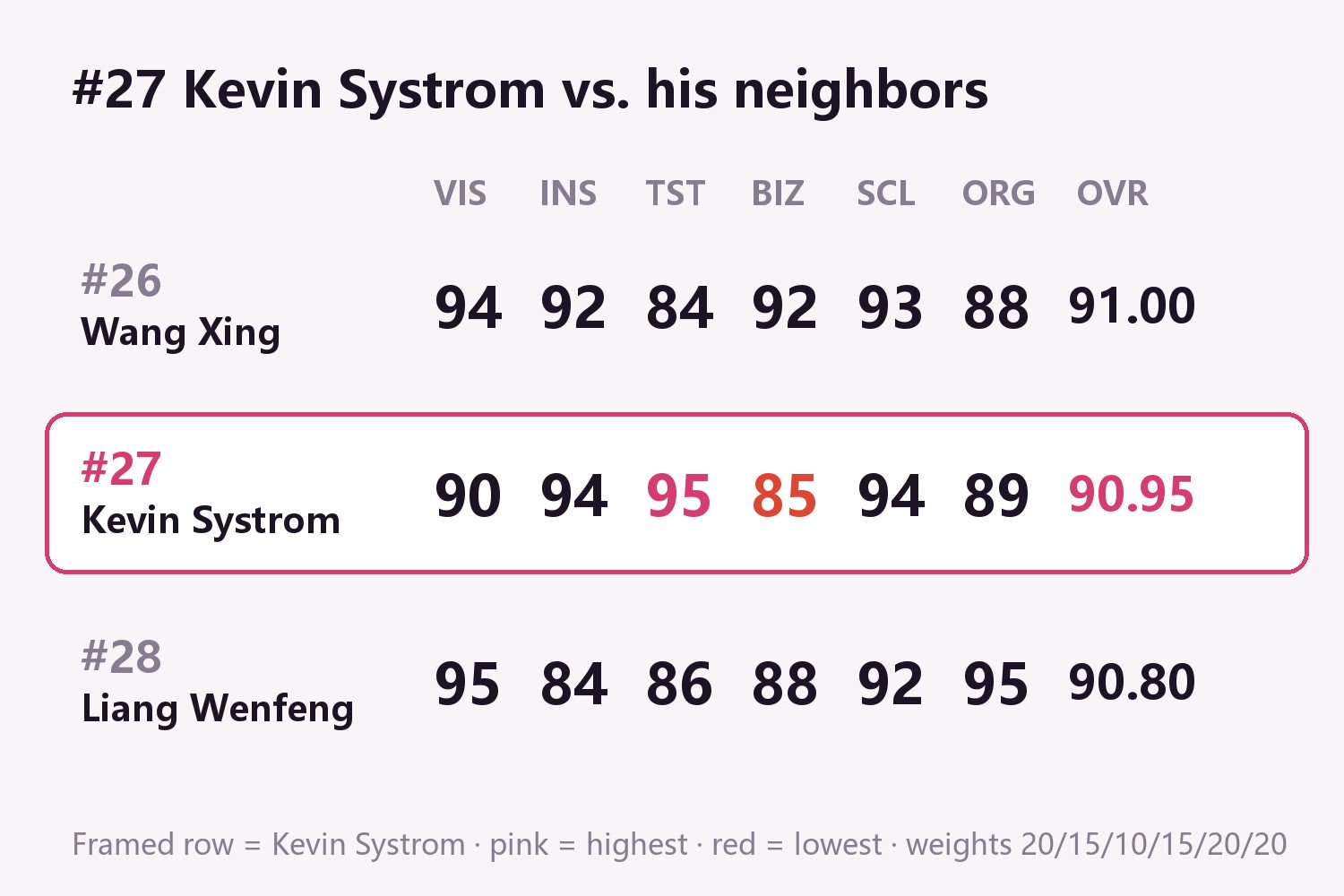
He ranks just behind #26 Wang Xing (91.00) by a margin of 0.10. Wang Xing leads in strategic vision (94 vs. 90) and brutal commercial execution (92 vs. 85), forged in the crucible of Meituan’s hyper-efficient capital control and heavy offline logistics. Yet Systrom delivers a decisive victory in taste (95 vs. 84) — while Wang Xing’s Meituan is an indispensable urban utility, Systrom’s Instagram is an artistic triumph of aesthetic restraint and digital craftsmanship.
He ranks ahead of #28 Liang Wenfeng (DeepSeek, 90.80) by 0.15 points. While Liang Wenfeng stands as an audacious open-source pioneer shattering Silicon Valley’s compute hegemony (Vision 95 vs. 90, Originality 95 vs. 89), Systrom proves superior in consumer empathy (Insight 94 vs. 84), aesthetic taste (95 vs. 86), and the profound cultural scale of reshaping daily life for 2 billion humans (Scale 94 vs. 92).
In a technology landscape often dominated by metrics-obsessed utilitarianism, Kevin Systrom demonstrated that a founder with an eye for photography, an instinct for restraint, and a team of just 13 believers could fundamentally change the way humanity sees the world.
All scores and rankings generated by Claude (AI).
Cover artwork is an original infographic illustrating the iconic 1:1 square viewfinder and retro filter spectrum; no trademarked logos or founder portraits were used.
Factual references: Date of birth, Stanford University MS&E degree, Florence photography studies with the Holga camera, Google APM and Nextstop experience, Burbn prototyping and seed funding, pivot to photos/filters/square format, October 2010 App Store debut, Optimistic Upload technical architecture, April 2012 acquisition by Facebook for $1B with a 13-person team, launch of Stories and September 2018 departure from Facebook, 2 billion MAU and advertising performance figures drawn from ‘No Filter: The Inside Story of Instagram’ by Sarah Frier, public interviews, and Meta financial filings. Ranked on product leadership dimensions.
Discussion