100 Product Managers Who Changed the World · #26: Wang Xing
Among Chinese tech entrepreneurs, Wang Xing is the rare product manager who pushed both relentless endurance and unit economics to their absolute limits.
After dropping out of a PhD program in the United States in early 2004, he suffered consecutive, crushing setbacks: the distress sale of Xiaonei and the abrupt regulatory shutdown of Fanfou. In 2010 he founded Meituan, surviving the “War of a Thousand Groupons” and the brutal on-demand delivery battles, ultimately turning a group-buying site into the indispensable physical infrastructure of modern Chinese cities.
The serial setbacks of a young hacker
Wang was born in Longyan, Fujian, in 1979. He graduated in electronic engineering from Tsinghua University in 2001 and went to the University of Delaware to pursue a PhD in computer engineering.
In early 2004, inspired by the explosion of Friendster in the United States, he abandoned his doctorate and flew home to build social software.
His earliest attempts—Duoduoyou and Youzitu—failed to gain traction.
In late 2005, Wang and his Tsinghua roommate Wang Huiwen launched Xiaonei, an authentic real-name social network for Chinese college students modeled after Facebook. It exploded across Chinese campuses.
However, with no clear monetization engine, surging server and bandwidth costs crushed the underfunded startup. Unable to raise capital, in October 2006 they were forced to sell Xiaonei for roughly $2 million to Oak Pacific Interactive (which later rebranded as Renren).
In 2007, Wang quickly caught on to Twitter’s breakthrough and founded Fanfou, China’s first microblogging platform.
With a minimalist text-input box and real-time feed, Fanfou attracted China’s earliest cohort of product geeks and cultural figures. But in the summer of 2009, amid unforeseen content controversies and regulatory interventions, Fanfou was abruptly shut down for 505 days.
Losing two high-flying products taught Wang a brutal, lifelong lesson: visionary product instinct alone is not enough; you must build bulletproof unit economics and defensive resilience.
The Thousand Groupons: counterintuitive economics
In March 2010, Wang launched Meituan. Within months, more than 5,000 copycat group-buying sites sprang up across China, a phase remembered as the “War of a Thousand Groupons.”
Rivals like Lashou, Wowo, and 24Quan raised tens of millions of dollars from venture capital and unleashed massive ad blitzes: plastering celebrity posters across subway stations, office elevators, and prime-time CCTV broadcasts.
Wang made a fiercely counterintuitive product and business decision: he refused to spend a single dime on offline branding.
Instead, he channeled every dollar of funding into the hidden back-end:
- Proprietary merchant clearing and verification systems: replacing paper vouchers with instant, second-by-second digital redemptions;
- Algorithmic digital ad spending: obsessively tracking Customer Acquisition Cost (CAC) and Lifetime Value (LTV) on search engines;
- Guarding cash flow and merchant settlements: while competitors blindly subsidized and over-expanded, Meituan opened cities strictly based on local gross margin contribution.
When the venture capital winter arrived in late 2011, competitors who burned cash on billboards collapsed into mass layoffs and vendor defaults. Meituan, with ample cash reserves and refined software pipelines, swept up the entire market at virtually zero cost.
Meituan Waimai: urban capillaries powered by code
If group buying merely bridged information and discounts, Meituan Waimai (launched in late 2013) dragged the company into the deepest physical operations.
At the peak of China’s food delivery wars, Ele.me was backed by Alibaba, and Baidu Waimai was armed with search traffic. Subsidies were thrown around furiously.
Yet the ultimate differentiator was not coupon discounts, but fulfillment certainty: during pouring rain and noon lunch peaks, can hot food reliably arrive at a customer’s desk within 30 minutes?
Meituan built one of the world’s most complex real-time algorithmic dispatch systems:
- In milliseconds, analyzing tens of millions of daily orders, millions of active couriers, real-time GPS locations, kitchen preparation speeds, traffic lights, and staircase climbing delays to compute the optimal multi-order routing path.
- Compressing average delivery times down to under 30 minutes.
Connecting hundreds of millions of consumers, millions of restaurants, and millions of yellow-jacketed couriers, instant delivery became the living capillaries of urban China.
Wang then leveraged high-frequency food delivery to cross-sell low-frequency, high-margin hotel bookings and local in-store services, constructing the most defensible flywheel in local commerce.
Why he ranks #26
| Dimension | Score | Why |
|---|---|---|
| Vision VIS | 94 | Spotted the four decisive waves—SNS (Xiaonei), microblogging (Fanfou), group buying (Meituan), and on-demand logistics—years before competitors |
| Insight INS | 92 | Understood that the core pain in local services was not sleek interface design, but fulfillment certainty, ruthless cost efficiency, and cash flow security |
| Taste TST | 84 | Lowest of his six scores. Meituan is an ultra-pragmatic super-app packed with countless verticals and promotional popups, trading aesthetic restraint for sheer conversion power |
| Business BIZ | 92 | The precise unit economics during the Groupon war and the high-frequency to high-margin cross-sell flywheel are textbook platform business design |
| Scale SCL | 93 | Serving hundreds of millions of annual transacting users, millions of merchants, and fulfilling tens of millions of daily deliveries across China |
| Originality ORG | 88 | Did not invent group buying or food delivery, but engineered real-time algorithmic urban dispatch at the largest physical scale on earth |
Overall OVR 91.00, ranked #26.
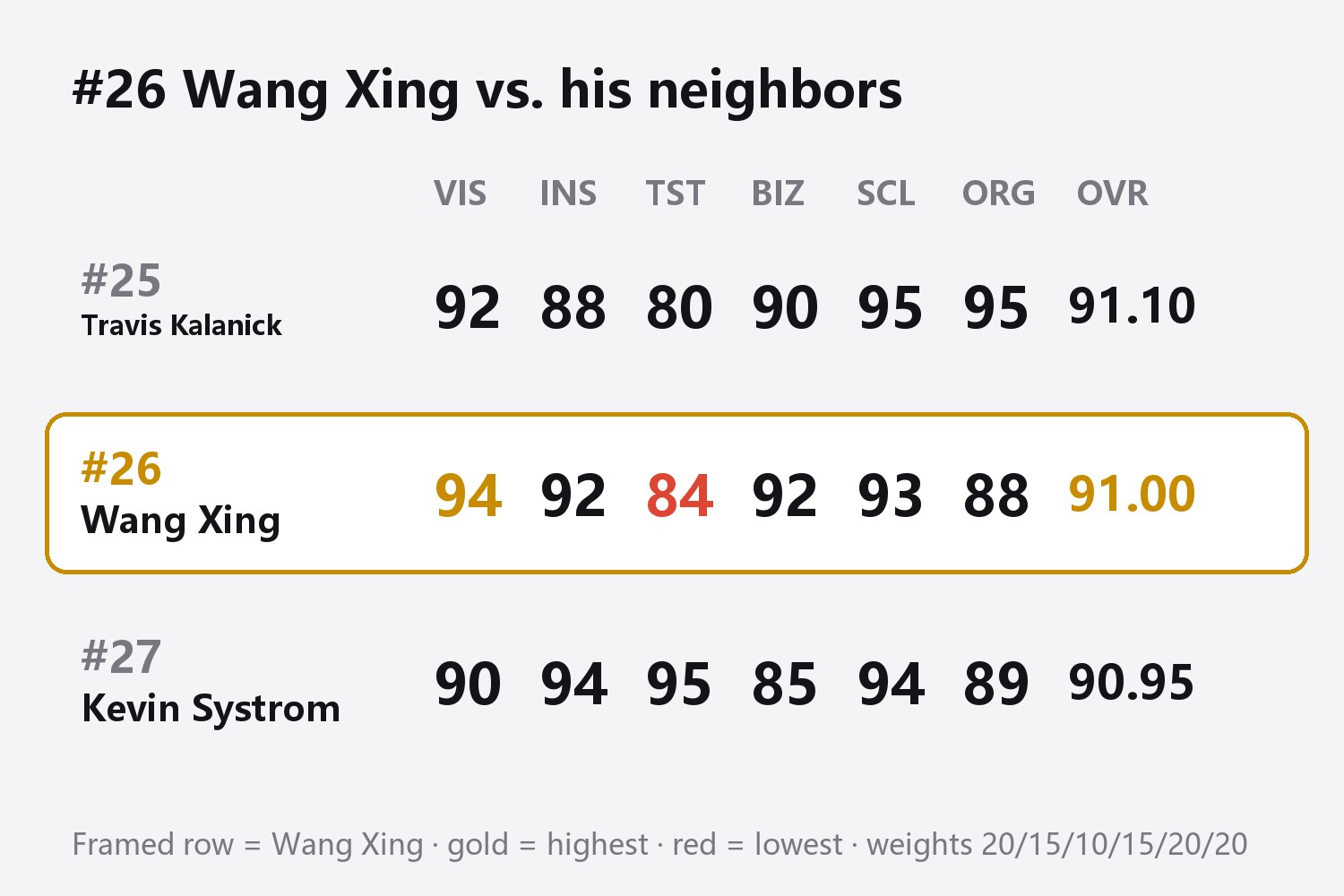
He ranks just behind #25 Travis Kalanick (91.10), separated by 0.10. Wang leads in vision (94 vs. 92), insight (92 vs. 88), taste (84 vs. 80), and business (92 vs. 90). Kalanick makes up the difference through originality (95 vs. 88) and global scale (95 vs. 93). At their core, both solved the same problem: “press a button on a glass screen, and physical resources in your city move swiftly to your feet”—one moved people, the other moved food.
He edges out #27 Kevin Systrom (Instagram, 90.95) by 0.05. Systrom demonstrated masterclass aesthetic restraint in taste (95 vs. 84) and user insight (94 vs. 92); Wang wins on strategic endurance (vision 94 vs. 90) and the complex commercial machinery of heavy physical offline operations (business 92 vs. 85).
From serial failures to building the operating system for urban living, Wang Xing demonstrated that the most consequential product decisions often happen away from the glamorous spotlight: when the tide recedes, it is about who calculates the ledger clearest and digs the deepest pipes underground.
All scores and rankings in this article were generated by Claude (AI).
Cover image is an original infographic illustrating algorithmic urban dispatch network topology; contains no proprietary trademarks or portraits.
Facts and timeline: birth, Tsinghua University graduation, Delaware dropout, founding of Xiaonei and 2006 sale to Oak Pacific Interactive, founding of Fanfou in 2007 and 505-day suspension in 2009, launching of Meituan in March 2010, the strategy of avoiding offline ads during the Groupon wars, launch of Meituan Waimai in late 2013 and development of the real-time dispatch system, HKEX IPO and local commerce flywheel, sourced from official financial filings, IPO prospectuses, and authoritative tech chronicles.
Discussion