100 Product Managers Who Changed the World · #25: Travis Kalanick
In September 2026, several outlets reported that Travis Kalanick’s robotics company, Atoms, had raised $1.7 billion in a round led by a16z. Fortune’s October/November issue ran a cover story headlined “Travis Kalanick is back”.
It had been nine years since he was pushed out of the company he built.
Two companies taken down by lawsuits and a bubble
Kalanick was born in Los Angeles in 1976. He studied computer engineering at UCLA and left in 1998 to join Scour, a peer-to-peer search engine some classmates had built for finding and downloading music and video files.
In 2000, the Motion Picture Association of America, the Recording Industry Association of America and others sued Scour for about $250 billion. Scour filed for bankruptcy that year.
In 2001 he started Red Swoosh, again peer-to-peer, but this time sold to businesses: it moved files between users’ computers to cut websites’ bandwidth costs. The company survived the dot-com crash and was sold to Akamai in April 2007 for about $19 million.
A snowy night in Paris and one button
In the founding story Uber tells, Kalanick and Garrett Camp were in Paris for the LeWeb conference in the winter of 2008 and could not get a cab one night. Camp wanted to build an app that could summon a car.
Camp founded UberCab in March 2009, with Kalanick as one of its first advisers. The app launched in San Francisco in 2010. That October, after regulators objected that “Cab” in the name suggested a licensed taxi, it was renamed Uber. In December, Kalanick became CEO.
What it did fits in one sentence: press a button, and a car comes.
Underneath were three product decisions:
- No phone call, no standing at the curb waving. You can see the car on a map and how many minutes away it is
- No cash. Your card is on file and charged when you get out, with no change and no tip to work out
- Drivers and riders rate each other, so whether a driver can be trusted is left to data rather than to a taxi medallion
Surge pricing: the most criticized decision
The hardest times to get a ride are rainy days, New Year’s Eve and the end of a concert: everyone wants a car and there are not enough on the road.
Uber’s answer was surge pricing: when demand outruns supply, the price goes up by a multiple. At a higher price, some people decide not to ride; at a higher price, drivers sitting at home decide to go out. The price suppresses demand and pulls in supply at the same time.
The mechanism drew criticism every holiday. Kalanick’s public line never changed: without the surge, there would be no cars at all at those times. The higher price is how the cars show up, not a way to cash in.
UberX: ordinary people driving their own cars
Early Uber offered only black cars and cost more than a taxi. UberX, launched in 2012, let drivers with ordinary private cars take rides at prices below a taxi’s. UberPool followed in 2014, letting several riders going the same way split one fare.
From there Uber went from “a better taxi” to “a cheaper taxi”. Riders and drivers grew together, and so did head-on conflicts with the taxi industry and regulators, one city at a time.
The expansion was fast and hard-edged. In March 2017 The New York Times reported that Uber used a tool called Greyball to identify and avoid ride requests from enforcement officers in some cities.
Leaving in 2017
In 2017 Uber went through a series of controversies, including an investigation into its workplace culture. In June, at the request of major investors, Kalanick resigned as CEO. Dara Khosrowshahi took over in August. Uber listed on the New York Stock Exchange in May 2019, and at the end of that year Kalanick sold his shares and left the board.
In 2018 he put $150 million into City Storage Systems and took it over, building CloudKitchens: kitchens that only cook for delivery, with no tables for customers. For years after that, he was almost never seen in public.
Why he ranks #25
| Dimension | Score | Why |
|---|---|---|
| Vision VIS | 92 | Judged that phone location plus mobile payment could turn hailing a car into one button, and that it would copy to cities worldwide |
| Insight INS | 88 | Saw that the worst part of a taxi was not the price but the uncertainty: when will it come, will it come at all |
| Taste TST | 80 | His lowest. The core experience was clean, but much of the growth came from subsidies and fights with regulators, and product decisions like Greyball cost points here |
| Business BIZ | 90 | Surge pricing and UberX let both sides of the market grow; Uber lost money for years before its IPO, so this is not a top score |
| Scale SCL | 95 | Tied highest. He took the same way of getting a ride to hundreds of cities worldwide |
| Originality ORG | 95 | Tied highest. “Press a button, a car comes”, plus dynamic pricing, was built from scratch by him and Uber |
Overall OVR 91.10, ranked #25.
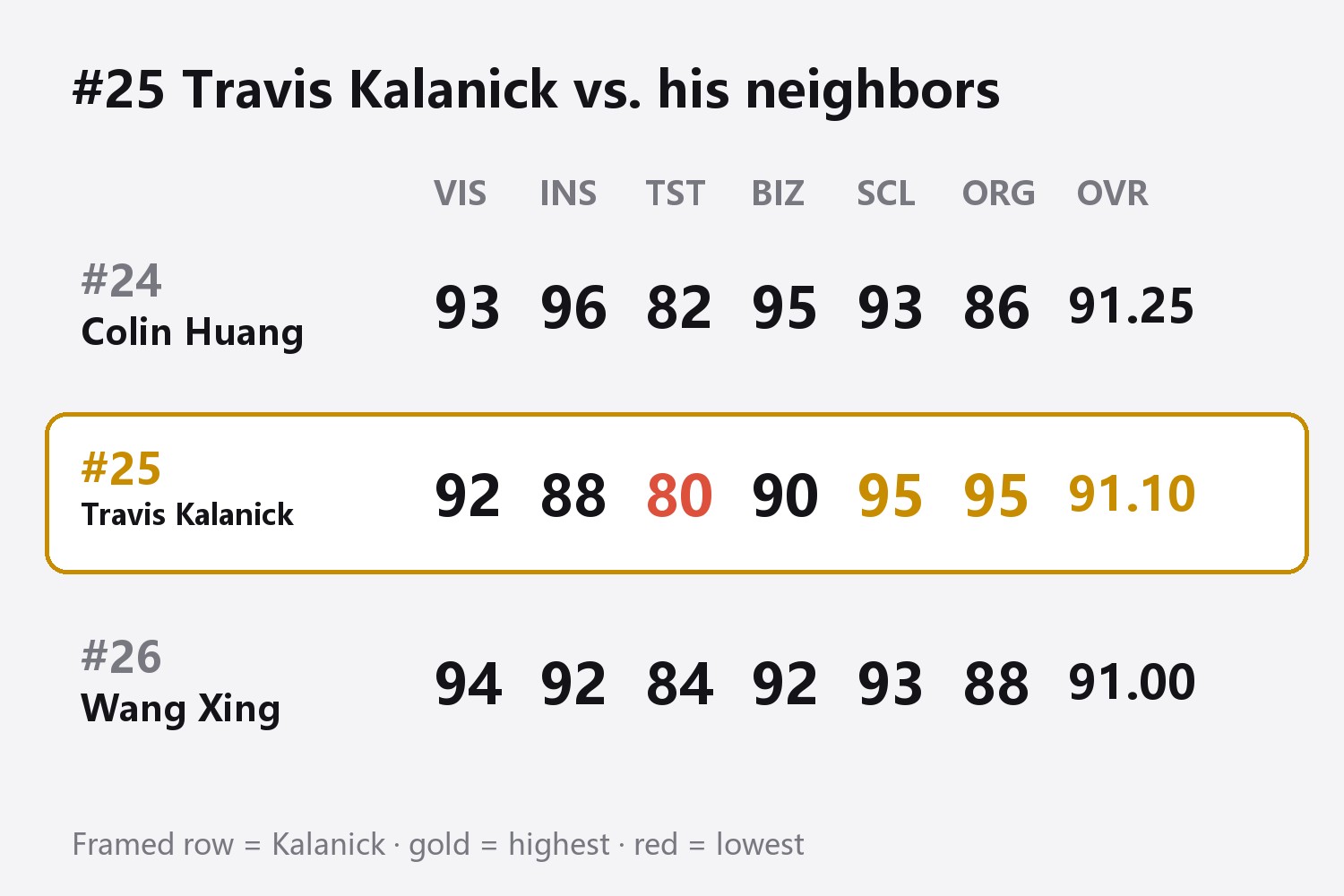
He ranks behind #24 Colin Huang (91.25) by 0.15. Kalanick scores higher on originality (95 to 86) and scale (95 to 93); Huang wins on insight (96 to 88) and business (95 to 90). One built a new way of getting around from nothing; the other found overlooked people in a market everyone thought was full.
He ranks ahead of #26 Wang Xing (91.00) by 0.10. Wang scores higher on vision, insight, taste and business; Kalanick’s 7-point lead in originality pulls the total back. Both made things arrive in a city at the press of a button: one moves people, the other moves meals.
Nine years later he is back, building robots. The button Uber left behind is still on phones around the world.
All scores and rankings in this article were produced by Claude (AI).
Cover photo: cellanr, 2014, CC BY-SA 2.0 (Wikimedia Commons, “Travis Kalanick 2014.jpg”), cropped with text added.
Sources: birth year and place, leaving UCLA, the roughly $250 billion suit against Scour and its 2000 bankruptcy, Red Swoosh’s 2001 founding and 2007 sale to Akamai, Camp founding UberCab in March 2009, the 2010 launch and renaming, becoming CEO in December 2010, the launch dates of UberX and UberPool, resigning as CEO in June 2017, Khosrowshahi taking over in August, the May 2019 IPO and leaving the board at the end of that year, and the $150 million investment in City Storage Systems in 2018 are from the English Wikipedia articles “Travis Kalanick” and “Uber” and the reports they cite. The Paris story is Uber’s own founding story. Greyball is from The New York Times, March 2017. The Atoms $1.7 billion round led by a16z is from multiple September 2026 reports, and the Fortune cover story is from its October/November 2026 issue. The ranking scores product decisions.
Discussion