100 Product Managers Who Changed the World · #23: Daniel Ek
On September 30, 2025, Daniel Ek announced he would step down as CEO of Spotify at the end of the year and stay on as executive chairman. Since January 2026 the company has been run by two co-CEOs, Alex Norström and Gustav Söderström.
Here is what he handed over. In June 2026, 777 million people used Spotify every month, and 300 million of them paid. In 2025 it had revenue of 17.186 billion euros and net income of 2.212 billion euros.
Before 2024, Spotify had never had a profitable full year. Its first one came sixteen years after launch.
Stockholm, building websites at 14
Ek was born in Stockholm on February 21, 1983, and grew up in the Rågsved district. At 14 he started building websites and writing open-source code. He finished IT high school in 2002, enrolled at KTH Royal Institute of Technology, and dropped out after eight weeks.
He then worked at a string of companies: Jajja, a search engine optimization firm; Tradera, a Nordic auction site that eBay bought in 2006; and Stardoll, an online doll community, where he was CTO. He started an online advertising company, Advertigo, and sold it to TradeDoubler in 2006. He was also briefly CEO of the download client μTorrent, until BitTorrent acquired it in December 2006.
Martin Lorentzon, a co-founder of TradeDoubler, became Spotify’s other founder.
2002: piracy cannot be legislated away
The idea for Spotify came around 2002. That year Napster was shut down and Kazaa took its place. Close one, and the next one appears.
Ek’s conclusion: piracy could not be eliminated through legislation alone. The only way was a legal service that was easier to use than piracy and paid the music industry at the same time.
He had run μTorrent, so he knew what downloaders were after. Piracy’s upside was that it was free. Its downside was hassle: finding files, waiting for downloads, managing folders, and sometimes getting the wrong song. A service where you press play and it plays, with no downloads, no files and a bigger catalog than the pirates had, would get a lot of people to stop bothering.
On April 23, 2006, Ek and Lorentzon founded Spotify in Stockholm.
2008: listen free, pay to drop the ads
On October 7, 2008, Spotify launched in Sweden, Finland, France, Norway and Spain.
It ran on freemium: the basic service was free with ads, and a paid subscription removed the ads and added features. The free tier was there to win people back from piracy. The paid tier was there to pay the record labels. Today Spotify pays roughly 70% of its revenue to rights holders, mostly labels.
The model only works if the labels agree. In 2008 the record industry was taking its worst beating from piracy, and Spotify had to convince it that letting people listen for free would end up bringing money back. When free sign-ups grew too fast, Spotify pulled back too: in September 2009 free registration in the UK briefly became invitation-only.
The US took longest. Spotify launched there on July 14, 2011, nearly three years after Europe, and offered new users six months of unlimited listening with ads.
Recommendations, a direct listing and podcasts
In July 2015 Spotify launched Discover Weekly, a playlist of recommendations refreshed for each user every Monday. Listening no longer depended only on what you searched for. The service started finding music for you.
On April 3, 2018, Spotify listed on the New York Stock Exchange through a direct listing: no new shares and no underwriters setting the price, just existing shareholders’ stock going straight to trading. The reference price was $132, it opened at $165.90, and the valuation came to about $26.5 billion.
On February 6, 2019, Spotify announced the acquisitions of podcast company Gimlet Media and podcast-tool maker Anchor on the same day. In May 2020 it signed an exclusive deal with Joe Rogan, reported to be worth about $200 million.
Exclusivity brought trouble. On January 26, 2022, Neil Young’s music came off Spotify because he objected to the platform carrying Rogan’s show, and Joni Mitchell pulled her catalog too. On January 30 Spotify announced a content advisory on every podcast episode discussing COVID-19.
In February 2024 Rogan renewed, in a deal reported at $250 million, on different terms: no longer exclusive. The show went back to Apple Podcasts and YouTube.
Layoffs in 2023, a first profitable year in 2024
Spotify cut staff three times in 2023: 6% in January, 2% in June, and about 17%, roughly 1,500 people, in December.
The next year, 2024, it made a profit for a full year for the first time, with net income of 1.138 billion euros. In 2025 revenue was 17.186 billion euros and net income 2.212 billion euros.
Why he ranks here
| Dimension | Score | Why |
|---|---|---|
| Vision VIS | 92 | Saw in 2002 that piracy could only be replaced by a legal service that was easier to use; bet on streaming in 2006, before smartphones were common |
| Insight INS | 90 | Understood that users wanted convenience, not just free; the deduction is podcast exclusivity, paid for heavily in 2020 and walked back to non-exclusive at the 2024 renewal |
| Taste TST | 88 | His lowest. Spotify wins on catalog deals and recommendations rather than a design people remember at a glance; among its big calls, podcast exclusivity was later reversed by the company itself |
| Business BIZ | 94 | Joint highest. Made the numbers work for labels, artists and listeners at once: about 70% of revenue goes to rights holders, and the company has been profitable every full year since 2024 |
| Scale SCL | 94 | Joint highest. 777 million monthly users and 300 million subscribers in June 2026 |
| Originality ORG | 90 | Online music subscriptions existed before him; what he created was the combination of a free tier that pulls users from piracy and a paid tier that pays the rights holders, plus press-play-and-it-plays |
Overall OVR 91.60, ranked #23.
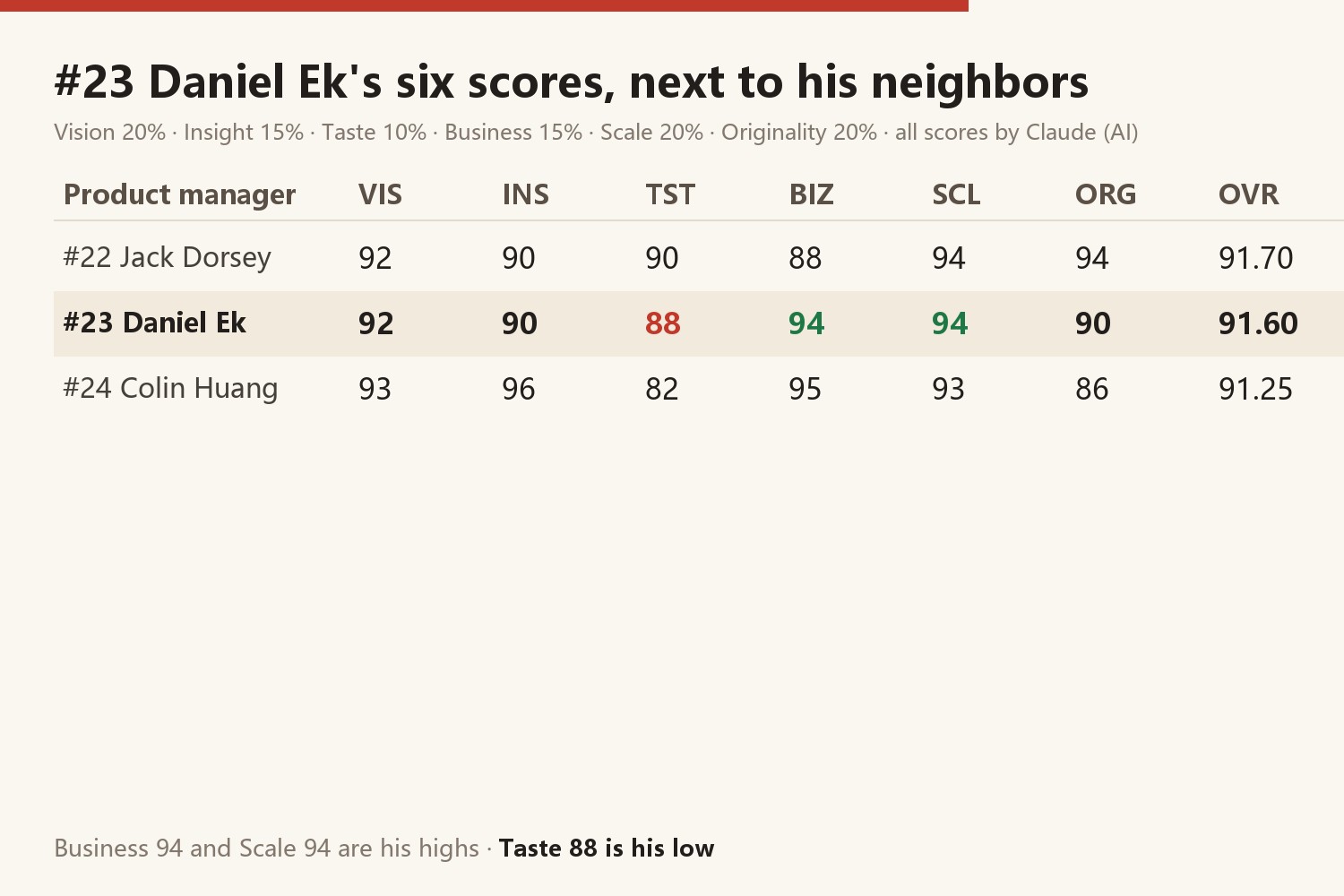
He sits behind Jack Dorsey (91.70), 0.10 points apart.
Their shapes are mirror images. Dorsey has originality 94 and business 88; Ek has originality 90 and business 94. Dorsey built things that did not exist before, and never got the business to run smoothly; Ek’s product was not a first, but he closed the hardest deal in the industry. Online music subscriptions existed before Spotify. Very few services got the labels to hand over their whole catalogs and then turned free listeners into paying ones, little by little.
#24 Colin Huang (91.25) is the same kind of product manager: he wins on the business model. Huang is higher on insight (96) and business (95); Ek is 6 points higher on taste (88 to 82) and 4 higher on originality (90 to 86). Huang won by understanding the shoppers in China’s smaller cities. Ek won by getting the labels’ numbers to balance.
Ek was CEO for almost twenty years. In 2002 he wanted people to stop downloading pirated music; later Spotify found that the recommended playlist itself could keep people listening. By the time he handed over the job, most people could no longer remember that listening to a song once meant downloading it first.
All scores and rankings in this article were produced by Claude (AI).
Cover photo: Daniel Ek visiting the European Commission, February 25, 2025, by Lukasz Kobus (European Commission), via Wikimedia Commons under CC BY 4.0 (creativecommons.org/licenses/by/4.0). The cover crops the photo and converts it to black and white.
Sources: date and place of birth, building websites and open-source projects from 14, 2002 high school graduation, eight weeks at KTH, the Jajja / Tradera / Stardoll / Advertigo / μTorrent roles, and the 2025-09-30 announcement that he would step down as CEO at year end and become executive chairman, from the English Wikipedia article “Daniel Ek”; the 2006-04-23 founding, the 2008-10-07 launch in five countries, the freemium model and the roughly 70% paid to rights holders, the 2011-07-14 US launch, Discover Weekly in July 2015, the three 2023 layoff rounds, the 2024 and 2025 financials, the June 2026 monthly users and subscribers, and the January 2026 co-CEOs, from “Spotify”; the 2002 view on piracy, the September 2009 UK invitation-only period, the six-month free trial at the US launch, the reference price, opening price and valuation of the 2018-04-03 direct listing, and the 2019-02-06 Gimlet and Anchor acquisitions, from “History of Spotify”; the Rogan exclusive and renewal values (both as reported), the Neil Young and Joni Mitchell removals and Spotify’s response, from “The Joe Rogan Experience”. The ranking scores product dimensions only.
Discussion