100 Product Managers Who Changed the World · #21: Tony Fadell
On July 7, 2026, Tony Fadell published a long column on CNET about why the choice of AI assistant matters.
His argument: an assistant that really knows you has to see every device around you, your phone, watch, earbuds, laptop and the things in your home. He calls that set of devices a “Federation of Devices.” In his words: “Whoever controls this Federation of Devices has the foundation to build the most trusted and most valuable AI assistant.”
The historical examples he names in the column are the Mac, the iPod, the iPhone and the Nest thermostat. He built the last three.
A decade of failure
Fadell was born in Michigan on March 22, 1969, to a Lebanese father and a Polish mother. He graduated from the University of Michigan in computer engineering in 1991.
In 1992 he joined General Magic and worked his way from diagnostics engineer to systems architect. The company was trying, in the early 1990s, to build a handheld device that could go online and send messages, with Sony, Philips, Matsushita and Toshiba as partners. The product shipped. Almost nobody bought it, and the company later went bankrupt.
In 1995 he moved to Philips, helped start its mobile computing group, worked on the Velo and Nino handhelds and served as the group’s technology lead. Neither product took off.
In July 1999 he founded Fuse, to build a hard-disk music player paired with an online music store. The dot-com bubble burst and the second funding round never came.
At a 2020 CogX panel with former General Magic colleagues, he summed it up: “So I literally had a decade of failure.”
A call on a ski lift
In January 2001, Fadell was riding a ski lift when Jon Rubinstein, Apple’s senior vice president of hardware, called and invited him to Apple for a project. He didn’t say what it was.
In February Fadell signed a six-week contract as a hardware consultant. In those six weeks he made three foam-core models with rough interface graphics stuck on the screens, and lead fishing weights inside so each one felt about as heavy as a finished device. “It was all very, very rough,” he later said. “I only had six weeks and it was only me really doing all the work.”
In April he presented to Jobs and other executives. He showed his two weakest models first and hid the one he wanted under a decorative bamboo bowl on Jobs’s conference table. After the first two, Jobs picked the one under the bowl.
That month he joined Apple full time to build the iPod & Special Projects group. Apple’s engineers were busy with the Mac, so he hired from Fuse, General Magic and Philips. The core team was about 25 people.
1,000 songs in your pocket
The parts were off the shelf: a 1.8-inch 5GB Toshiba hard drive, and a music chip and base software from PortalPlayer. Scrolling through thousands of songs with buttons was too slow, so Phil Schiller, Apple’s senior vice president of marketing, suggested a wheel.
Fadell promised six months, to make the 2001 holiday season. The team worked 18 to 20 hours a day, seven days a week.
On October 23, 2001, Jobs introduced the iPod: “1,000 songs in your pocket.” It went on sale November 10. From the consulting contract to the store shelf took less than ten months.
In his 2015 TED talk he described a detail. Electronics used to come with a sticker on the box saying “charge before use,” so you took your new device home and waited hours. The iPod shipped with its battery already charged, so you could open the box and listen. That meant every unit had to spend longer in factory testing. He calls this “noticing”: the annoyances everyone has gotten used to are where design should start.
He became vice president of iPod engineering in 2004, and on October 14, 2005, Apple named him Rubinstein’s successor as senior vice president of the iPod division. In fiscal 2006 Apple sold more than 39 million iPods, and the iPod accounted for roughly 40 percent of the company’s revenue.
The line ran until the iPod touch was discontinued on May 10, 2022, after 450 million units.
The iPhone he lost
In 2005, two phone prototypes competed inside Apple. Fadell’s team built P1, which added phone features to the iPod and was driven by a virtual click wheel on the screen. Scott Forstall’s team built P2, a screen of icons you could tap.
Jobs chose P2. It became iOS.
Fadell’s team was responsible for the iPhone hardware, and he worked on the first three generations. On November 3, 2008, Apple announced he was leaving to spend more time with his family.
A $90 thermostat
After Apple, he was designing an energy-efficient house in Lake Tahoe. The heating and cooling system cost tens of thousands of dollars, and it was going to be wired to a $90 thermostat from Home Depot that barely worked as advertised because its design was so poor.
He wrote the business plan in Paris in 2009. In May 2010 he and former Apple colleague Matt Rogers founded Nest Labs.
The Nest Learning Thermostat was announced in October 2011. It learned when you got up, when you left and what temperature you liked, and after a few days it built its own schedule. TechCrunch reported at the time that there were roughly a quarter of a billion thermostats in US homes and offices, controlling about half of an average American home’s energy budget. Fadell said he wanted the thermostat to be a “beloved” object in the home.
In February 2012 Honeywell sued Nest for infringing seven thermostat patents. The case never reached a verdict; in May 2016 Google and Honeywell signed a patent cross-license.
In 2013 Nest launched Nest Protect, a $130 smoke and carbon monoxide alarm. One feature let you silence an alarm by waving at it. In April 2014 Nest found the wave could be triggered by accident, which meant the alarm might not sound right away in a real fire. It switched the feature off remotely and stopped sales, and in May it formally recalled about 440,000 units.
$3.2 billion, and after
On January 13, 2014, Google announced it would buy Nest for $3.2 billion in cash. Later that year Nest bought the camera company Dropcam. In January 2015, Google Glass was moved out of Google X and put under Fadell.
The next two years were rough. Nest’s 2015 sales were about $340 million, above the $300 million annual target agreed at the acquisition but below Google’s original expectations. By November 2015 about 70 of Nest’s roughly 1,000 employees had quit, many of them from the acquired Dropcam and Revolv teams.
Revolv was a smart home hub company Nest bought in 2014. In April 2016 Nest announced it would shut down service for every Revolv hub on May 15, turning a $299 device into a brick. After the backlash, Nest pushed the shutdown to June and offered full refunds.
On June 3, 2016, Fadell stepped down as CEO of Nest.
Investor, author, and the first Nest going dark
Out of Google, he became an investor, first under the name Future Shape and later Build Collective, backing early deep-tech companies in clean farming, fusion energy, and AI for recycling and healthcare.
On May 3, 2022, he published a book, Build, about making things, running teams and being a CEO; it became a New York Times bestseller. When Apple announced Vision Pro in 2023, he told Fortune that Apple had “jumped the shark.” From fall 2025 to January 2026 he was MIT’s first designer in residence at the Morningside Academy for Design.
On October 25, 2025, Google cut off online service for the first- and second-generation Nest Learning Thermostats. They can no longer be controlled from a phone or by voice, and are left as ordinary thermostats you adjust by hand on the wall. The first generation is the one he launched in 2011.
Why he ranks here
| Dimension | Score | Notes |
|---|---|---|
| Vision VIS | 92 | Working on handheld connected devices at General Magic in the early 1990s; in 2010, judged that a thermostat nobody cared about was worth rebuilding |
| Insight INS | 92 | Saw that a music player’s problem was not sound quality but how to carry and find thousands of songs; a thermostat’s problem was not features but that nobody could program it |
| Taste TST | 96 | His highest. Weighted foam models, a battery charged out of the box, a thermostat you’d want on your wall: all of it is the moment the thing is in your hand |
| Business BIZ | 88 | His lowest. iPod pricing and the iTunes deals with record labels were Jobs’s calls; Nest, where he was CEO, fell short of Google’s expectations, and the Revolv shutdown damaged trust |
| Scale SCL | 92 | 450 million iPods and the hardware of the first three iPhones; Nest is much smaller |
| Originality ORG | 92 | He invented neither the MP3 player nor the thermostat; what he started was the first mass-market hit of the smart home |
Overall 91.80, rank 21.
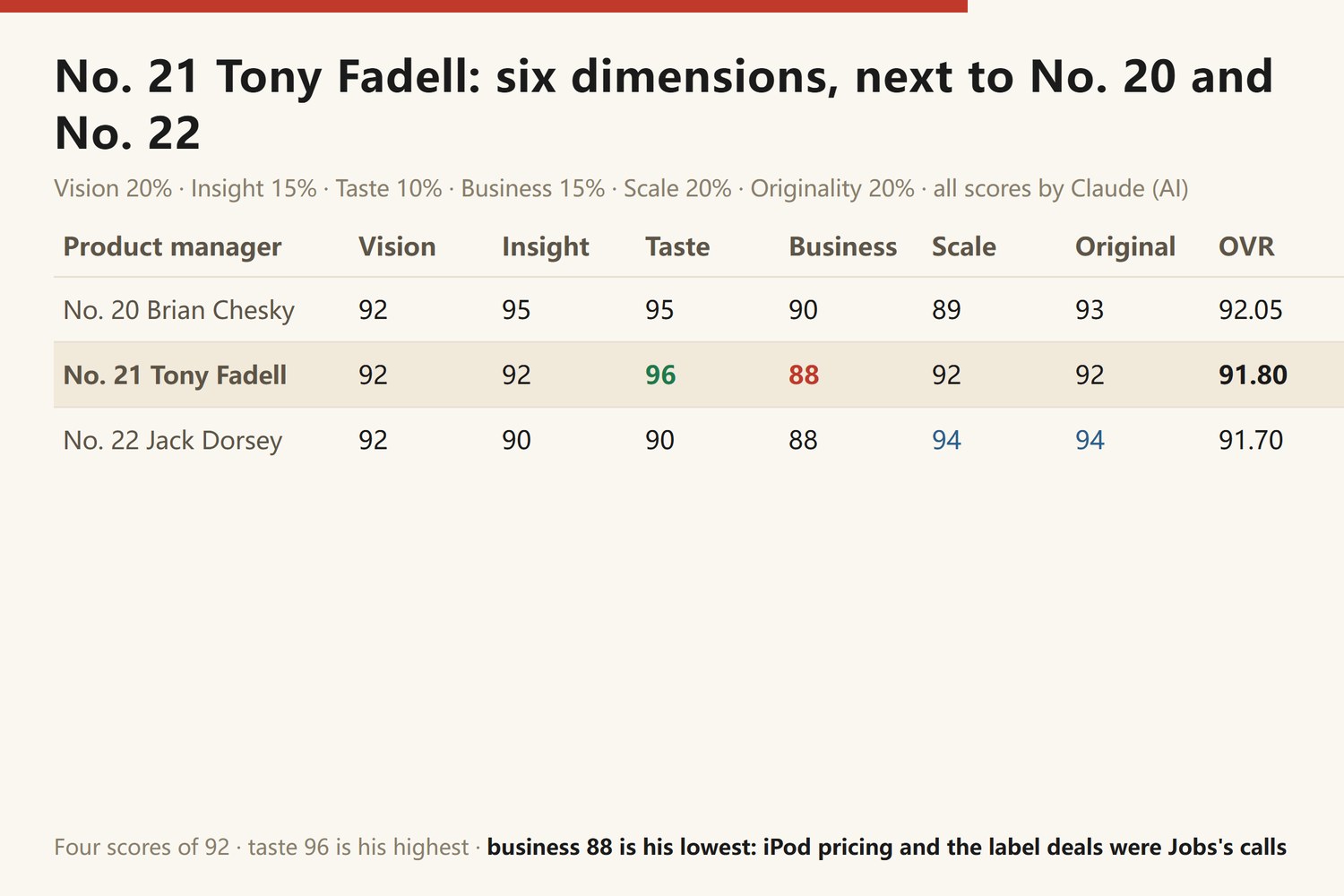
He sits between Brian Chesky (92.05) and Jack Dorsey (91.70).
Four of his six scores are 92. Taste at 96 sticks out above them and business at 88 sits below. That shape says he is someone who makes things, not someone who makes businesses. The iPod sold 450 million units. He led the team that built it, but the pricing, the distribution and the record-label negotiations behind iTunes were the work of Jobs and the Apple machine. When he was CEO himself, Nest made good products, but the business never grew into what Google wanted.
Against Chesky, he is 1 point higher on taste (96 to 95) and 3 higher on scale (92 to 89): an iPod is in your pocket every day, while you book an Airbnb a few times a year. But Chesky is 3 points higher on insight (95 to 92), 2 higher on business (90 to 88) and 1 higher on originality, which adds up to a gap of 0.25.
Against Dorsey, he is 6 points higher on taste (96 to 90) and 2 higher on insight. Dorsey’s Twitter and Square were new things built from nothing, and he is 2 points higher on both originality and scale. The gap between them is 0.10.
One more person on the list worked on the same products: Jony Ive, at #33 with 90.20. Ive’s taste is 99, three points above Fadell’s, but his business score is 82 and his insight 88. What the iPod and iPhone looked like was Ive’s call; getting them out of the factory on time and in volume was Fadell’s job.
In 2011 he wanted the thermostat to be a beloved object in the home. In 2025 it was cut off from the network and turned back into an ordinary thermostat. In 2026 he wrote that the next AI assistant will be built on a network of devices. Once a device is connected, how long it keeps working starts to depend on how long some other company is willing to keep supporting it.
All scores and rankings in this article were produced by Claude (AI).
Cover photo: Tony Fadell on Centre Stage at Web Summit 2022, November 3, 2022, by Web Summit, published on Wikimedia Commons under CC BY 2.0 (creativecommons.org/licenses/by/2.0); cropped and converted to black and white.
Sources: birth date and place, parents, education, roles at General Magic and Philips, the founding and funding of Fuse, the April 2001 iPod team, the 2004 and October 14, 2005 appointments, the November 3, 2008 departure announcement, the May 2010 founding of Nest with Matt Rogers, the 2009 business plan in Paris, the June 3, 2016 resignation, Future Shape and Build Collective, and the publication date of Build are from the English Wikipedia article “Tony Fadell”; the “decade of failure” quote is from CNBC’s June 10, 2020 report on the CogX panel; the ski-lift call, six-week consulting contract, foam-core models with fishing weights, the bamboo bowl, the team’s origins and size, the Toshiba drive and PortalPlayer, Schiller’s wheel, the six-month deadline and 18- to 20-hour days are from Macworld’s “The birth of the iPod”; the iPod’s announcement and release dates, “1,000 songs,” 450 million units and the May 10, 2022 discontinuation are from the English Wikipedia article “iPod”; 39 million units in fiscal 2006 is from Apple’s October 2006 earnings release filed with the SEC, and the roughly 40 percent revenue share from AppleInsider and Statista; the charged battery is from his 2015 TED talk “The first secret of design is … noticing”; the P1 and P2 prototypes are from 9to5Mac and AppleInsider reports from January 2017; Lake Tahoe and the $90 thermostat are from his own article in IEEE Spectrum and TechCrunch’s October 24, 2011 report, which is also the source for the quarter of a billion thermostats and half of the energy budget; the Honeywell suit is from AllThingsD (February 7, 2012) and PCWorld (May 2016); the Nest Protect recall is from CNBC and TechCrunch (May 21, 2014); the Google acquisition is from TechCrunch (January 13, 2014); Glass moving under Fadell is from Fortune (January 15, 2015); 2015 sales and the target are from CNBC and Recode (March 30, 2016); staff departures and the Revolv shutdown are from VentureBeat, BGR and Time (April 2016); the Vision Pro remark is from Fortune (June 7, 2023); the MIT residency is from the MIT Morningside Academy for Design announcement; the end of online service for first- and second-generation thermostats is from Tom’s Guide and Tech Advisor; the CNET column and its quotes are from 9to5Mac (July 7, 2026). The rankings score product work only.
Discussion